AdvancedAI
Hugging Face Opens Preorders for Microduck, a $399 Open-Source Biped
- Hardware
- Robotics
- embodied ai
- hugging face
- open source
- reinforcement learning
Pollen Robotics opened preorders for Microduck on August 27, 2026 — a 25 cm, 800 g open-source biped robot priced at $399. The robot is the second hardware product from the French startup Hugging Face acquired in April 2025, and the first built explicitly as a reinforcement-learning testbed: the SDK, the on-robot software, the MuJoCo training environments, and the full sim-to-real recipe are all on GitHub under Apache 2.0. First deliveries are targeted before Christmas 2026.
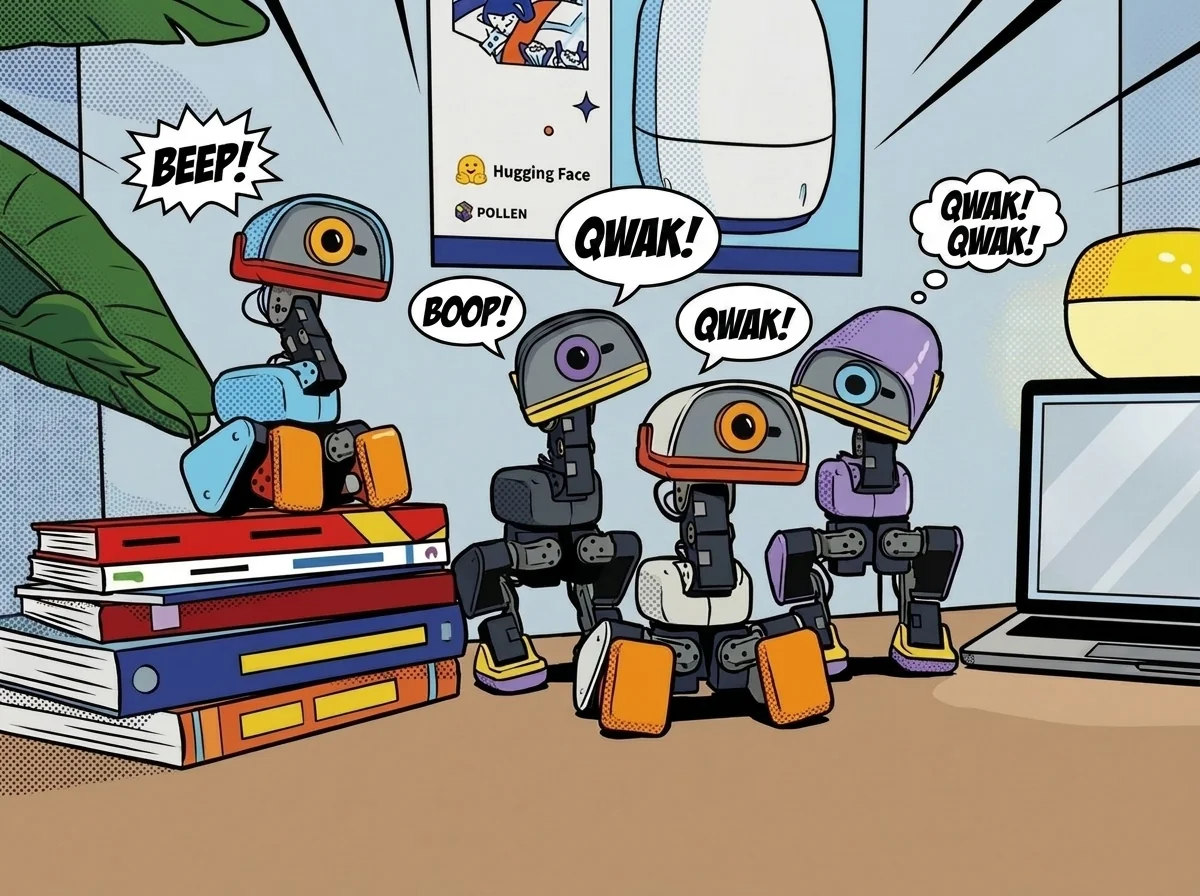
The Hardware
Microduck stands 25 cm tall and weighs 780–800 g. Fifteen servos drive the legs, neck and head, plus an articulated beak that can grasp and carry objects weighing up to 800 g — roughly the robot’s own mass. Perception comes from a wide-angle front camera, a compact 8×8 time-of-flight LiDAR, and two IMUs. There are microphones, a speaker, and two NFC antennas — one in the head, one in the beak.
Compute is a Rockchip RK3566 with an on-board AI accelerator, 1 GB of RAM and 32 GB of storage, with Wi-Fi and Bluetooth. Power is a removable NP-F550 battery pack rated around 2,600 mAh, good for roughly an hour of continuous operation. A gamepad ships in the box, and the robot arrives with seven pre-trained behaviours already loaded — walking, sitting, crouching, getting back up from common falls, and roller-skating among them.
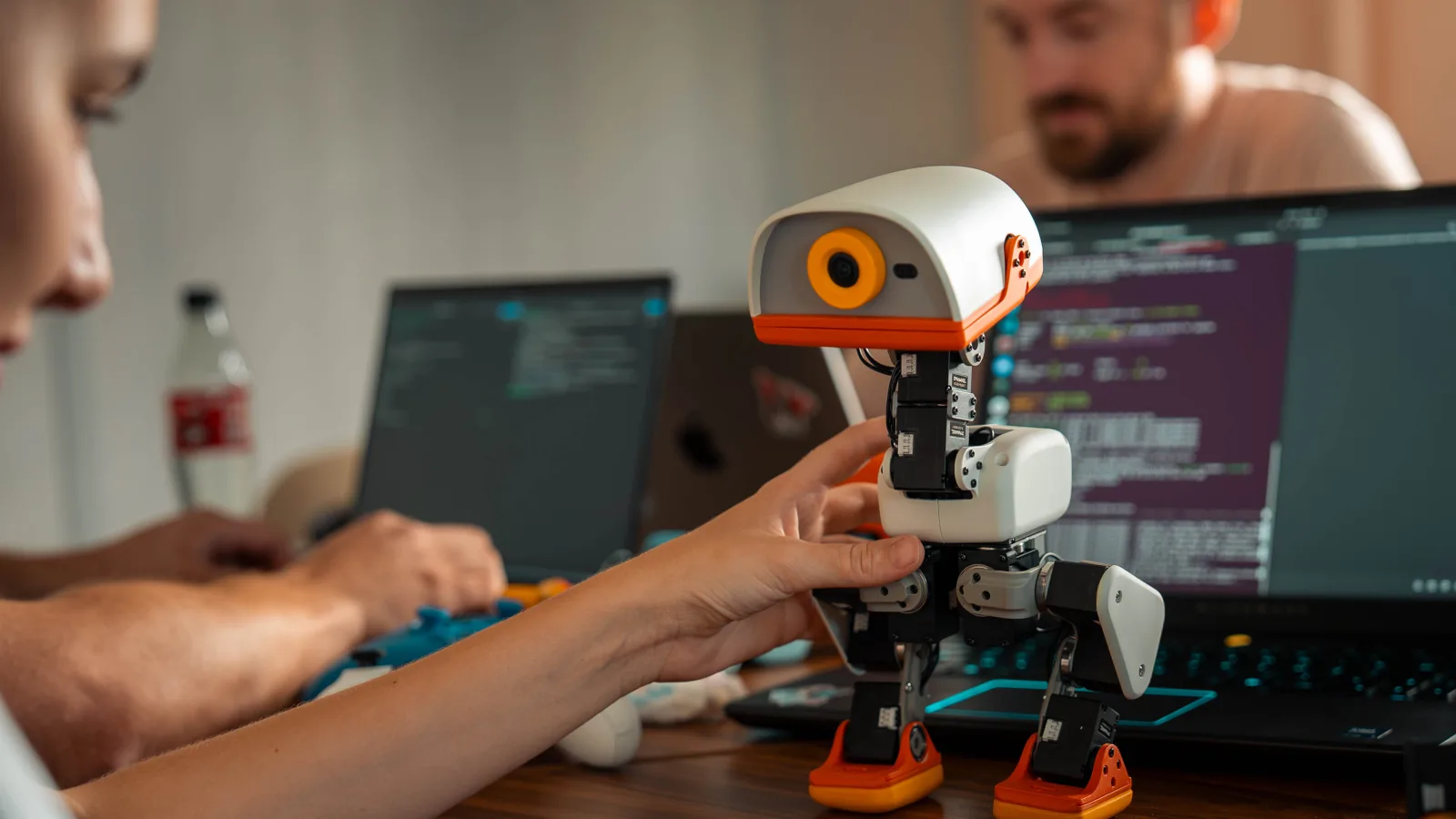
The size is the design argument. At under a kilogram, a failed policy ends in a thud rather than a repair bill, and the robot can usually right itself and carry on. That changes the economics of the iterate-crash-iterate loop that physical RL actually consists of. The introductory price is $399 (€340) before tax and shipping, in four colourways — Cream, Graphite, Lavender and Sky — with launch availability in the US, Canada, the EU, the UK, Norway, Switzerland, Japan and South Korea.
How the Software Stack Works
The on-robot software in pollen-robotics/microduck is written in Rust as a set of cooperating daemons that talk over a JSON-RPC contract on Unix sockets: robotd owns the control loop and the motor bus, updaterd handles signed releases, configd manages Wi-Fi and identity, and btd, padd, mediad and tofd cover Bluetooth, gamepad, camera streaming and the depth sensor. The control loop runs at 50 Hz, driving all fifteen servos from a neural policy rather than from scripted trajectories.
Training lives in a separate repository, microduck_rl, built on mjlab (MuJoCo Warp) with PPO. Policies are trained at the same 50 Hz the robot runs, then exported to ONNX via scripts/export.py with the observation normalizer baked into the graph so runtime behaviour matches training. All tasks share a 61-dimensional observation contract, which is what makes policies hot-swappable on the robot. Pollen reports usable gaits in roughly one to two hours at 4,096 parallel environments; a CUDA GPU is required, with no CPU-only path.
The Sim-to-Real Details
The interesting part of the RL repository is how much of the reality gap it models explicitly rather than papering over with noise. Actuation uses a BAM M6 model of the Dynamixel XL330 servo, including a voltage control law, back-EMF, and Coulomb, Stribeck and load-dependent friction terms. Domain randomization runs per-environment across battery voltage, voltage sag, command delay, friction and terrain, toggled through ENABLE_* flags.
Gear backlash gets its own treatment: ±1° of play per joint (2° total) is simulated as unactuated passive hinges, with the encoder reading through the backlash the way the real hardware does. These ship as -Backlash task variants that leave the observation and action dimensions unchanged, so a policy trained with backlash modelling drops into the same runtime slot as one trained without it. Code is Apache 2.0; the 3D model files carry a Creative Commons BY-NC-SA licence.
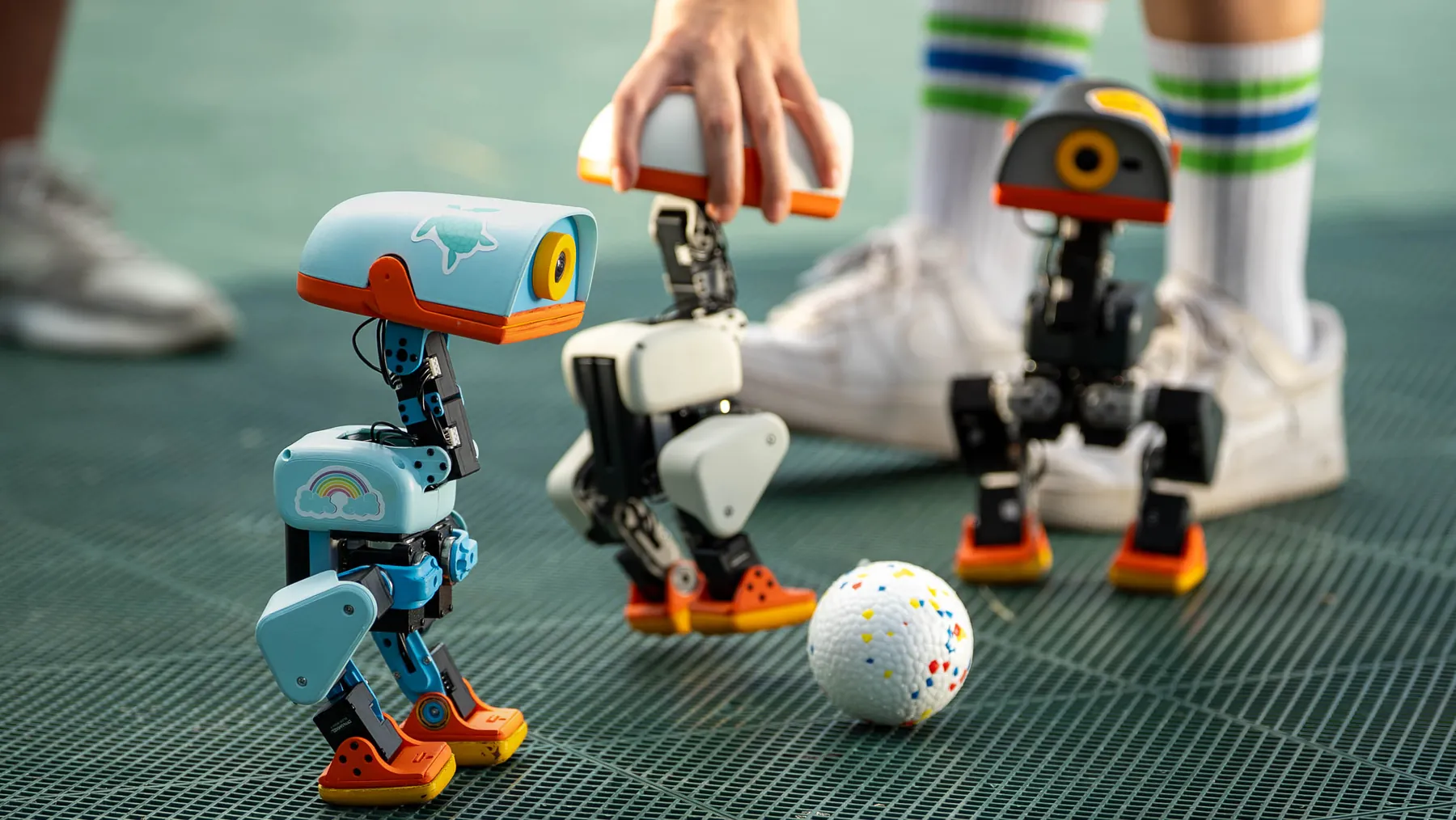
What This Means
Legged-robot research has generally required either a five-figure quadruped or a simulator and no hardware at all. Microduck is a bet that the missing piece is a platform cheap and robust enough that the sim-to-real loop can be closed by a single student on a single GPU — train a gait in MuJoCo, deploy it, watch where it fails, adjust the randomization, retrain. The published actuator and backlash models matter more than the price here, because they are the part that is normally reverse-engineered per lab and never shared.
Hugging Face CEO Clem Delangue framed the launch as an “open-source robot you can teach new tricks with reinforcement learning,” adding: “Welcome to the era of open-source affordable robots to democratize physical AI and world models!” The strategy is recognisable from the company’s software side — publish the stack, let a community produce the behaviours — and Microduck follows Reachy Mini, the desktop robot Pollen shipped shortly after the acquisition. Whether the crowdsourcing analogy transfers from model weights to physical policies is the open question; a 61-dimensional shared observation contract is at least a plausible answer to what a hub of shareable robot policies would need underneath it.
For teaching, the practical read is that a graduate robotics or RL course can now put a working biped in front of every student for the cost of a textbook stack, with a training pipeline that is inspectable end to end. The one-hour battery and the 1 GB of on-board RAM are the constraints to plan around.
This post was drafted with AI assistance and reviewed by RITS staff.
Sources
- Meet Microduck — Pollen Robotics
- Microduck product page and specifications — Pollen Robotics Store
- pollen-robotics/microduck — robot software and SDK (GitHub)
- pollen-robotics/microduck_rl — RL training environments for Microduck (GitHub)
- Hugging Face is selling a cute $399 open source duck robot, Microduck — TechCrunch
- Hugging Face and Pollen Robotics open pre-orders for the $399 Microduck — Engadget



 沪公网安备31011502017015号