IntermediateAI
Mistral Releases Robostral Navigate: Single-Camera Robot Navigation
- AI
- Mistral
- Robotics
- computer vision
- embodied ai
- navigation
On July 8, 2026, Mistral AI announced Robostral Navigate — the company’s first embodied navigation model and its formal entry into physical AI. The 8-billion-parameter model guides robots through complex environments using nothing but a single RGB camera and natural language instructions — no LiDAR, no depth sensors, and no pre-built maps. It sets a new state of the art on the R2R-CE benchmark with a 76.6% success rate on unseen environments, outperforming even systems that rely on depth sensing or multiple cameras.


Navigation From a Single Camera
Most robot navigation stacks depend on expensive sensor suites — LiDAR, depth cameras, or multi-camera rigs — plus pre-built maps of the environment. Robostral Navigate strips that down to the bare minimum: one forward-facing RGB camera and a text prompt like “go to the kitchen and stop next to the refrigerator.” A member of Mistral’s robotics team confirmed in public discussion that the system operates without any pre-built map, relying solely on the camera feed and the instruction.
The model uses a pointing-based approach to navigation: instead of directly outputting motor commands, it predicts the image coordinates of where the robot should go next, along with the desired orientation. When the target falls outside the camera’s field of view, it falls back to displacement commands in the robot’s local coordinate frame. Because the interface is visual rather than robot-specific, the same model generalizes across wheeled, legged, and flying robots, and Mistral reports it is robust to differences in camera intrinsics and robot size.
Benchmarks and Training
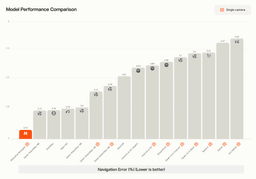
On R2R-CE, the standard vision-and-language navigation benchmark in continuous environments, Robostral Navigate reaches a 79.4% success rate on the validation-seen split and 76.6% on validation-unseen. That beats the best previous single-camera approach by 9.7 percentage points — and, notably, surpasses the best systems using depth sensors or multiple cameras by 4.5 points. It also records the lowest navigation error of the compared models at 3.25.

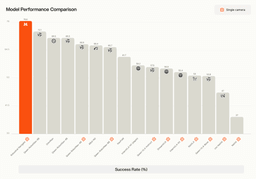
Mistral says the model was built entirely in-house rather than fine-tuned from an existing open-source vision-language model. It was initialized from Mistral’s own VLM specialized in grounding tasks — pointing, counting, and object localization — then trained on roughly 400,000 simulation-generated trajectories spanning 6,000 unique scenes. A training optimization using prefix-caching with tree-based attention masking compresses whole navigation episodes into single sequences, cutting training tokens by 22× and turning month-long training runs into day-long ones. A final online reinforcement learning stage using the CISPO algorithm added another 3.2 points of success rate.
What This Means
Robostral Navigate is Mistral’s clearest signal yet that it intends to compete in physical AI, not just language models. The company announced partnerships with Airbus and BMW in May as part of a push into advanced manufacturing, and Bloomberg reported in June that Mistral is in talks to raise around €3 billion at a €20 billion valuation. A camera-only navigation model targets a real cost bottleneck: cheap consumer-grade robots ship with RGB cameras, not LiDAR, so a model that navigates from a single camera could unlock applications in delivery, logistics, and hospitality where sensor cost matters.
There are caveats. Community observers note that a 76.6% success rate still means roughly one failed navigation in four on unseen environments — fine for a benchmark, but a real deployment hurdle. Established SLAM- and LiDAR-based pipelines remain cheaper in some configurations and battle-tested. And as of the announcement, the model weights are not publicly available for independent testing, so Mistral’s numbers stand unverified for now — a notable departure from the company’s usual open-weights releases.
This post was drafted with AI assistance and reviewed by RITS staff.




 沪公网安备31011502017015号