GLM-5.3-Flash: 320B Multimodal MoE, Weights on Day One


On August 26, 2026, Z.ai released GLM-5.3-Flash — a 320-billion-parameter Mixture-of-Experts model that activates just 18 billion parameters per token, and the first natively multimodal model in the GLM-5 series. It is also the release that inverts the pattern set twelve days earlier: GLM-5.3 shipped on August 14 with its weights held back for a safety review, while GLM-5.3-Flash landed on Hugging Face under an MIT license the day it was announced.
Advanced

Architecture
GLM-5.3-Flash is built for cheap inference rather than maximum capability. Against the GLM-4.5 series it holds a comparable total parameter count — 320B versus 355B — while nearly halving both the activated parameters (18B versus 32B) and the layer count (45 versus 92).
The headline change is a hybrid attention stack. Z.ai interleaves linear-attention layers, which capture local dependencies through state modeling, with sparse-attention layers that retrieve global context through a lightweight indexer. At a one-million-token context the indexer itself becomes a latency and memory problem, so the model adds IndexPool, which compresses four indexer key vectors into one through weighted pooling. The model also adopts Manifold-Constrained Hyper-Connections (mHC) for scaling efficiency, and was pre-trained on a 30-trillion-token multimodal corpus.
The efficiency claim is specific: measured as attention compute per head per layer and average KV cache per layer in BF16, Z.ai reports GLM-5.3-Flash cutting attention compute by 3.0× and KV cache size by 4.4× relative to GLM-5.3. The company notes its KV cache remains slightly larger than Kimi-K3’s and DeepSeek-V4-Flash’s, “leaving further room for improvement.”
Benchmarks

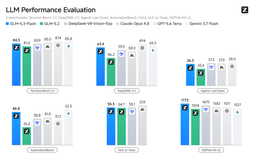
The generational jump over GLM-5.2 is the clearest signal. DeepSWE v1.1 climbs from 46.2 to 63.4; AutomationBench v1.0.6 nearly doubles, 26.2 to 48.8; Terminal Bench 2.1 moves from 81.0 to 84.3. On GDPval-AA v2, scored by Artificial Analysis, GLM-5.3-Flash posts 1773 against GLM-5.2’s 1504 — ahead of every comparison model in Z.ai’s table, including Claude Opus 4.8 (1582) and GPT-5.6 Terra (1571).
Against closed frontier models the picture is mixed, which is what “approaching” means in practice. Terminal Bench 2.1 puts it at 84.3 to Opus 4.8’s 85.0 and GPT-5.6 Terra’s 87.4. On DeepSWE v1.1 it clears Opus 4.8 (58.0) but trails GPT-5.6 Terra (69.6) and Gemini 3.7 Flash (65.3). On Z.ai’s in-house Code Bench v1.0, run through Claude Code 2.1.207 at maximum effort, it reaches 29.0 against Opus 4.8’s 29.5.
The vision numbers are new territory for the series, since GLM-5.2 has no scores to compare against. GLM-5.3-Flash reports 62.4 on OfficeQA Pro against Opus 4.8’s 48.9, and 89.4 on CharXiv Reasoning with tools against Opus 4.8’s 89.9. It is weaker on video and perceptual tasks: BabyVision 53.4 against Gemini 3.7 Flash’s 70.9, MVBench 77.8 against 82.2.
Serving, and the ox-alpha Run

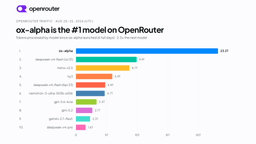
Before the announcement, Z.ai ran the model anonymously as ox-alpha on OpenCode and OpenRouter to collect feedback. By the company’s own charts it finished the week first on both — 23.2 trillion tokens on OpenRouter over six days, 2.3× the next model, and 43 trillion tokens across OpenCode.
Z.ai says every one of those tokens was served on a large-scale cluster of Chinese AI chips. To work within the memory capacity and bandwidth limits of those parts at million-token context, the company built a dedicated inference engine on top of SGLang, combining intra-node tensor parallelism for the linear-attention layers and LM head, ReplaySSM, W8A8 quantization, hybrid INT8/FP8/BF16 cache quantization, and layer splitting. At cluster scale it runs an Encode–Prefill–Decode disaggregated architecture that schedules multimodal encoding, prefill, and decode as independent worker pools. Z.ai reports a 3× end-to-end serving improvement over its initial baseline on the same hardware, reaching what it describes as per-token cost comparable to mainstream NVIDIA GPUs.
What This Means
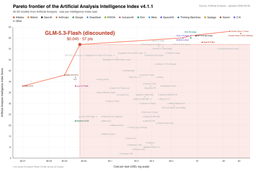
The pricing is the argument. Artificial Analysis places GLM-5.3-Flash at 57 on its Intelligence Index v4.1.1 at $0.045 per task on Z.ai’s discounted tier — a score that until now sat roughly an order of magnitude higher on the cost axis. Secondary trackers list standard API pricing at $0.15 per million input tokens and $0.50 per million output, with cached input at $0.03. GLM Coding Plan subscribers get 3× the usable quota they had on GLM-5.3.
For anyone running the weights locally, the practical constraint is roughly 306 GiB of FP8 weights — a Hopper-or-newer eight-GPU node, per third-party deployment write-ups — with SGLang, vLLM, and TokenSpeed supported at launch and quantized community builds already circulating for llama.cpp, Ollama, and LM Studio.
The strategic read is that Z.ai is treating a cost-optimized model as the vehicle for its architectural bets rather than its flagship. Hybrid linear-plus-sparse attention, IndexPool, and mHC all debut here, not in GLM-5.3, and the company states plainly that it is “now scaling this recipe to larger models.” The open-weights asymmetry points the same direction: a 320B model whose vulnerability-discovery profile does not trigger a holdback can ship immediately, while the 743B flagship stays in safety review. Whether that flagship’s weights arrive on schedule is the more consequential question, and it is still open.
Related Coverage
- GLM-5.3: Z.ai Scales Post-Training, Holds the Weights Back — the August 14 flagship whose weights were deferred pending a safety review
- GLM-5.2: Z.ai’s Open-Weights Coder Beats GPT-5.5 at 1/6 the Cost — the June release GLM-5.3-Flash is measured against throughout
- GLM-5: Zhipu AI Ships a 744B Open-Weight Frontier Model — the February base model the Flash architecture departs from
- Qwen3.8-2.4T-A95B: Alibaba Open-Weights Its Max-Tier Flagship — the other major Chinese open-weight release this month
This post was drafted with AI assistance and reviewed by RITS staff.
Sources
- GLM-5.3-Flash: Frontier Intelligence, Flash Cost — Z.ai, August 26, 2026
- zai-org/GLM-5.3-Flash — model card and weights, Hugging Face
- GLM-5.3-Flash technical report — arXiv
- Z.ai Releases GLM-5.3-Flash: A 320B-A18B Natively Multimodal MoE With a 1M-Token Context — MarkTechPost
- Z.AI Reveals Ox Alpha Is GLM 5.3 Flash — OfficeChai
- GLM 5.3 Flash — API pricing and providers — OpenRouter
- GLM-5.3-Flash intelligence, performance and price analysis — Artificial Analysis


 沪公网安备31011502017015号