IntermediateAI
Raschka Maps the Two-Way Street in Open-Weight LLM Design
- architecture
- china
- llm
- open weights
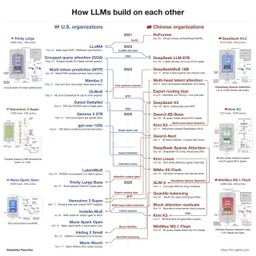
Sebastian Raschka published a timeline on November 21, 2026 tracing how open-weight language models from US and Chinese labs have borrowed architecture ideas from each other since 2021. His argument, stated in a sentence at the top of the post, is that US open-weight models would not be as good without Chinese ones and vice versa, and that proprietary models would not be as good or as cheap without the open ones. The evidence is a single diagram: about thirty model releases in two columns, with labelled arrows crossing between them wherever a later model’s paper credits an earlier model’s mechanism.

What an arrow means
Each arrow in the diagram stands for a documented borrowing rather than a resemblance. The RoFormer line is the clearest early case. Zhuiyi Technology’s April 2021 paper introduced rotary position embeddings, which encode token position by rotating queries and keys inside each attention layer; Meta adopted them for LLaMA in February 2023, and they are now close to universal.
The traffic then reverses. Google published grouped-query attention in May 2023 as a way to shrink the key-value cache by letting several query heads share one set of keys and values. DeepSeek’s first 67B model shipped with 64 query heads and 8 key-value heads in November 2023, and Qwen3-8B followed in April 2025 with 32 query heads sharing 8. Raschka’s other examples run in both directions and sometimes twice: DeepSeekMoE’s fine-grained experts, from January 2024, were taken up by AI2’s OLMoE later that year at 8 active experts out of 64; Meta’s multi-token prediction objective, from April 2024, appears in DeepSeek-V3 in December 2024; DeepSeek-V2’s multi-head latent attention, from May 2024, was adopted by Moonshot’s Kimi K2 in July 2025 and then by AMD’s Instella-MoE in July 2026; and Qwen’s gated attention work from May 2025 shows up as the output gate in Arcee’s Trinity Large Base in January 2026.
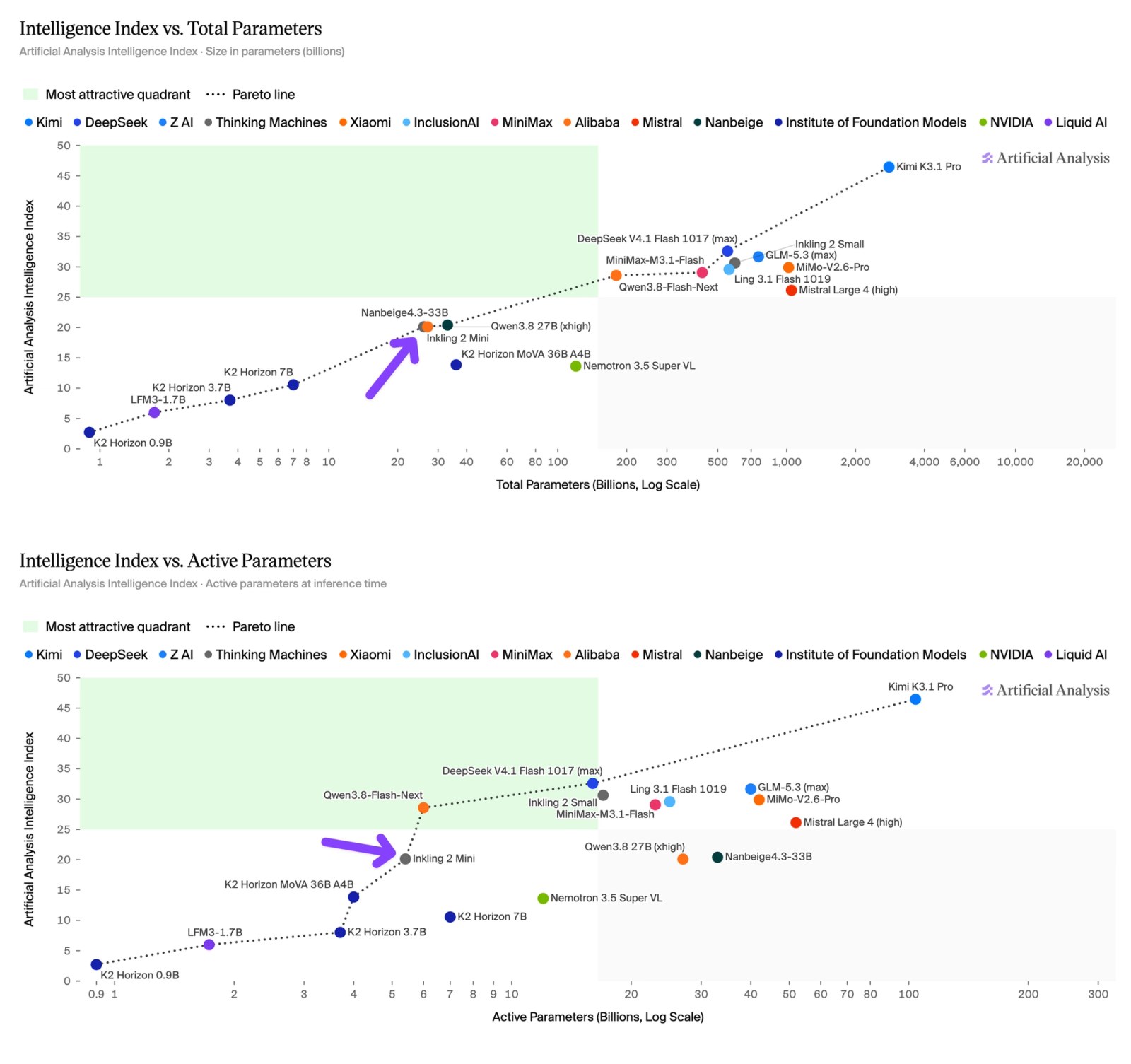
The most recent transfer in the figure is also the one closest to this blog’s own coverage. Moonshot’s block attention residuals, dated March 2026, are the mechanism Thinking Machines credits to the Kimi Team in Inkling 2 Mini, released on November 20 — each layer reads the outputs of earlier blocks through attention instead of adding into one running residual stream. Eight months separate the two papers.
Raschka is explicit that the diagram is not exhaustive. In the post he calls it “just a selection,” and the accompanying table lists nine transfers with links to the underlying papers. The set spans five years, both attention variants that replaced the standard multi-head layer and the routing and training objectives around them.
| Mechanism | First described | Adopted by | Direction |
|---|---|---|---|
| Rotary position embeddings | RoFormer, Zhuiyi Technology, April 2021 | Meta LLaMA, February 2023 | China → US |
| Grouped-query attention | Google, May 2023 | DeepSeek LLM 67B, November 2023; Qwen3-8B, April 2025 | US → China |
| Fine-grained mixture-of-experts | DeepSeekMoE, January 2024 | AI2 OLMoE, September 2024 | China → US |
| Multi-token prediction | Meta FAIR, April 2024 | DeepSeek-V3, December 2024 | US → China |
| Multi-head latent attention | DeepSeek-V2, May 2024 | Kimi K2, July 2025; AMD Instella-MoE, July 2026 | China → China, then China → US |
| Gated delta rule | Gated DeltaNet, NVIDIA and MIT, December 2024 | Qwen3-Next, September 2025 | US → China |
| Gated attention output | Qwen, May 2025 | Arcee Trinity Large Base, January 2026 | China → US |
| Block attention residuals | Moonshot, March 2026 | Thinking Machines Inkling 2, November 2026 | China → US |
The size gap, measured elsewhere
The claim that the two ecosystems are entangled is easier to show than the claim that each made the other better, and here a second source helps. Hugging Face’s August 2026 ecosystem report counted the largest open release by month and found that in almost every month of the year the biggest model from a Chinese lab was larger than any model a US lab published: China’s monthly ceiling ran from 754 billion to 2.78 trillion parameters, while US releases stayed under 130 billion in five of seven months, the exceptions being NVIDIA’s Nemotron 3 Ultra at 561 billion and Thinking Machines’ Inkling.

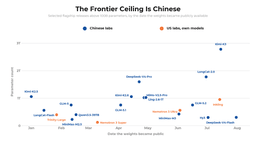
The same report supports the direction of travel Raschka describes, and does it from download and licence data rather than citations. It states that some US releases above 100 billion parameters this year “are built on top of Chinese models or leverage artifacts from Chinese labs,” naming Thinking Machines’ 952-billion-parameter Inkling. It also finds that of 178 Chinese releases above 20 billion parameters, 59% carry Apache 2.0 and 22% carry MIT, against 29% Apache or MIT on the US side of the same size band. And Qwen, the base model most of the arrows in the diagram point away from, had accumulated 151,448 derivatives on the Hub by August — 2.6 times Meta’s total footprint and 4.7 times its Llama repositories, growing at 180 to 210 new repositories a day.
What the arrows do not show
A citation is evidence that an idea travelled, not evidence that it caused a capability jump. Three qualifications are worth keeping in view.
First, the diagram records the papers a model’s authors chose to credit. Silent reuse, independent reinvention and simultaneous discovery all look the same from the outside, and architecture choices converge for mundane reasons: a mechanism that cuts the key-value cache is attractive to anyone serving long contexts, wherever they work.
Second, the sample is selected. Raschka says so himself, and a timeline built to demonstrate a loop will contain the arrows that demonstrate it. Nothing in the post estimates how much of the total progress came from cross-pollination, and the headline claim — that each side would be worse without the other — is an argument supported by examples rather than a result.
Third, attention and adoption are different quantities. Hugging Face’s own report makes this point sharply: of the top 25 model repositories by downloads this year and the top 25 by likes, exactly one appears in both lists. Moonshot’s frontier-only catalogue drew 37 million downloads across 2026, while Qwen’s broader range drew 2,045 million. Being the model that other labs copy and being the model that other teams deploy are separate kinds of influence, and the timeline measures the first.
What This Means
For readers who follow releases by lab, the practical takeaway is that the transit time between ecosystems is short. An idea published in one lineage shows up in the other within a year or two, and sometimes within months: DeepSeek’s sparse attention from September 2025 is already in Z.ai’s GLM-5, and Moonshot’s attention residuals reached a US lab by November 2026. Anyone evaluating only one country’s releases is working from a stale design vocabulary.
For the open-versus-closed argument, Raschka’s framing is narrower than it first appears. He is not claiming that open weights win; he is claiming that competition between two open ecosystems, and between open and closed models, is what produced the pace. The mechanism he implies is ordinary: a published mechanism becomes a free input to everyone else’s next training run, and a lab that keeps its architecture private pays for the same idea twice — once to invent it and once again to defend a price that a free copy undercuts.
The open question is where the convergence stops. Most of the arrows in the diagram move mechanisms that reduce cost per token or per unit of context — cache compression, sparse attention, latent attention, hybrid linear attention. Those are the parts of a model that are cheap to copy and easy to verify in a paper. Post-training recipes, data mixtures and reinforcement-learning environments travel less visibly, and there the diagram has almost nothing to draw.
This post was drafted with AI assistance and reviewed by RITS staff.
Sources
- Sebastian Raschka, “The US-China Open-Weight Feedback Loop,” November 21, 2026
- Su et al., “RoFormer: Enhanced Transformer with Rotary Position Embedding,” 2021
- Touvron et al., “LLaMA: Open and Efficient Foundation Language Models,” 2023
- Ainslie et al., “GQA: Training Generalized Multi-Query Transformer Models from Multi-Head Checkpoints,” 2023
- Dai et al., “DeepSeekMoE: Towards Ultimate Expert Specialization in Mixture-of-Experts Language Models,” 2024
- Muennighoff et al., “OLMoE: Open Mixture-of-Experts Language Models,” 2024
- Gloeckle et al., “Better & Faster Large Language Models via Multi-token Prediction,” 2024
- DeepSeek-AI, “DeepSeek-V2: A Strong, Economical, and Efficient Mixture-of-Experts Language Model,” 2024
- DeepSeek-AI, “DeepSeek LLM: Scaling Open-Source Language Models with Longtermism,” 2024
- Yang, Kautz and Hatamizadeh, “Gated Delta Networks: Improving Mamba2 with Delta Rule,” 2024
- Qiu et al., “Gated Attention for Large Language Models: Non-linearity, Sparsity, and Attention-Sink-Free,” 2025
- Hugging Face, “State of Open Models: Summer 2026 Observations,” August 14, 2026



 沪公网安备31011502017015号