AdvancedAI
Thinking Machines’ Inkling 2 Mini Loops Its Layers to Fit a Laptop
- benchmarks
- local inference
- mixture of experts
- open weights
- thinking machines
Thinking Machines released Inkling 2 Mini on November 20, 2026, a 26.4-billion-parameter open-weights model that runs the middle half of its layers three times for every token and still fits in about 20 GB. The lab describes it as small enough to run on a consumer laptop, and it arrives two weeks after Inkling 2 Small, a 594-billion-parameter model released without downloadable weights. Mini is the opposite bet: fewer stored parameters, more computation per token, and an Apache 2.0 download.
Why loop the middle layers
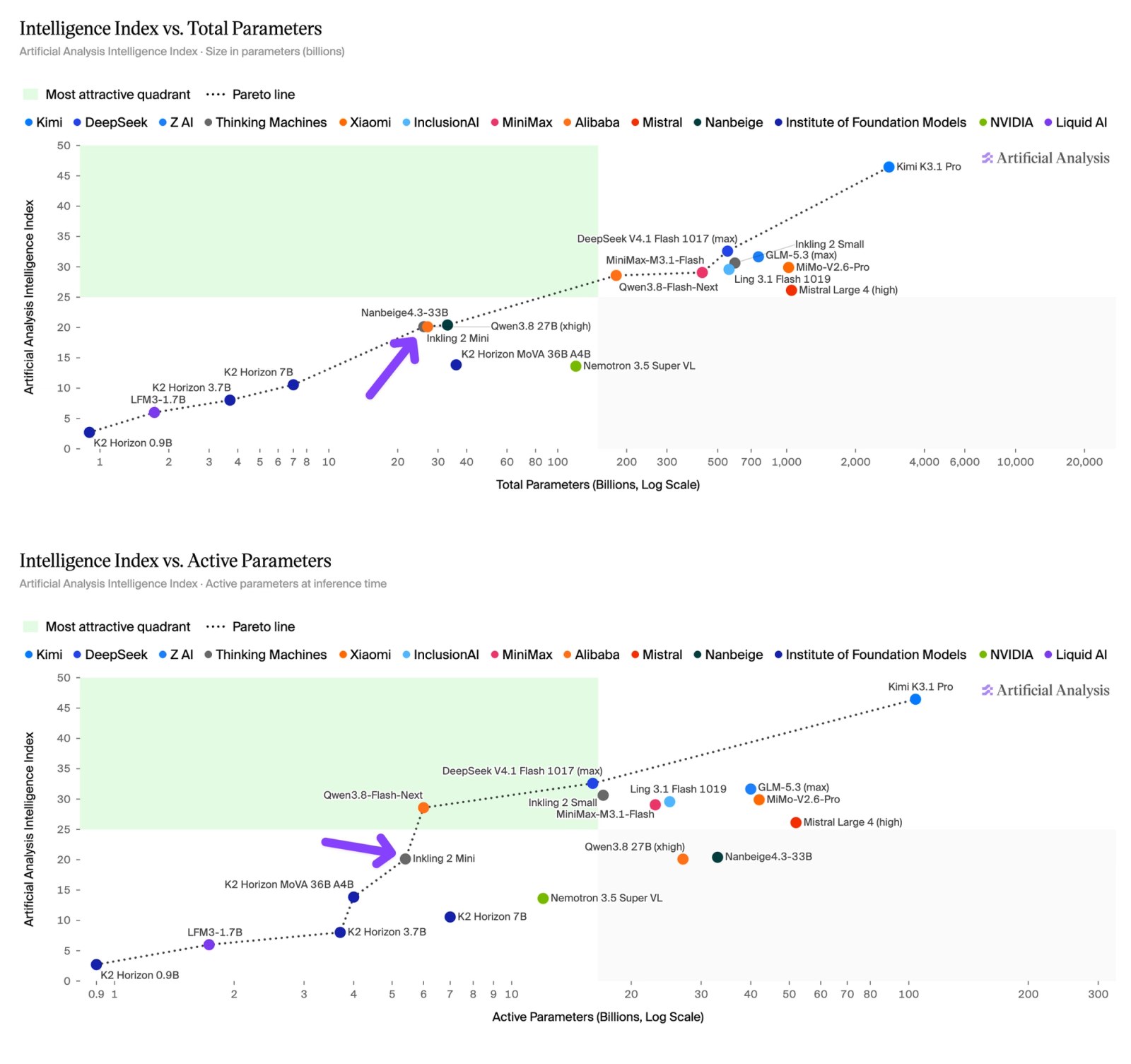
Inkling 2 Mini has 24 layers in four blocks of six. The first block runs once on the input, the two middle blocks run three times, and the last block runs once to produce the output. That is 48 layer applications per token from 24 layers of stored weights, and it is the source of the model card’s two parameter figures: 3.4 billion unique parameters are active per token, and each extra pass over the looped layers adds about a billion more, for 5.4 billion effective active parameters at three passes.
The design assumes that middle layers do the abstract reasoning while the first and last few translate between embeddings and internal representations. Thinking Machines tested that assumption directly. Looping the middle 12 layers produced larger accuracy gains than looping the last 12 on 27 of 28 evaluations, and the lab estimates the non-looped baseline would need 1.51 to 1.91 times as much training compute to match the middle-loop loss, against 1.24 to 1.36 times for the last-loop variant.
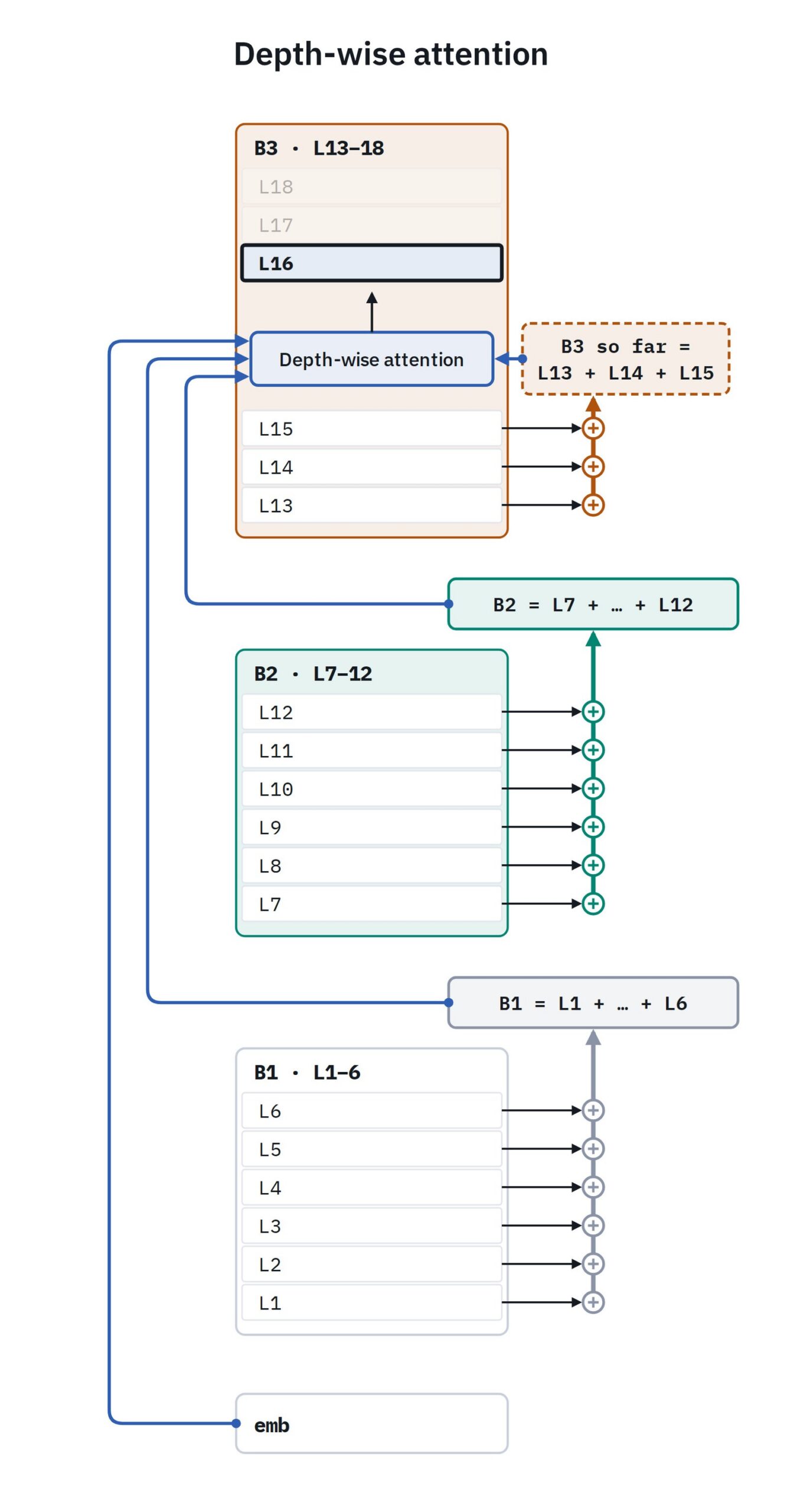
Two other choices make the loop trainable. The model uses attention residuals, an idea credited to the Kimi Team, so each layer reads the outputs of earlier blocks through attention and learns its own mixture rather than adding into one running residual stream. And each repeat pass receives a “message” — the middle blocks’ output from the previous pass — merged through a gate that starts closed and opens during training, so looping is introduced gradually rather than as a shock. In a separate unpruned comparison, the non-looping model cost 7.5% less compute to train but needed 140% more inference compute to match the looped model’s loss on 512,000-token agentic traces.
Four-bit training, then a third of the experts
Inkling 2 Mini is trained in the precision it ships in. Expert layers use NVFP4 on every forward pass from pretraining through reinforcement learning, backed by a custom kernel on NVIDIA’s GB300 platform, while the final four layers run in MXFP8. Deployed weights are 20 layers in NVFP4 and four in MXFP8, so there is no post-training quantization step and, the lab says, no conversion loss.
The model also began life much larger. Training started with 384 experts per layer and a top-8 routing rule; at one point in midtraining, Thinking Machines pruned two-thirds of them, keeping the 128 most used in each layer. The remaining experts were then trained on 1 trillion tokens distilled from a larger internal Inkling model, a healing step the lab says recovered the pre-pruning performance. Supervised fine-tuning followed, then reinforcement learning over 2.2 trillion tokens and 2,000 steps.
The scores, and the rows where it loses
Thinking Machines’ comparison table is long, and the pattern is consistent: strong agentic coding, weaker closed-book knowledge. Inkling 2 Mini reports 48.2% on DeepSWE v1.1, 77.9% on SWE-bench Pro v2 Hard, 79.2% on SWE-bench Verified, 73.7% on SWE-bench Multilingual, 71.6% on Terminal-Bench v2.1, 79.0% on BrowseComp and 82.7% on MCP Atlas. On knowledge it reports an AA-Omniscience score of -8.6 and a non-hallucination rate of 63.4%, behind Qwen3.8-27B at -6.4 and 71.4%.
The lab is direct about the mechanism: looping adds reasoning depth, not stored facts. In its variable-loop research model, long-context tasks such as GraphWalks BFS and MRCR v2 improved with more passes, while AA-Omniscience, SimpleQA Verified and WorldVQA stayed roughly flat. The same model also shows the limits of the approach, scoring 50.0% on MultiChallenge and 33.4% on ComplexConstraints v1.1, both behind Qwen3.8-27B, and trailing on reasoning-heavy tests such as CritPt v2 and HLE-Diamond.
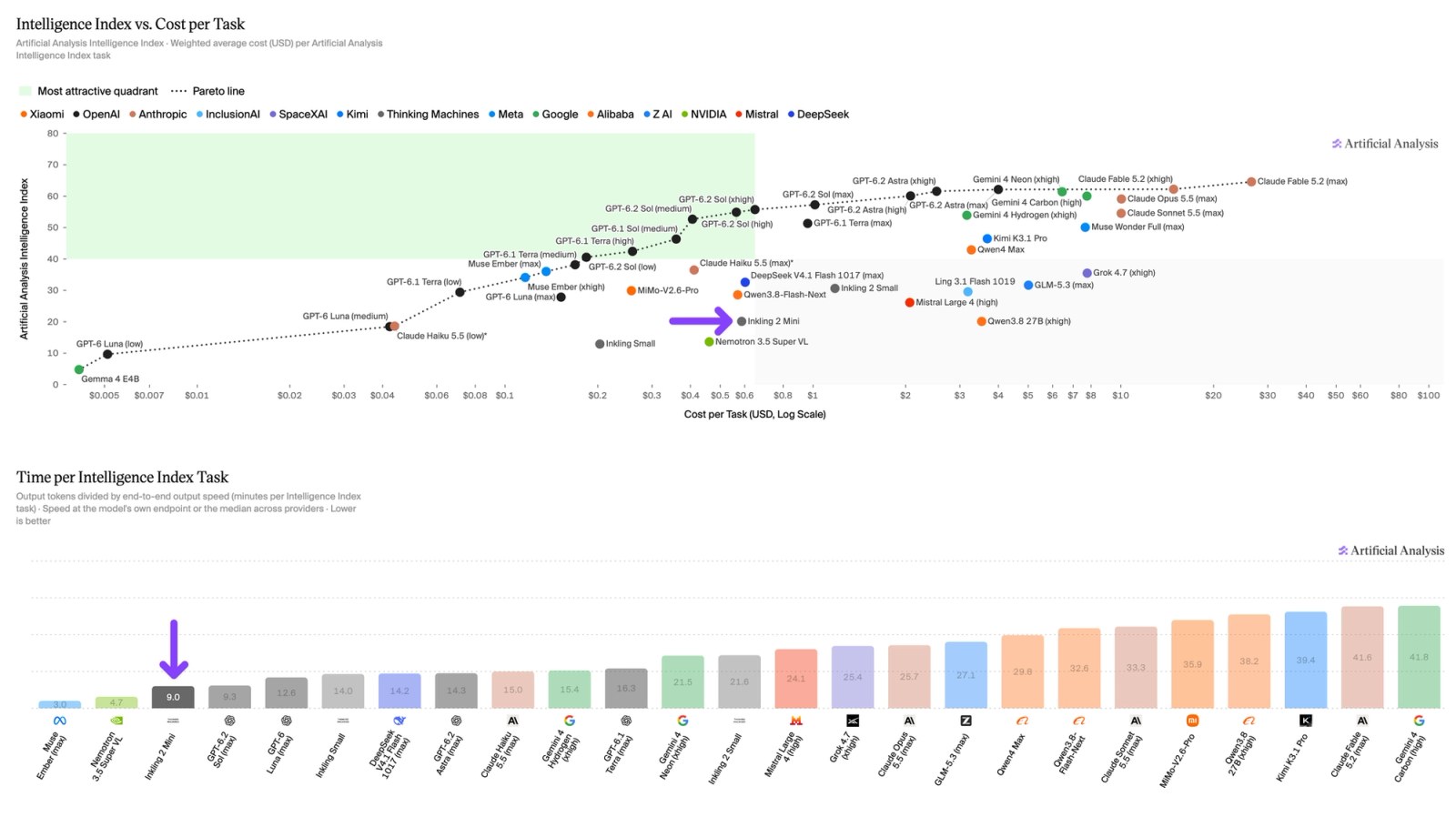
Artificial Analysis, which ran its own suite, scores Inkling 2 Mini at 20.1 on Intelligence Index v5.0 — the same score it gives Qwen3.8-27B at extra-high effort — and notes that it reaches it with roughly five times fewer active parameters. It measures about 152,000 output tokens per index task against 110,000 for Qwen, and yet about 2.8 times less total compute by its active-parameters-times-tokens proxy. Cost per task is $0.59 and 9.0 minutes, against $3.53 and 38.2 minutes for Qwen3.8-27B at Thinking Machines’ list prices of $0.15, $0.50 and $0.015 per million input, output and cached tokens.
Thinking without writing it down
Looping creates an oversight problem the lab does not hide. A standard transformer passes each token through a fixed stack once, which caps how much serial computation happens before the model must emit a token; reasoning that needs more steps has to appear in the visible chain of thought. Looping raises that ceiling, so a model can do more work internally and say less about it. Reasoning that never appears in the text cannot be caught by a monitor reading the text.
The preliminary results are reassuring but narrow. On Think Fast, which estimates how long a task a model can finish with no chain of thought, the variable-loop research model’s horizon rises from 16 seconds at one pass to 37 seconds at three, then flattens. On N-Hop Lookup, which chains table lookups, accuracy keeps improving out to ten passes even though the model was trained on at most five. In the lab’s own tests, chains of thought grew shorter with more loops but stayed legible, and scores on agentic sabotage evaluations did not rise as loops were added. Goodfire, given early access to the weights, found that looped layers can read from what it calls “future” layers — weights that will run later in the same pass — which is the kind of structure the lab wants interpretability researchers to study.
What This Means
The headline is not the benchmark score, which is roughly what a 27-billion-parameter dense model already delivers. It is that a looped, natively four-bit model with open weights now runs on a 48 GB laptop. Thinking Machines demonstrated it offline on a MacBook Pro building a playable flight simulator, and ran a 20-agent town simulation on the same machine. For anyone building local agents, a 20 GB checkpoint that spends compute per token instead of memory per parameter is a different point on the cost curve than downloading a 30-billion-parameter model at 16-bit.
The caveats are the usual vendor ones. Every benchmark in the launch table was run by Thinking Machines with its own harnesses and, in several rows, a harness named after the model. The independent evidence is thinner but points the same way: Artificial Analysis agrees on the index score and on the efficiency claim, and disagrees on nothing large. The open question is the one the lab itself raises — whether looped models stay monitorable as they scale. At 26 billion parameters the answer appears to be yes; the variable-loop model exists so that others can test it further.
This post was drafted with AI assistance and reviewed by RITS staff.
Sources
- Introducing Inkling 2 Mini, Thinking Machines, November 20, 2026
- Inkling 2 Mini model card, Thinking Machines, November 20, 2026
- thinkingmachines/Inkling-2-Mini, Hugging Face
- Thinking Machines has released Inkling 2 Mini, an open weights looped transformer, Artificial Analysis, November 20, 2026
- Interpreting Inkling 2 Mini, Goodfire, November 20, 2026



 沪公网安备31011502017015号