AdvancedAI
Inworld Open-Sources a 48 kHz Voice Isolator in Two Checkpoints
- Audio
- benchmarks
- inworld
- open source
- speech
Inworld released Voice Isolator on November 18, 2026, its first open-source model: two Apache 2.0 checkpoints that strip noise, music and background chatter from speech at 48 kHz while keeping the speaker’s breaths, laughter and timing intact. The offline model has 64.0 million parameters and the realtime one 58.2 million, small enough that Inworld’s pitch is as much about what runs on a laptop as about what tops a benchmark. The company says its models scored best among the open-source denoisers it tested on a benchmark it built for the purpose.
What it does, and what it deliberately will not do
Most speech denoisers optimise for a clean-sounding waveform, which usually means removing anything that is not steady voiced speech. That includes the breath before a sentence, the laugh after one and the “hmm” in the middle. For a voice agent, those sounds carry turn-taking information; for an interview recording, they carry the character of the speaker. Inworld’s stated goal is to return the voice as recorded — same timbre, same level, same timing — and remove everything else, including the late tail of the room.
The tool writes two files: the isolated voice and, by subtraction, the background that was removed. That second output makes it usable for more than cleanup. Inworld suggests it as a way to pull a backing track or noise bed out of a mixed recording, and the command line and Python API both expose the residual directly. Two limits are stated plainly. It is not a speaker selector: when two people talk at once the louder voice is kept and one a few decibels quieter is removed, while voices at similar levels are usually both kept. And it is not a restoration model. Version 1 suppresses noise and invents nothing, so a recording that lost its high band stays narrow until the promised version 2.
A band-split network with two kinds of sequence model
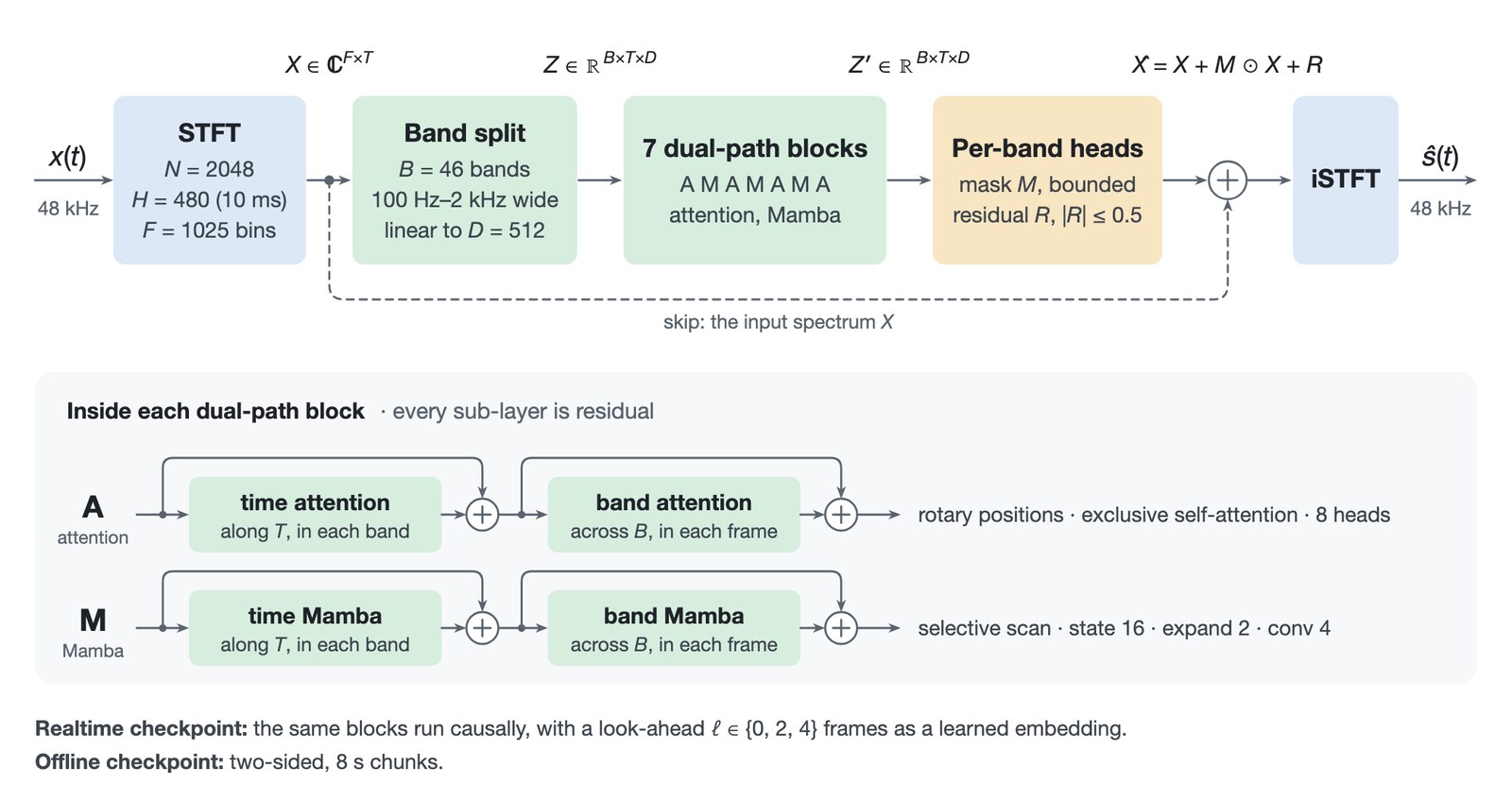
The architecture is conventional for speech enhancement and carefully specified. Audio enters at 48 kHz mono and is transformed with an STFT of 2,048 points and a 480-sample hop, giving one frame every 10 milliseconds and 1,025 frequency bins. Each frame’s spectrum is cut into 46 bands — narrow at low frequencies, wider at the top — and each band becomes a 512-wide token. Seven dual-path blocks refine those tokens, alternating two kinds. Four blocks run time attention with rotary positions and exclusive self-attention, then attention across bands; three blocks run Mamba along time and then across bands, with a state size of 16. Per-band heads output a bounded complex mask and a bounded per-bin residual, which are added to the input spectrum before the inverse transform.
The two checkpoints differ in causality rather than size. The offline model is two-sided: every frame sees its whole 8-second chunk, and long recordings are rendered in 8-second chunks overlapping by 2 seconds. The realtime model is causal with a trained look-ahead of 0, 20 or 40 milliseconds, and Inworld quotes an algorithmic latency of 63 milliseconds at 20 milliseconds of look-ahead. That is the number that matters for a live call: it is fast enough to sit inside a conversational pipeline without the delay becoming the dominant term.
The benchmark is Inworld’s own
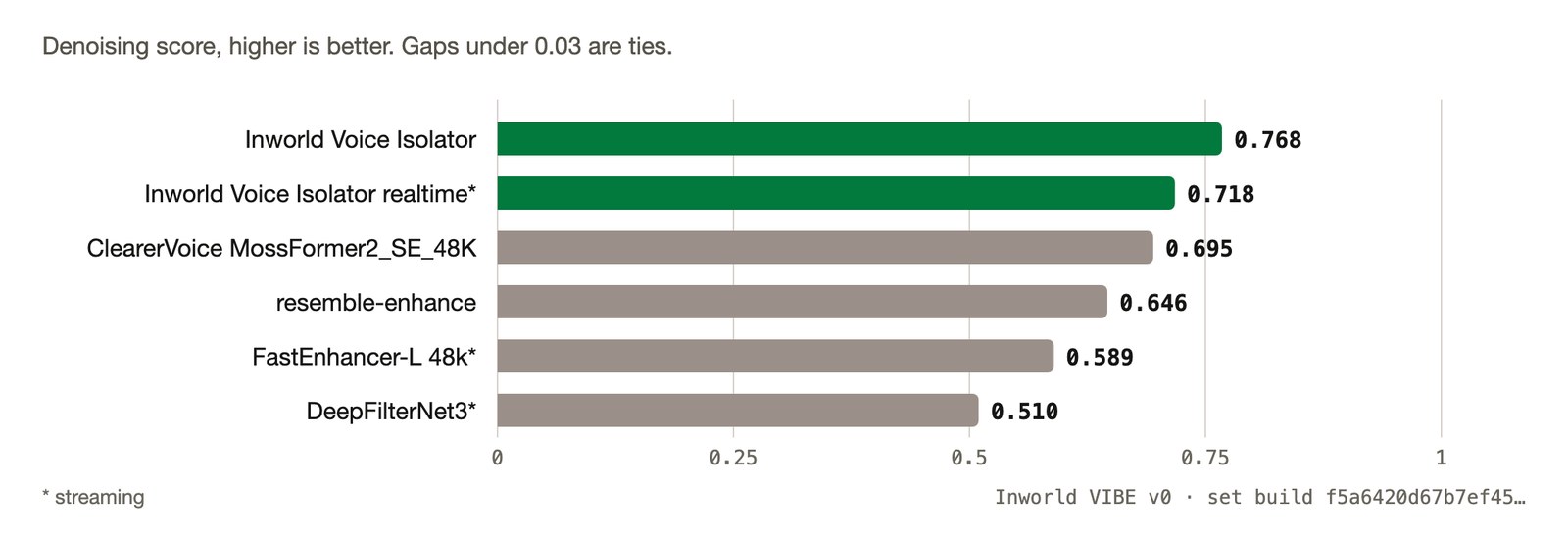
VIBE — Voice Isolation Benchmark and Evals — is a multilingual, multi-condition set of real utterances, scored from 0 for the unprocessed input to 1 for the clean reference. On the denoising board the offline model scores 0.768 and the realtime model 0.718. ClearerVoice’s MossFormer2_SE_48K reaches 0.695, resemble-enhance 0.646, FastEnhancer-L 48k 0.589 and DeepFilterNet3 0.510. Inworld notes that gaps under 0.03 count as ties, which makes the top three a genuine separation and the bottom two clearly behind.
The caveat is structural rather than hidden. Inworld scores every system on an internal evaluation set that it does not distribute, and the comparison covers the open-source denoisers it was able to test. That makes the board a vendor claim, not an independent ranking. The company’s own framing is modest — “best among the open-source denoisers we were able to test” — and it invites submissions and benchmark criticism through GitHub issues. A second board ranks systems that add more than 10 dB of energy above a band-limited input’s band on restoration rather than denoising, which is where the deliberately non-restorative design puts this model by definition.
Training, packaging and where it runs
Inworld trained version 1 on roughly 10,000 hours of unique audio. The paired examples were built from recorded speech — read and conversational, many languages, expressive and character voices, whispers, singing, laughter, breaths and sighs — mixed with environmental and household noise, traffic, rain, wind, music, crowds, isolated transients and competing talkers, passed through measured and simulated room responses and through telephony and codec degradation. Clean recordings of the same speech complete the set. The objective was reconstruction of the voice as recorded, which is why the non-verbal sounds survive.
The package is a pip install, with weights downloaded on first use and checksums verified. It runs on CUDA when available, on Apple’s Metal backend through PyTorch 2.6 or later, and on the CPU otherwise. Inworld tested NVIDIA Ampere, Hopper and Blackwell cards — A100, H100, B200 and B300 — and says smaller GPUs are untested for now. The repository also ships an interactive demo with a file tab and a 60-second microphone tab for the realtime model.
What This Means
Voice isolation has been a paid API feature for several years, and the interesting part of this release is the licence and the size. An Apache 2.0 model at 58 million parameters that streams at 63 milliseconds can sit inside a local voice pipeline, a classroom recording tool or a dataset-curation script without a per-minute bill, and it can be fine-tuned without negotiating terms. That is a meaningful change for anyone building speech systems where the audio cannot leave the building.
The technical claim worth watching is the one about non-verbal sounds. If the model really preserves breaths and laughter while removing a vacuum cleaner, it solves a problem that matters more for conversational agents than for podcast cleanup: turn-taking cues that a denoiser would otherwise delete. The benchmark that would settle it is not VIBE, which measures fidelity to a clean reference, but a downstream test of whether a speech recogniser or a turn-detection model performs better on the isolated audio than on the noisy original. Inworld says it trained for that neutrality on purpose; independent evaluation will be the test.
This post was drafted with AI assistance and reviewed by RITS staff.
Sources
- Introducing Voice Isolator: open-source 48 kHz denoising, Inworld AI, November 18, 2026
- inworld/voice-isolator model card, Hugging Face
- inworld-ai/voice-isolator, GitHub


 沪公网安备31011502017015号