AdvancedAI
Apple’s Depth Pro 2 Makes Video Depth Sharp and Stable
- 3d
- apple
- benchmarks
- computer vision
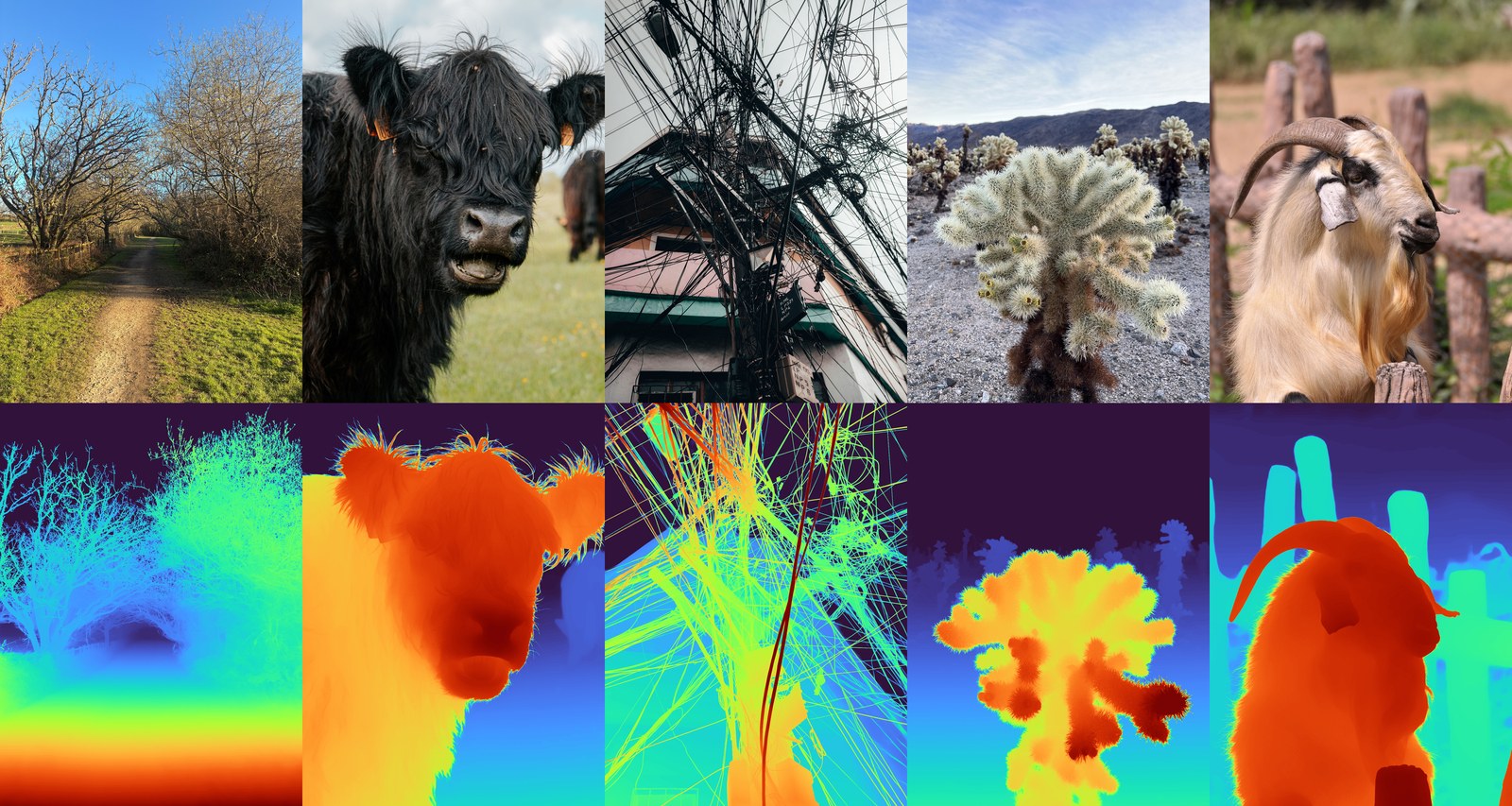
Apple published Depth Pro 2 on November 19, 2026, a family of four metric depth models that estimate distance for every pixel of a photo or a video at its native resolution. The technical report argues that earlier monocular depth methods faced a choice: multi-frame models kept depth stable across a video but blurred object edges, while single-frame models kept edges sharp but flickered. Depth Pro 2 is one network trained on both images and video, and Apple says it produces maps that are metrically accurate, sharp and temporally consistent at the same time.
The trade-off it attacks
The report starts from a survey of prior work rather than a new architecture. Single-image depth models such as Apple’s own Depth Pro from 2024 produce crisp boundaries because each frame is estimated independently, but consecutive frames disagree slightly, so a video made from those maps shimmers. Video depth models, including diffusion-based ones, enforce consistency across frames and lose fine structure: fur, leaves and thin objects blur into the background. Both families also tend to resize their input to a fixed square, which throws away the resolution that makes edges sharp in the first place.
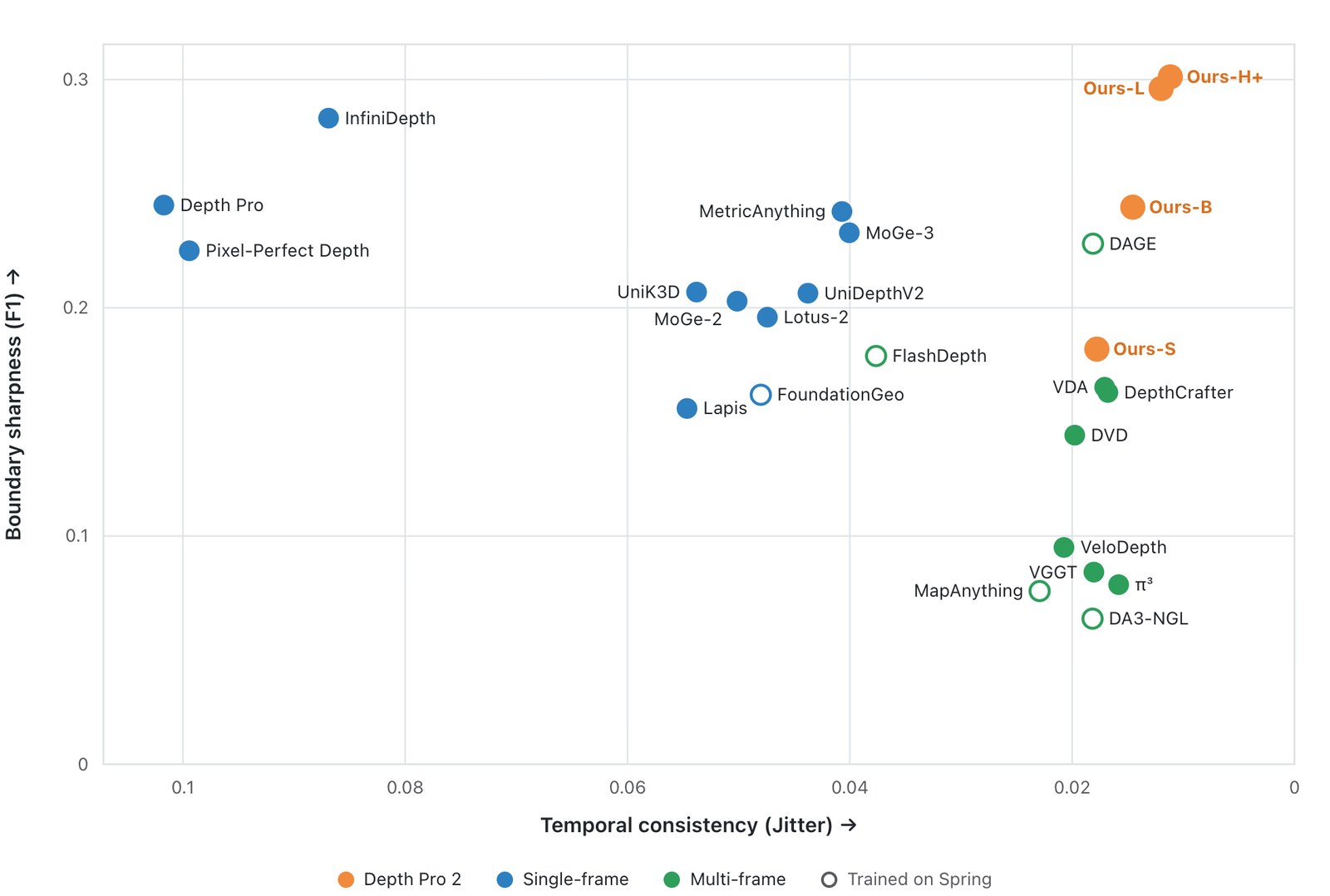
Depth Pro 2’s answer is a single scalable network that accepts either a still or a sequence and predicts depth maps at the input’s native resolution. Apple evaluates the result on boundary F1, which measures sharpness at object edges, and jitter, which measures frame-to-frame instability, averaged over the Sintel and Spring datasets. The project page plots those two axes and places the model at the top right, the corner where sharp and stable meet. The same figure positions prior single-frame and multi-frame methods below it.
How the network works
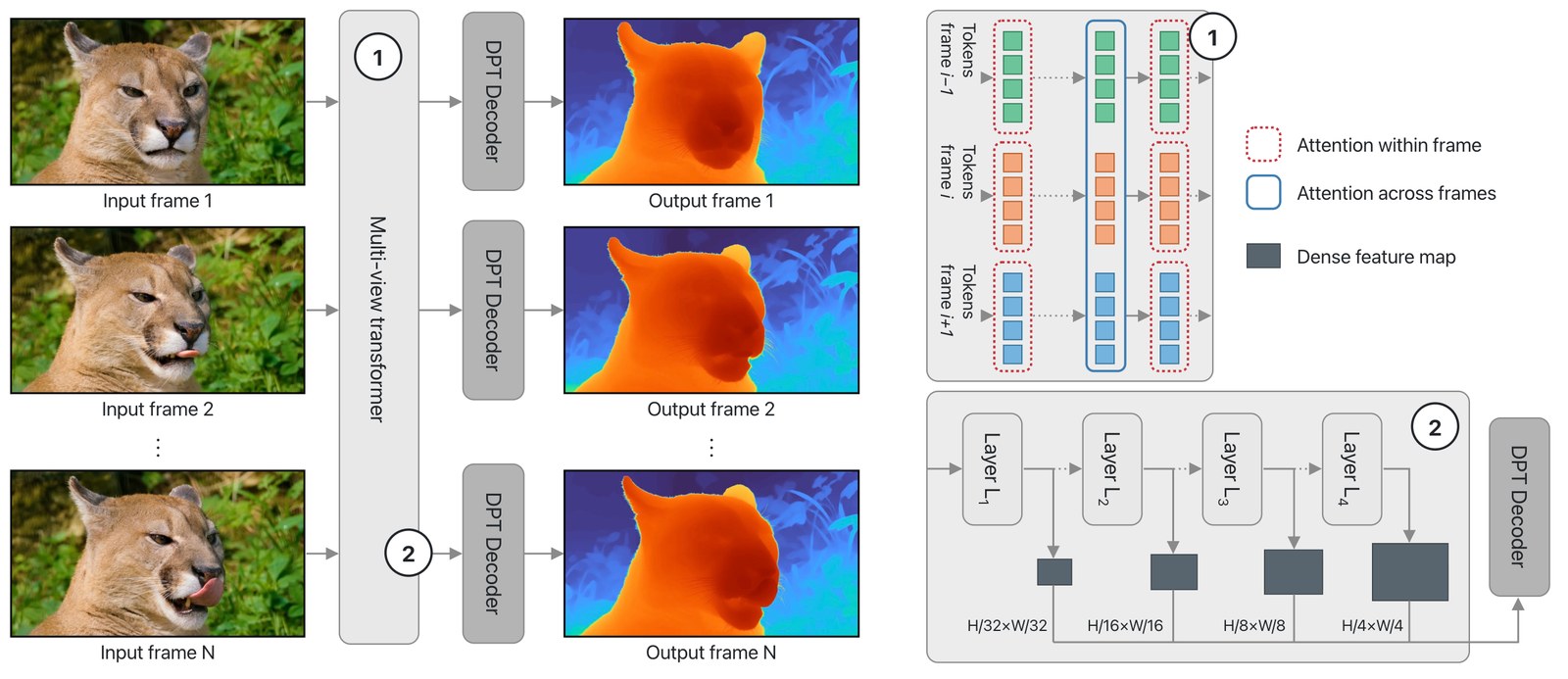
The architecture has two parts. A multi-view transformer ingests one or several frames and processes them jointly. For the first third of its blocks it attends within each frame; after that it alternates attention within a frame and attention across frames, so information can be shared between neighbouring frames without collapsing each frame’s own detail. A DPT decoder then collects tokens from several transformer blocks, assembles them into feature maps at one-thirty-second to one-quarter of the input resolution, and decodes an inverse depth map for each frame.
Three implementation choices matter for practical use. Depth is metric, in metres, rather than relative, which means the output can drive a measurement rather than only a look. A separate 23.5-million-parameter focal-length estimator loads alongside every model size and predicts the focal length when the metadata does not supply one, so ordinary photos and videos work without calibration. And the video path processes 16 frames at a time, returning one prediction per frame in order, which keeps memory bounded for long clips. Depth is reported as infinite where the scene itself is infinitely far, such as sky.
Four sizes, and what each one costs
The family spans two orders of magnitude: S at 24 million parameters and 97 MB, B at 97 million and 386 MB, L at 334 million and 1.3 GB, and H+ at 872 million and 3.5 GB. The paper’s parameter counts are slightly higher — 48, 120, 357 and 896 million — because they include the shared focal-length estimator. Larger sizes are sharper and steadier; smaller ones are faster.
Apple’s runtime table, measured on one B200 in eager PyTorch at bfloat16 on a 32-frame clip, makes the spread concrete. Depth Pro 2-S processes 347 frames per second at 640×480, 143.9 at 720p, 44.8 at 1080p and 3.6 at 4K. The H+ model reaches 95.9, 20.2, 5.3 and 0.4 frames per second at the same sizes. Peak reserved memory runs from 1.9 GB for the small model at VGA to 114.6 GB for the largest at 4K, which is the practical reason most users will choose S or B for video and reserve H+ for stills.
For context, the table also lists the original Depth Pro at 23.5 frames per second, though it resizes every input to 1536×1536 and reports the same throughput at every resolution as a result. The comparison that matters is not the raw number but the resolution: 44.8 frames per second at 1080p is about 93 million pixels per second, against roughly 55 million for the older model’s fixed 1536-square input at 23.5 — though those two rows describe very different model sizes.
What This Means
Depth is one of the quiet inputs to a lot of consumer software: portrait-mode blur, relighting, inserting a virtual object that respects occlusion, turning a phone video into a 3D scene. The limitation of existing models was never that they could not estimate depth at all, but that the estimate was either sharp and noisy or smooth and wrong at the edges. A model that is both, at native resolution, removes a preprocessing step that teams currently spend effort working around — temporal smoothing filters, edge-aware upsampling, manual masks.
The constraint is the licence. Apple’s Machine Learning Research Model licence permits non-commercial scientific research and academic development only, so Depth Pro 2 is not something a product team can ship, and it is not comparable in licensing terms to the Apache 2.0 depth models in the same benchmark table. Academic groups and research labs get a strong new baseline and a family of sizes that fit different GPUs; commercial users get a reference implementation and, at best, a reason to build their own. Apple has released research weights under this licence before, and the pattern is consistent: the paper and the code are open, the deployment right is not.
This post was drafted with AI assistance and reviewed by RITS staff.
Sources
- Depth Pro 2: Sharp and Temporally Consistent Metric Monocular Depth, Apple, November 2026
- Depth Pro 2 (arXiv:2611.26603), submitted November 19, 2026
- apple/DepthPro2 model card, Hugging Face
- apple-aiml-research/ml-depth-pro-2, GitHub


 沪公网安备31011502017015号