AdvancedAI
Apple’s FastFrames Generates Video Frames in 36 Milliseconds
- apple
- benchmarks
- diffusion
- video generation
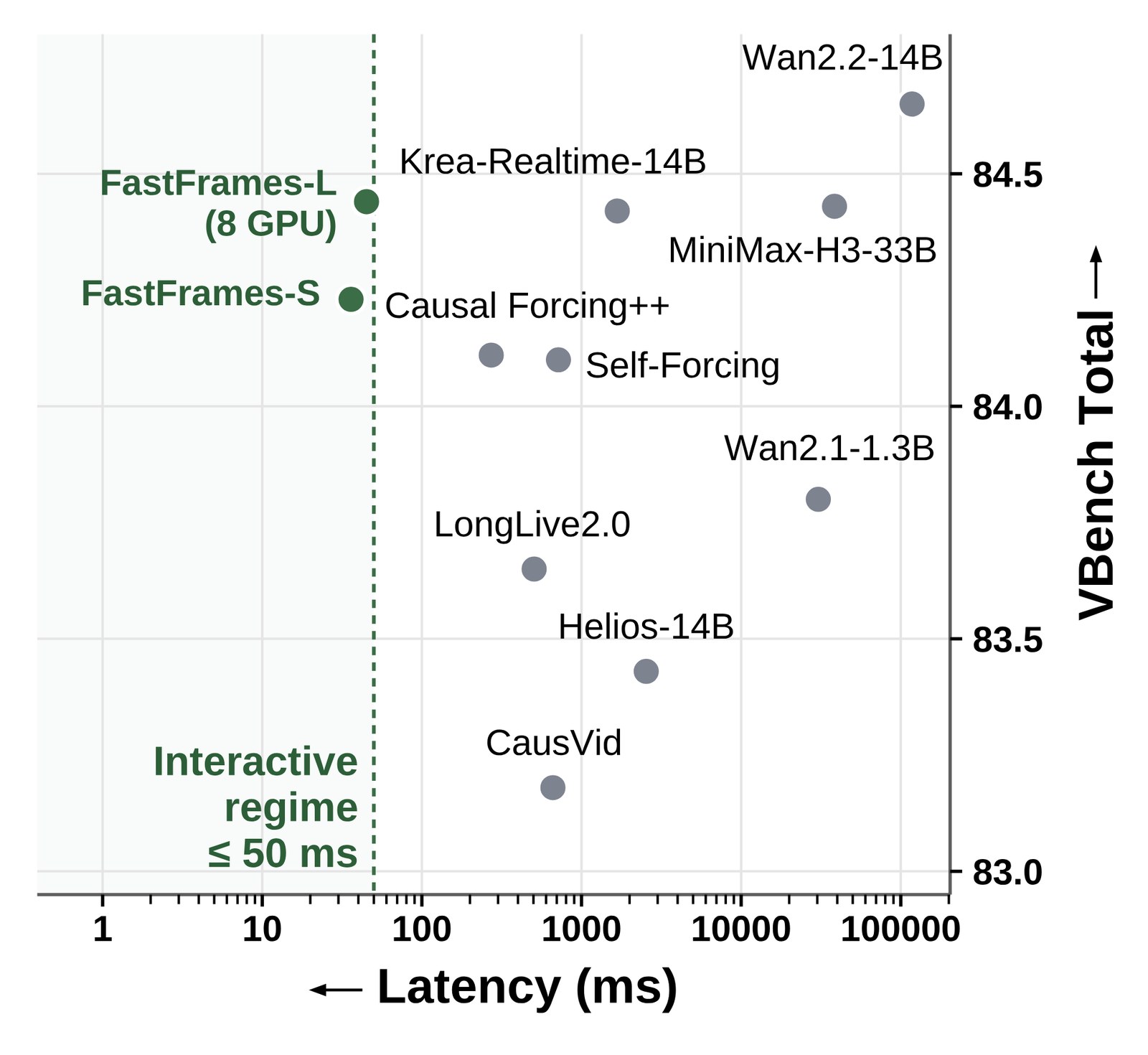
Apple published FastFrames on November 17, 2026, a pair of autoregressive video diffusion models that generate 480p frames in 36 and 45 milliseconds — fast enough, the authors argue, for video to respond to a keyboard or a mouse in real time. The smaller model, FastFrames-S, is a 1.3-billion-parameter system that runs on a single NVIDIA B200; the 14-billion-parameter FastFrames-L needs eight of them. Both build on Wan 2.1 backbones and a two-step sampling recipe, but the paper’s contribution is less about the generator than about everything around it: the parts of the inference pipeline that most teams treat as fixed costs, and that turn out to consume more than half the time.
Where the milliseconds actually go
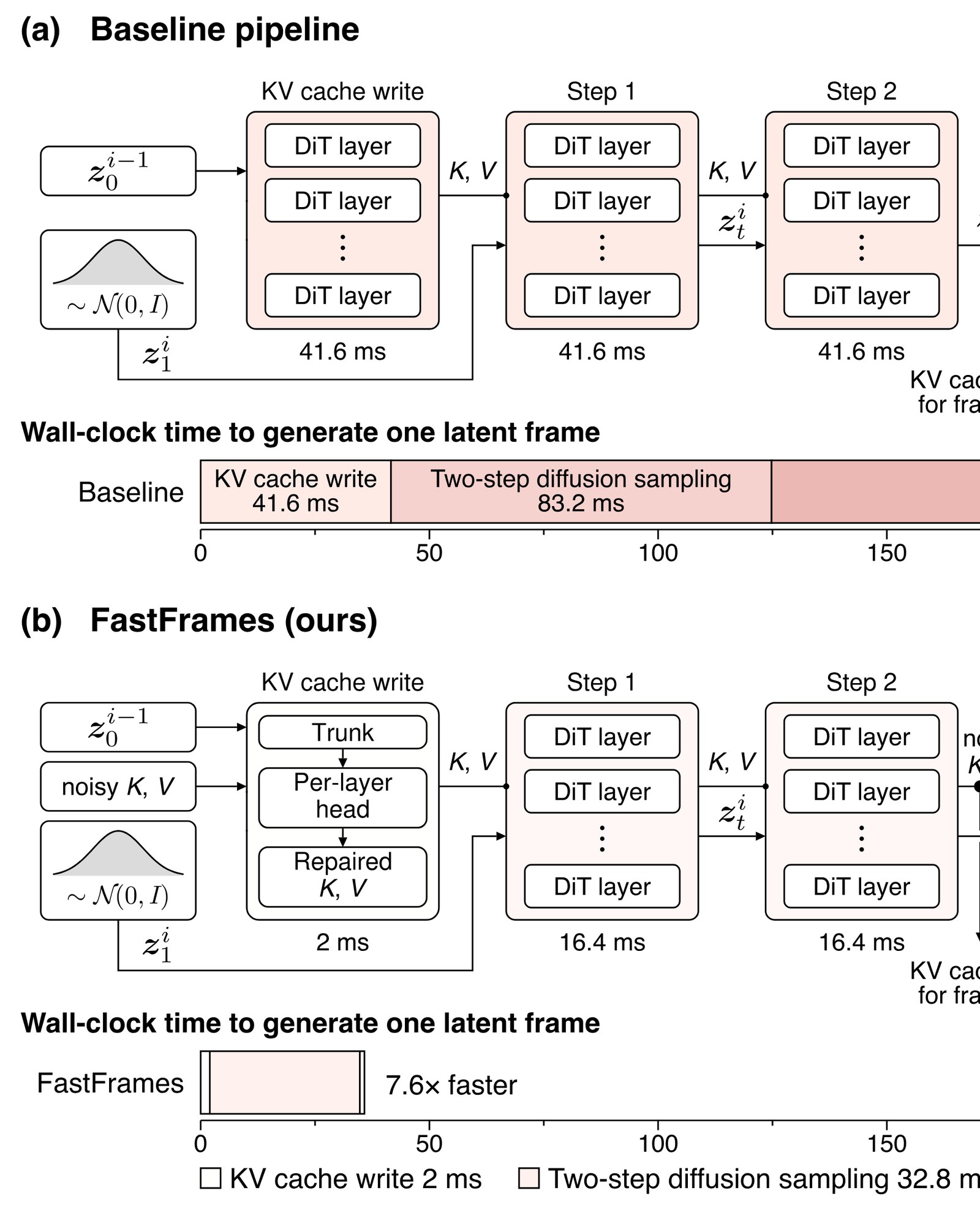
The paper begins with a profile rather than a model. In a typical autoregressive video diffusion pipeline, each generated frame requires a diffusion transformer pass, an update to the key-value cache that carries context forward, and a decode from latent space to pixels. The first of those is the part everyone optimises. Apple’s measurement found that the other two are not rounding errors: VAE decoding and KV cache updates together accounted for more than half of end-to-end latency.
FastFrames replaces them. A small learned pixel decoder renders the frame directly, removing the VAE decode, and a learned KV refinement network updates the cache more cheaply than writing full keys and values. The effect is visible in the component table for FastFrames-S at 480p on one GPU: two diffusion transformer evaluations at 16.1 and 16.2 milliseconds dominate, KV refinement costs 2.2, the pixel decoder 0.9, for a total of 35.4 milliseconds — the paper rounds to 36. The end-to-end profile in the paper falls from 271.8 to 35.8 milliseconds.
Two models, two starting points
FastFrames-S is a fine-tune of Causal Forcing++, a two-step causal video generator. Apple freezes that model’s diffusion transformer and trains only the new pixel decoder and KV refinement network against their targets. FastFrames-L starts further back: the team converted Wan 2.1 14B into a causal autoregressive model, distilled it to two steps, applied DMD distillation, and then trained the same two components. The released checkpoints include the intermediate teacher, the consistency-distilled model and the DMD-distilled model, not just the final generator.
Both models produce 832 by 480 video, 81 frames at 16 frames per second. Two-step sampling is what makes the arithmetic work: at 36 milliseconds per frame, a second of 16 fps video takes about 0.6 seconds to generate, which is slower than playback but close enough for an interactive loop where the model generates ahead of the user. The paper’s latency is measured at steady state with a full KV cache, after warm-up, which is the right regime for a live session and the wrong one for a one-off clip.
Speed without a visible quality tax
The claim that matters is not the latency but the pairing of latency with VBench scores. Apple reports that FastFrames-S matches Causal Forcing++, the model it was built from, while being nearly eight times faster, and that FastFrames-L is comparable to Krea-Realtime on realism, prompt adherence, composition and text rendering while being more than ten times faster on a single GPU — 158 milliseconds against 1,675. The paper attributes the small quality gain over Causal Forcing++ to adversarial training in pixel space, which the pixel decoder makes possible.
The 14-billion-parameter model is not just a bigger version of the same result. Apple says the larger models produce more realistic lighting and shadows, more coherent compositions and more legible text than their 1.3-billion counterparts, which is consistent with what the wider video literature reports about scale. The trade is GPU count: FastFrames-L on a single B200 runs at 158 milliseconds per frame, about 3.5 times slower than the same model across eight GPUs, and slower than FastFrames-S on one.
Making other models interactive
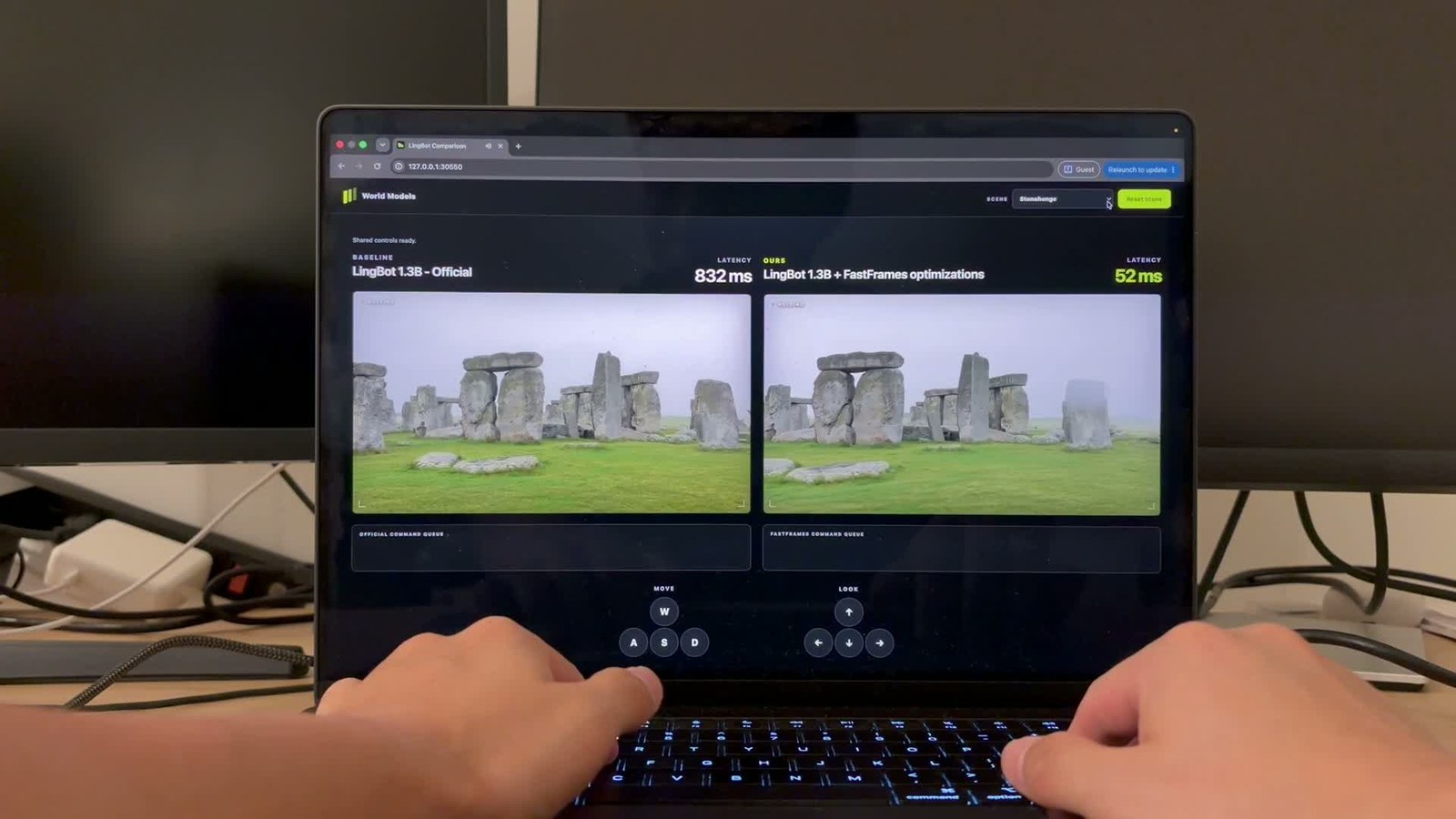
The most useful result may be the transfer. Apple applied the same optimisations to two existing interactive video systems. LingBot 1.3B, a camera-conditioned model, went from 842 milliseconds on its fastest official configuration — two GPUs with Ulysses sequence parallelism — to 52 milliseconds on eight GPUs with FastFrames, a 16-fold speedup. RealWonder 1.3B, a physics-conditioned model, went from 1,141 milliseconds on one GPU to 51 milliseconds on eight, a 22-fold speedup. LingBot 14B went from 1,373 to 233 milliseconds on eight GPUs.
What This Means
The threshold the paper targets is 50 milliseconds, which is roughly the point where a visual response stops feeling like a delay and starts feeling like a consequence of the input. At 36 and 45 milliseconds, both models clear it, and the LingBot and RealWonder results show that the same techniques can pull an existing model across the line. For anyone building an interactive world model, a game prototype or a camera-driven video tool, that changes the design space: the model no longer has to generate a clip and hand it off, it can run inside the control loop.
The caveats are practical. This is a Linux x86-64, NVIDIA-only release with a CUDA 12.8 driver requirement, and the smallest configuration still needs a B200 to hit the published numbers. The weights carry Apple’s research-only model licence, and the code uses the Apple Sample Code License, so production use is out of scope; the LingBot components add a non-commercial share-alike licence of their own. And the headline comparison is against baselines Apple chose and ran itself, on its own hardware, with VBench as the quality measure. None of that undercuts the engineering result — the profile of where latency goes is a fact anyone can reproduce — but it does mean the 10x and 16x figures are claims about specific configurations, not about video generation in general.
This post was drafted with AI assistance and reviewed by RITS staff.
Sources
- FastFrames: Video Generation at Interactive Latency, Apple, November 2026
- FastFrames (arXiv:2611.23226), submitted November 17, 2026
- apple-aiml-research/ml-fastframes, GitHub
- apple/FastFrames-L model card, Hugging Face


 沪公网安备31011502017015号