Kimi K3 Open Weights Ship: 2.8T Parameters, 1.4 TB to Run


Moonshot AI released the full Kimi K3 weights on July 27, 2026, hitting the date it promised when the model debuted eleven days earlier. K3 is a 2.8-trillion-parameter Mixture-of-Experts model with a 1-million-token context window and native vision — the first open 3T-class model ever published. The download is 1.56 TB across 118 files, and the license is not the Modified MIT that Moonshot used for K2.
Advanced


What Shipped
The release covers more than the checkpoint. Moonshot published the K3 technical report, the model card on Hugging Face, and three pieces of supporting infrastructure: MoonEP, a high-performance MoE communication library; FlashKDA, a kernel implementation clocking 1.72–2.22× faster prefill than the flash-linear-attention baseline on NVIDIA H20; and AgentEnv, a sandbox system for agent-scale training built jointly with KVCache.ai. vLLM, SGLang, and TokenSpeed all support the model.
The Architecture
K3 activates 104B of its 2.8T parameters per token across 93 layers. The sparsity is aggressive: 896 experts with only 16 selected per token, plus 2 shared experts. Moonshot credits a “Stable LatentMoE” framework for making that ratio trainable without the instability that normally accompanies pushing MoE this far, and claims roughly 2.5× better overall scaling efficiency than K2.
Attention is split 69 Kimi Delta Attention (KDA) layers to 24 Gated Multihead Latent Attention layers — a 3:1 interleave of linear attention against periodic full attention that Moonshot says yields up to 6.3× faster decoding at million-token contexts. A second mechanism, Attention Residuals (AttnRes), works across network depth rather than sequence length, selectively retrieving representations between layers instead of accumulating them uniformly. Moonshot reports about 25% higher training efficiency from AttnRes for under 2% extra compute. Vision comes from MoonViT-V2, a 401M-parameter encoder handling images and video in the same model.
Benchmarks
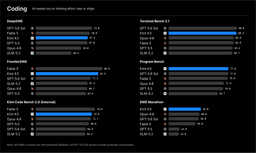
K3 leads on several coding evaluations and trails on others. It takes SWE Marathon (42.0 vs. Opus 4.8’s 40.0 and Fable 5’s 35.0) and Program Bench (77.8), and lands within half a point of the top on Terminal-Bench 2.1 at 88.3. On DeepSWE it sits third at 67.5, behind GPT-5.6 Sol (73.0) and Fable 5 (70.0). FrontierSWE goes to Fable 5 by a wide margin, 86.6 to 81.2.

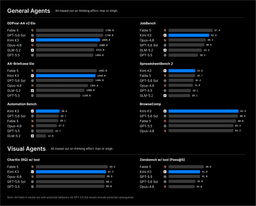
On agentic and visual tasks the pattern repeats — competitive, occasionally first, rarely dominant. K3 tops BrowseComp (91.2), Automation Bench (30.8), and SpreadsheetBench 2 (34.8), while Fable 5 holds GDPval-AA v2 Elo (1760 to K3’s 1668) and JobBench. Reasoning is closer: GPQA Diamond at 93.5 ties GPT-5.5 and beats every model here except GPT-5.6 Sol.

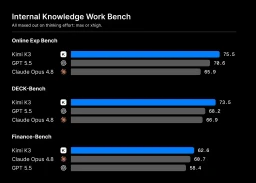
Moonshot’s internal knowledge-work suite is the most flattering set, with K3 ahead of both GPT-5.5 and Opus 4.8 on all three tasks — though these are self-reported benchmarks, not independent ones.

Open, With Conditions
K2.6 shipped under a Modified MIT license. K3 ships under a bespoke “Kimi K3 License” that permits download, self-hosting, fine-tuning, and quantization, but attaches two conditions. Groups earning more than $20M in aggregate revenue over any consecutive 12 months must negotiate a separate agreement with Moonshot before reselling raw K3 inference. Products exceeding 100M monthly active users or $20M monthly revenue must prominently display “Kimi K3” in their interface. Purely internal use and access through Moonshot’s official products or certified partners are exempt.
The practical barrier is heavier than the legal one. At native MXFP4 the weights need roughly 1.4 TB resident, before any KV cache for a 1M-token context. That exceeds any single GPU or 8-GPU node; production serving realistically means a multi-node cluster with 64+ accelerators. For most readers the API remains the sane path — $3 per million input tokens on a cache miss, $0.30 on a hit, $15 per million output.
What This Means
The interesting question is no longer whether open weights can reach the frontier. K3 sits fourth of 189 models on the Artificial Analysis Intelligence Index at 57, the leading open-weights score, and the gap to the closed leaders is measured in single-digit benchmark points rather than generations. The question is what “open” buys you when the artifact is 1.4 TB and the license has revenue triggers.
For research groups and universities, quite a lot: the weights can be inspected, fine-tuned, and studied in ways an API never permits, and the released kernels and training infrastructure are arguably as valuable as the checkpoint. For anyone hoping to run frontier intelligence on their own hardware, K3 mostly relocates the bottleneck from access to capital. That is still a meaningful shift — but it is a different one than the open-weights community has been describing.
Related Coverage
- Kimi K3 Hits Third on Artificial Analysis; Open Weights Due July 27 — our coverage of the July 16 launch and the release promise Moonshot has now kept
- Moonshot AI Releases Kimi K2.6 with 256K Context and 300-Agent Swarms — the previous generation, shipped under a Modified MIT license
- MiniMax M2.7 Ships as Open Weights: Frontier Agentic Model on Hugging Face — a 230B comparison point at one-tenth the footprint
- GLM-5.2: Z.ai’s Open-Weights Coder Beats GPT-5.5 at 1/6 the Cost — the unrestricted-MIT alternative K3 is measured against above
This post was drafted with AI assistance and reviewed by RITS staff.
Sources
- Kimi-K3 model card — Hugging Face
- MoonshotAI/Kimi-K3 — GitHub repository and technical report
- Kimi K3 — Moonshot AI tech blog
- Moonshot released Kimi K3 model weights and technical report — Geopolitechs
- Kimi K3 Open Weights Shipped: What the Licence Says — Digital Applied
- Kimi K3 Model Size, Open Weights, and Hardware Requirements — Yotta Labs


 沪公网安备31011502017015号