Kimi K3 Hits Third on Artificial Analysis; Open Weights Due July 27


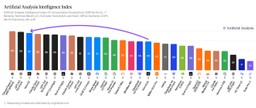
Moonshot AI launched Kimi K3 on July 16, 2026 — a 2.8-trillion-parameter Mixture-of-Experts model with a 1-million-token context window that now sits third on the Artificial Analysis Intelligence Index, ahead of Claude Opus 4.8 and behind only Claude Fable 5 and GPT-5.6 Sol. The full weights are promised by July 27, which would make K3 the largest open-weight model ever released. Until then, it is API-only.
Intermediate

Where It Lands
Artificial Analysis scores K3 at 57 on version 4.1 of its Intelligence Index, a composite of nine evaluations including GDPval-AA v2, Terminal-Bench v2.1, GPQA Diamond, and Humanity’s Last Exam. That places it behind Claude Fable 5 (60) and GPT-5.6 Sol (59), and one point above Claude Opus 4.8 (56).
The more telling number is the generational jump. Kimi K2.6, which we covered in April, scores 44 on the same index. A 13-point gain in three months is the steepest move any open-weight family has made this year, and it lifts K3 past every proprietary model except two.
Architecture
K3 is a sparse MoE that activates just 16 of 896 experts per token. Moonshot credits two changes for the efficiency gains. Kimi Delta Attention (KDA), a hybrid linear attention scheme, delivers up to 6.3× faster decoding in million-token contexts. Attention Residuals (AttnRes) selectively retrieve representations across model depth for roughly 25% higher training efficiency at under 2% additional cost. Combined with quantile balancing and per-head Muon, Moonshot reports about 2.5× better scaling than K2. Weights are MXFP4 with MXFP8 activations.
Two variants shipped: K3 Max for chat and agent work, and K3 Swarm Max for large-scale parallel processing.

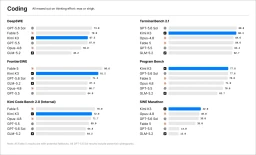
On coding, K3 takes two of six benchmarks — Program Bench (77.8, just past GPT-5.6 Sol’s 77.6) and SWE Marathon (42.0). It finishes a close second on Terminal Bench 2.1 (88.3 to GPT-5.6 Sol’s 88.8) and on FrontierSWE (81.2, well behind Fable 5’s 86.6). Worth noting: these are Moonshot’s own figures, and its footnote concedes that all Fable 5 results include potential fallbacks and all GPT-5.6 Sol results include cyberguards.

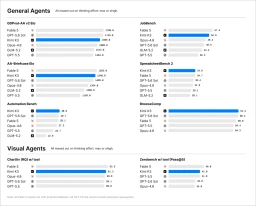
Agentic work is the stronger showing: K3 wins three of six general-agent tests, leading BrowseComp at 91.2 and posting 1,548 Elo on AA-Briefcase, second only to Fable 5. On visual agents, Fable 5 takes both tests, with K3 runner-up on each.
The Price Story

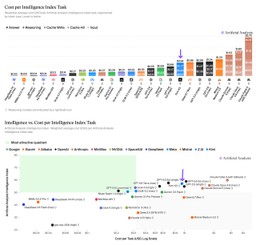
K3 runs the full Intelligence Index at an average $0.94 per task, roughly half of Opus 4.8’s $1.80 and a third of Fable 5’s $2.75. But the comparison that matters to existing Kimi users is with K2.6: API pricing jumped from $0.95/$4.00 per million input/output tokens to $3.00/$15.00 — Claude Sonnet territory. Cache hits soften it to $0.30, and K3 emits 21% fewer output tokens than K2.6, but the era of frontier-adjacent Chinese models at rock-bottom prices looks to be ending.
What This Means
Two caveats deserve weight. First, the weights are not out. There is no Kimi-K3 repository on Hugging Face yet, no published license, and “open by July 27” is a promise, not a shipped artifact — though every prior flagship in this lineage (K2, K2.5, K2.6) did ship open weights. Second, Artificial Analysis measured K3’s hallucination rate rising from 39% to 51% even as its AA-Omniscience accuracy improved from 33% to 46%. A model that knows more and also confabulates more is a real tradeoff for anyone deploying it unsupervised.
If the weights land as promised, the practical shift is that a model within three points of the frontier becomes something a lab can run on its own hardware. Arena CEO Anastasios Angelopoulos called it “the single biggest release of the year, and marks the moment that OSS Chinese models have surpassed US models.” Constellation Research analyst Holger Mueller was more measured: “It’s the largest open-weights model we’ve ever seen, it’s multimodal with its visual feedback mechanism, and it’s a lot cheaper.” July 27 will settle which framing holds.
Related Coverage
- Moonshot AI Releases Kimi K2.6 with 256K Context and 300-Agent Swarms — the April predecessor, which scores 44 to K3’s 57 on the same index
- GLM-5.2: Z.ai’s Open-Weights Coder Beats GPT-5.5 at 1/6 the Cost — June’s open-weights contender, now at 51 on the index
- MiniMax M2.7 Ships as Open Weights: Frontier Agentic Model on Hugging Face — the same weights-follow-the-API pattern, in April
- Cursor’s Composer 2 Exposed as Kimi K2.5 Under the Hood — how far Kimi’s open weights had already spread by March
Sources
- Kimi’s open model K3 nears GPT-5.6 Sol and Fable 5 while signaling the end of super cheap Chinese AI — The Decoder
- Moonshot AI Releases Kimi K3: A 2.8 Trillion Parameter Open MoE Model With Kimi Delta Attention and 1M Context — MarkTechPost
- China’s Moonshot throws down the gauntlet with Kimi K3, the world’s largest open-weights model — SiliconANGLE
- Kimi K3, and what we can still learn from the pelican benchmark — Simon Willison
- Kimi K3 Places Third, Right Behind Fable 5 And GPT 5.6 Sol On Artificial Analysis Intelligence Index — OfficeChai


 沪公网安备31011502017015号