AdvancedAI
Tencent Open-Weights Hy4 Flash, a 220B MoE With 12B Active
- hunyuan
- mixture of experts
- open weights
- tencent
Tencent published open weights for Hy4 flash on November 18, 2026, two days after announcing the model: a 220-billion-parameter mixture-of-experts system that activates about 12 billion parameters per token and reads up to a million tokens of text and images. The company is selling it at $0.070 per million input tokens and $0.281 per million output tokens, roughly a twentieth of the per-task cost of the larger Hy4 it was distilled from. For a research lab, the interesting part is not the price list but the architecture: a hybrid attention stack, experts that compute in a compressed latent space, and an n-gram lookup table holding 63.5 billion parameters of learned bigram and trigram embeddings.

The parts that make it cheap
The backbone is 42 layers: one dense feed-forward layer followed by 41 mixture-of-experts layers, with 512 routed experts per layer, 16 of them active per token plus one shared expert. The departure from a conventional MoE is where those experts compute. In Hy4 flash’s LatentMoE, routed experts operate in a 1,536-dimensional latent space rather than the model’s 3,072-dimensional hidden size, so the parameters are stored at full width but the arithmetic per token is narrower.
Attention is split two ways across the 42 layers. Twelve layers use sparse attention that selects up to 2,048 earlier tokens through a group-level index, 30 use sliding-window attention with a 512-token causal window, and the two are interleaved in a 2-sparse-then-ten-blocks-of-three-SWA pattern. Both use multi-head latent attention with separate query and key-value low-rank projections. Tencent says the combination reduces KV cache to one twenty-fourth of Hy3 and one sixth of Hy4, which is the constraint that usually decides how many long-context requests a serving cluster can hold at once.
The third component, Engram, is unusual enough to describe separately. At four backbone layers — indices 1, 11, 21 and 31 — the model consults learned bigram and trigram embedding tables through multi-head hash lookups: eight heads per n-gram order, each with a 10.3-million-entry hash vocabulary, producing a 768-dimensional embedding per order. That table is 63.4 billion parameters, larger than the entire active parameter count of most models, and it is retrieved rather than computed. It is also why the parameter totals in Tencent’s materials disagree with each other in a small, informative way: the press release rounds to 224 billion total with 64 billion Engram parameters and 12 billion active, while the model card’s table gives 155.5B backbone, 63.5B Engram, 0.43B vision encoder and 0.85B drafter, with 11.3B text plus 0.43B vision active per token.

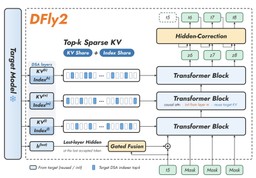
Serving relies on that drafter plus megakernel fusion and 4-bit quantization. Because DFly2 shares the target model’s KV cache and index selection instead of keeping its own, speculative decoding adds no KV memory and costs a constant amount per draft token rather than growing with context — the reason Tencent can claim decoding above 150 tokens per second on a million-token window. Post-training is a two-step: self-distillation from Hy4 for general capability, then reinforcement learning that Tencent says cuts average end-to-end output length by half.
What Tencent measured, and what it did not
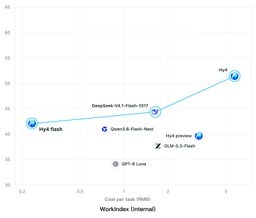
Tencent’s primary benchmark is one it built: WorkIndex, eight evaluation sets covering slide creation and editing, human-AI co-writing, document editing, spreadsheet repair, audio and video processing, and visual understanding. Hy4 flash scores 42.1 there, against 39.7 for Hy4 preview — the 770-billion-parameter, 49-billion-active model — and 51.4 for the shipping Hy4. The cost claim is steeper than the score claim: one thirteenth of Hy4 preview’s cost per task, one twentieth of Hy4’s, and one eighth of DeepSeek-V4.1-Flash-1017 at its peak-hour Max-tier pricing.
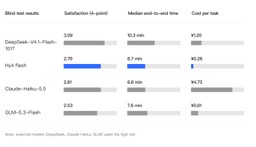
The human evaluation is the more candid artefact. Tencent ran a blind test with 85 internal WorkBuddy users across 259 tasks in 27 categories. Hy4 flash scored 2.79 out of 4 on satisfaction against 2.81 for Claude Haiku 5.5, with a 6.7-minute median completion time and a cost of ¥0.26 per task. The chart Tencent published alongside those numbers also shows DeepSeek-V4.1-Flash-1017 at 3.09 satisfaction — higher than either — while taking 10.3 minutes and costing ¥1.20. The claim Tencent makes is the narrow one: closest to Haiku on satisfaction, cheapest and fastest of the four evaluated models. It does not claim to be the best-liked.

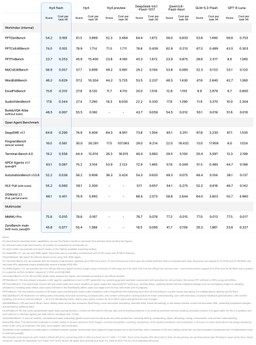
The published pretraining table points the other way, and Tencent printed it without softening. On few-shot evaluation, Hy4 flash Base trails Hy4 Base on nearly every knowledge row — MMLU 88.7 against 91.6, MMLU-Pro 71.1 against 73.9, SimpleQA 37.5 against 57.2 — and on most multimodal rows, with MMMU-Pro at 52.0 against 59.6. The card adds a disclaimer that the base model’s exposure to synthetic instruction data during mid-training occasionally breaks few-shot answer formatting. A 12-billion-active model losing to a much larger one at the pretraining stage is the expected result; it is the post-training that closes the gap on the tasks Tencent cares about.
The independent check
Plotly ran Hy4 flash through its private data-analysis exam on the day the model appeared on OpenRouter, before the weights were public, and published the transcripts’ outcomes. It passed 39 of 43 questions — 91%, an A — for $0.13, with a median of 29 seconds per question. That makes it the cheapest A-grade result on that board. It ties Ember-1, Claude Fable 5.1 and Thinking Machines’ Inkling 2 Small at 39, while 17 of the 51 models tested score higher and none at 39 or above costs less.
The breakdown is specific. Hy4 flash answered all 20 straightforward analytics questions, stated or asked about assumptions on all five ambiguous ones, declined all five impossible requests, and caught all three planted data-quality problems. It lost three of five hidden-pattern questions and one statistics trap, where it ranked the top values instead of setting a threshold from the distribution. Against the low-cost models Tencent named as competitors, it scored higher for less: Claude Haiku 5.5 took 37 for $0.38, DeepSeek V4.1 Flash 36 for $0.46, and GLM 5.3 Flash 38 for $0.69. Against its own predecessor it gives up three questions — 39 against 42 — for about a sixteenth of the cost and roughly four times the speed. Plotly cautions that a single run is one sample and that scores on its board move by up to three points between runs.

What the licence allows
The weights are open but not Apache-licensed. Hy4 flash ships under the Tencent Hy License, version 1.0, which the licence text describes as derived from Apache 2.0 with additional commercial terms in Section 10 — the same structure Tencent used for earlier Hy releases. Section 10 requires a separate written licence before using the model or its derivatives in a model-as-a-service business, in two cases: if aggregate worldwide gross revenue exceeded US$50 million in any consecutive 12-month period, or if the product or service has more than 100 million monthly active users in a calendar month. Internal use is exempt under Section 10.3, provided neither the weights nor their outputs are made available to third parties. A university group serving its own researchers is nowhere near either threshold; a cloud provider reselling inference on the weights is squarely inside them.
Tooling is partly there. The card publishes Transformers, vLLM and SGLang deployment recipes, but Transformers support is not merged: the instructions point at pull request 50903, which has to be installed from a commit. Tencent also published an FP8 quantized build, a base checkpoint, and a separate GGUF conversion from its AngelSlim toolkit for local inference. On availability, the model is live on Tencent Cloud TokenHub, WorkBuddy, Yuanbao, WeCom, QQ, ima and Marvis, with OpenRouter integration live by the time Plotly tested it, and Tencent is discounting API pricing by half through November 30.
What This Means
The cost of a competent mid-tier model is now set by architecture rather than by parameter count. Hy4 flash stores 220 billion parameters and computes with roughly 12 billion of them, and the two design choices that make that work — experts in a latent space and an n-gram table that is looked up rather than multiplied — are both ways of trading memory for arithmetic. The same trade appears in the KV cache figure: a long-context request that would occupy one twenty-fourth of Hy3’s cache budget leaves room for 24 times as many concurrent sessions.
For anyone building agents on open weights, the practical reading is narrower than the launch framing. Hy4 flash is a strong everyday-work model that costs about $8 per person per year at Plotly’s usage assumptions, and it is measurably weaker than Hy4 on the hardest analytical questions and on pretraining knowledge. That is the intended division of labour, and Tencent says as much: flash for deep search, documents, slides and simple front ends; Hy4 for long-horizon software engineering. The licence, not the benchmark table, is the part that will decide whether a university group can build on it.
This post was drafted with AI assistance and reviewed by RITS staff.
Sources
- Tencent Launches Hy4 flash to Power High-Speed, Cost-Efficient AI Deployment for Everyday Workflows, Tencent, November 16, 2026
- tencent/Hy4-flash model card, Hugging Face, November 18, 2026
- Tencent-Hunyuan/Hy4-flash, GitHub
- Tencent Hy License, Version 1.0
- Tencent Hy4 flash Benchmark Results for Data Analysis, Plotly, November 16, 2026



 沪公网安备31011502017015号