IntermediateAI
Gemini 4 Neon Beats Carbon on the Index at Lower Cost per Task
- Gemini
- Google DeepMind
- agentic ai
- benchmarks
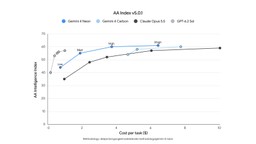
Google released Gemini 4 Neon on November 18, 2026, a mid-tier model it says reaches frontier-level scores at $3 per million input tokens and $15 per million output tokens. Neon is adapted from Gemini 4 Carbon, Google’s most capable model, and sits between Carbon and the faster Hydrogen in a family that has now shipped four models in seven weeks. On Artificial Analysis’s Intelligence Index it scores 61 at its highest thinking setting, one point above Carbon, and Google says it reaches that neighbourhood at 32% lower cost per task than Carbon at its own default setting.

What Google says it built
The model card is unusually short on architecture. Neon is described only as “adapted from Gemini 4 Carbon,” and every technical section of the card — training data, hardware, software — defers to the Carbon card rather than describing anything new. What the card does specify is the interface: text, images, audio and video in; text out; a combined input-output window of one million tokens; up to 64K output tokens in a synchronous response, or up to one million through a background long-decode mode. The knowledge cutoff is March 2026. Four thinking levels — low, medium, high and extra-high — are exposed to API callers, and Google’s benchmark claims are made at different levels rather than one.
The headline comparison is against Anthropic’s Claude Opus 5.5 and OpenAI’s GPT-6.2 Sol, and Google wins most rows of its own table. Neon scores 61 on the Artificial Analysis Intelligence Index against 59 for Opus and 57 for Sol, 70.9% on the Vals Index against 70.1% and 66.1%, and 56.3% on Zapier’s AutomationBench against 42.5% and 41.3%. It also leads on Agents’ Last Exam (75.8%), RiemannBench (84.0%), Terminal-Bench-Science (70.5%), HLE-Diamond (71.3%) and the long-context GraphWalks test (95.2%). The rows where it loses are equally specific: Opus edges it 65.8% to 65.2% on Terminal-Bench 4.1 and 47.3% to 46.2% on FrontierCode 2.0, and Sol leads 75.1% to 73.5% on Chartography, a test of reading dense charts.

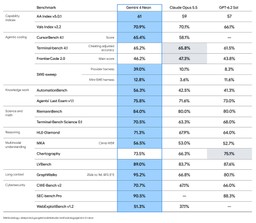
Google’s other claims lean on third-party leaderboards rather than its own harness. It reports first place on the Artificial Analysis Coding Agent Index at 58.6, second on Arena’s new Agent Arena Index at a score of 1336 across 4,200-plus real-world agent sessions, second on steerability in that same index, and first on Andon Labs’ Vending-Bench 2 with $16,843 of simulated business revenue. On the Vals professional-work index it says Neon is second overall and first on both the legal research and tax agent benches.
Where the independent numbers agree, and where they do not
Artificial Analysis has measured the model itself, and its results support the intelligence claim while complicating the speed one. Its model page records the same score of 61 at xhigh, a 95% cache discount on input, and a cost of $6.44 per Intelligence Index task. It also records 56.5 seconds to the first answer token, 21.5 minutes per task against a 12.3-minute median for comparable models, and 283 million output tokens across the index against a median of 65.1 million. On that page’s verbosity ranking the model sits 93rd of 95.
That is not a contradiction of Google’s “fast” framing so much as a different measurement. Google’s speed claim is about streaming throughput once generation starts, and VentureBeat cites a launch-day reading of about 110 tokens per second at xhigh, against roughly 59 for Carbon at high — close to twice the output rate. The waiting happens before the first token arrives. Google’s launch post gives no absolute task completion times, and its clearest speed comparison comes from a customer: “In our early evaluations, it matched or exceeded Gemini 4 Carbon on overall quality at 3x the speed and 60% of the cost,” said Thai Tran, Glean’s AI product lead, in the announcement.
The ranking itself carries a footnote. Google describes Neon as third overall on the Intelligence Index, and VentureBeat reports that Artificial Analysis confirmed that placement on X; the tracker’s own model page currently lists the model sixth of 96, with several effort settings of larger models ahead of it. Both can be true — the index stacks reasoning-effort variants, and the position depends on which ones are counted.

The price is a schedule, not a number
Neon’s rates are $3 per million input tokens, $0.15 per million cached input tokens and $15 per million output tokens. Whether that is cheap depends on the date. Carbon and Argon are on introductory pricing of $2 and $10 through November 30, after which both move to $4 and $20. So through the rest of November Neon costs 50% more per token than Carbon, the model it outscores; from December 1 it costs 25% less. Against Sonnet 5.5 and GPT-6.2 Sol, which are both at $2 and $10, Neon’s headline rates are 50% higher, and VentureBeat’s arithmetic puts the break-even at roughly one-third fewer tokens per task.
Google’s own efficiency claim is per task rather than per token: 32% lower cost per task than Carbon at Neon’s default high setting, and roughly 50% to 80% below top competing frontier models on the Vals and Agent Arena boards. At xhigh, where the score of 61 is earned, Artificial Analysis reportedly measured the advantage over Carbon at high narrowing to about 17%. The difference between those two figures is the whole argument about how to buy a reasoning model.
Which slot it actually takes
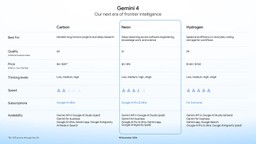
The family hierarchy Google describes — Hydrogen for everyday execution, Carbon for the hardest long-horizon work, Neon in between — is not quite how the product line now works. According to 9to5Google, Neon replaces Argon in the Gemini app’s model picker, the older 3.1 Pro is retired, and the picker collapses to four options: Auto, Everyday help (Hydrogen), Deeper analysis (Neon) and Code and complex work (Carbon). Google DeepMind’s Logan Kilpatrick noted on X that Pro subscribers can select Neon in the app while Carbon requires Ultra, which puts the cheaper of the two frontier-scoring models in the $20 tier.
A separate cyber-tuned build of Neon follows the pattern Google set with Argon and Carbon: it reaches eligible Fairwind Program defenders over the coming days rather than the general API. Google reports 76% on the hard tier of AutoBaxBench, 90.5% on SEC-bench Pro for finding vulnerabilities, 70.7% on CWE-Bench v2 for patching, and 51.3% on WebExploitBench. On the safety side it reports refusing 1.98% of tasks on Terminal-Bench 4.0 and 0% on Terminal-Bench-Science, no cheating on the former, shortcuts on 2.45% of coding tasks, a 0.09% misaligned-action rate, and a 0.0% attack success rate against Gray Swan’s indirect prompt-injection benchmark with safeguards on at the highest thinking level.
Two limits are stated plainly in the card. The full safety and security report is not published yet — it is promised “in the coming days” — and the frontier-safety assessment concluded that Neon’s general capability rose against Argon but stayed below Google’s Material Capability Change threshold, so a full suite of critical capability evaluations was not required.
What This Means
Three weeks ago a score of 61 on this index belonged to a restricted cybersecurity release. It now sits in a $20 consumer subscription and a mid-priced API tier, which is the more consequential fact than the one-point gap over Carbon: the frontier is being repriced faster than it is being extended.
The measurement caveats are worth carrying into any comparison. The same model scored 12.8% on SWE-sweep through a minimal harness and 39.0% through Google’s Antigravity agent — a threefold spread produced entirely by the software around the model. Effort settings change the index score, the token count and the cost per task together, so a single headline number from any vendor, including this one, is a claim about a configuration. For a lab or a classroom deciding what to run, the useful questions are how many tokens a task actually consumes and how long a person waits for the first one.
This post was drafted with AI assistance and reviewed by RITS staff.
Sources
- Introducing Gemini 4 Neon, Google, November 18, 2026
- Gemini 4 Neon model card, Google DeepMind, November 18, 2026
- Gemini 4 Neon: Intelligence, Performance & Price Analysis, Artificial Analysis
- Artificial Analysis Coding Agent Benchmarks
- Google launches Gemini 4 Neon with Opus 5.5-level coding performance at 25% lower API token prices, VentureBeat, November 18, 2026
- Google launches Gemini 4 Neon with Carbon quality at Flash speeds, live for AI Pro, 9to5Google, November 18, 2026




 沪公网安备31011502017015号