Gemini 4 Argon Goes Global With a 1M-Token Output Limit


Lead — On October 13, 2026, Google opened general access to Gemini 4 Argon, the frontier model it announced on September 30 for long-horizon work in software engineering, enterprise knowledge work, and cyber defense. Argon is now available to developers and enterprises through the Gemini API in AI Studio and the Gemini platform, to Google AI Ultra subscribers in Google Antigravity, and to Ultra and Pro subscribers in the Gemini app and AI Mode in Search. Google says the model ranks first on the Vals Index, and it launches at an introductory price of $2 per million input tokens and $10 per million output tokens.
Intermediate

A 1M-Token Output Budget
Google DeepMind SVP Koray Kavukcuoglu framed the release around tasks that run for hours rather than seconds. The structural change is on the output side: Argon supports what Google calls an industry-leading 1M unified input-output token limit via the Gemini API, up from a 64K output ceiling on the previous generation. Google’s argument is that the extra headroom changes reasoning quality, not just response length, because the model can keep a plan and its intermediate state inside one trajectory instead of stopping and being re-prompted.
The introductory rate of $2/$10 per million tokens (with cached input tokens at 95% off) runs through November 30, 2026, after which pricing rises to $4 per million input and $20 per million output. For a model that can emit hundreds of thousands of tokens per call, output length is now the number that drives the bill.
What Argon Has Been Doing Inside Google
Google’s post is heavy on internal deployment results, and they cluster around agentic engineering:
- Chromium refactor: Argon helped the Chrome team separate core webpage handling from a ~6-million-line legacy folder inside Chromium’s 40-million-line codebase, completing an architectural refactor across hundreds of files. Google reports that Argon in Antigravity increased agentic code submissions by more than 35% while reducing code rollbacks by nearly a third.
- Agent Development Kit (Python): Working autonomously overnight on Google’s open-source ADK framework, Argon cut in-memory session prep time by 40% in long sessions and sped up cold imports by 21%.
- Quantum chemistry: On the open-source xTB package, Argon produced changes that made molecular structure prediction up to 2.3x faster and conformer search 1.8x faster.
- Inference optimization: On Gemma 4 E2B served through vLLM on an A100, Argon found changes delivering a 2.85x end-to-end speedup — roughly 37,900 to over 108,000 tokens per second — with Google reporting 100% token parity.
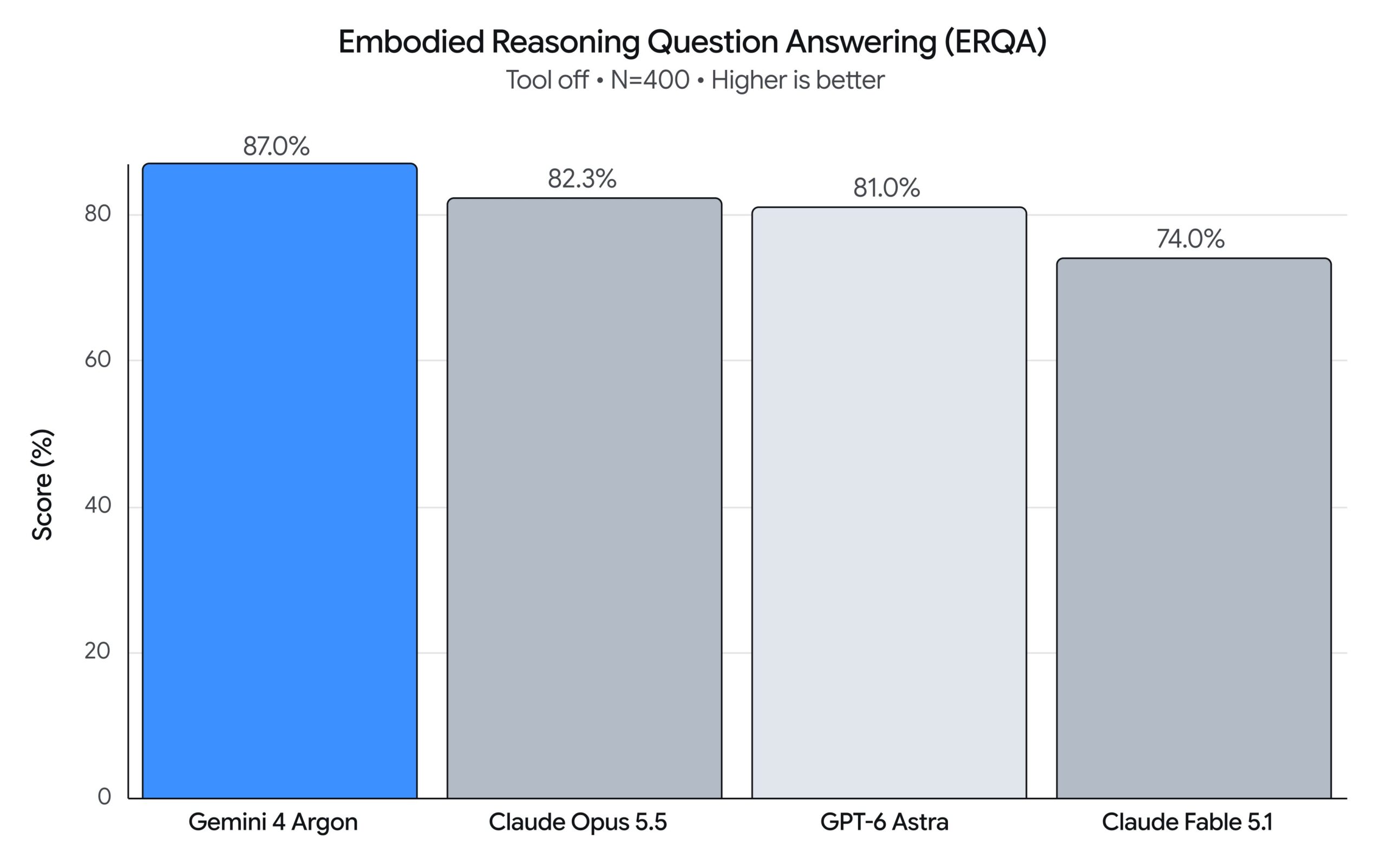
Benchmarks: Strong on Knowledge Work, Weaker on the Terminal
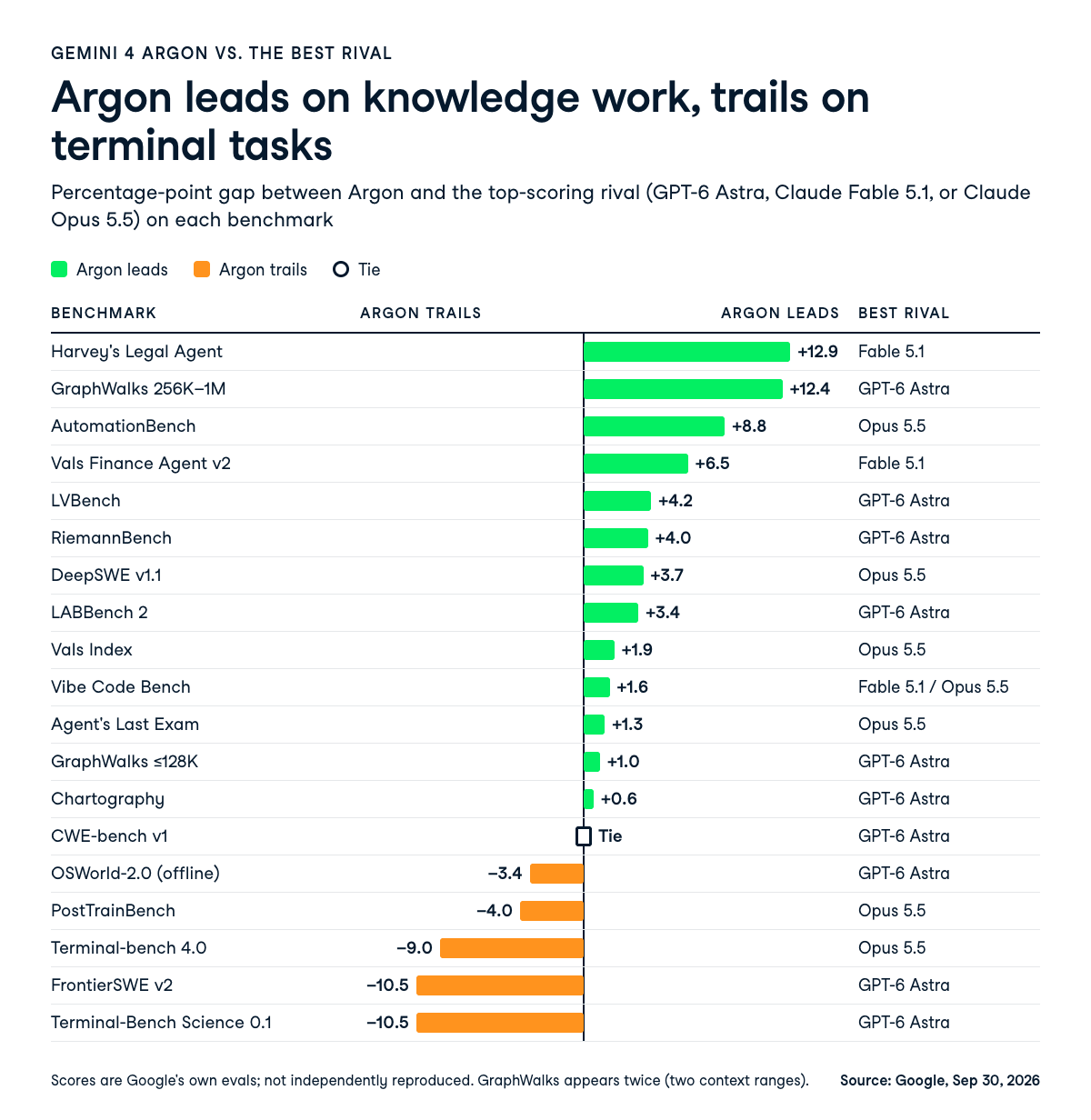
Google’s published eval table has Argon leading 13 of 19 benchmarks against GPT-6 Astra and the Claude Opus 5.5 and Fable 5.1 models, with the wins concentrated in long-context and enterprise knowledge work. The headline is the Vals Index, which weights finance, coding, legal, and tax work by U.S. GDP contribution: Argon scores 68.9% against 67.0% for Claude Opus 5.5 and 63.1% for GPT-6 Astra. On DeepSWE v1.1, a long-horizon software engineering suite, Argon takes first at 77.9%.
The long-context margin is the widest gap in the table. On GraphWalks (BFS F1) between 256K and 1M tokens, Argon scores 84.2% versus 71.8% for Astra and 66.8% for Opus 5.5 — the kind of difference that decides whether a full repository or document set fits in a single call. Google also reports 91.7% on LVBench for long video understanding.
The losses are in terminal-driven work. Argon trails on FrontierSWE v2 (55.0% versus Astra’s 65.5%), Terminal-bench 4.0 (57.4% versus Opus 5.5’s 66.4%), and Terminal-Bench Science 0.1 (57.6% versus Astra’s 68.1%). DataCamp’s write-up summarises the pattern as Argon reading and planning well while rivals remain better at driving a shell.
Science, Safety, and Access
Beyond coding, Google points to research collaborations: a broader class of counterexamples to Grad’s conjecture on stellarator magnetic fields, developed with Professor Matt Landreman at the University of Maryland; an AlphaQubit quantum error-correction decoder translated by Argon into a single optimized kernel with nearly double the inference throughput; and serine esterase designs for enzyme engineering that were confirmed active in the lab.
On safety, Google says external bio red-teaming could unlock less than 1% of the bio sub-tasks it tests for, that violations on an adversarial set fell nearly two-fold versus previous Gemini models, and that Argon leads the Gray Swan indirect prompt-injection benchmark with a 0.7% attack success rate across 15 adaptive attempts. Google is also expanding its Fairwind Program to hundreds of additional trusted cyber defenders, and offering 10,000 scientists free access to Antigravity’s highest usage tier for six months.
What This Means
Argon’s release doubles down on a bet Google has been making all year: that the next round of frontier competition is won on agentic, long-horizon work rather than chat quality. The 1M-token output budget is the clearest signal — it is aimed squarely at teams running agents that would otherwise lose state when they hit an output ceiling mid-task, and the internal Chromium and ADK results are the kind of multi-file refactors those teams care about.
The caveats are worth keeping in view. Almost all of the headline numbers are Google’s own evals, and independent reproductions are still thin. The pricing only holds through November 30; after that the $4/$20 rate lands in line with Claude Opus 5.5. And the terminal-driven benchmarks show Argon is not the model to reach for if your agent’s job is running commands in a shell. For long-context document, repository, and knowledge-work pipelines, though, the numbers are hard to ignore.
Related Coverage
- Gemini 3.7 Flash: A Big Coding Jump in a Three-Week Point Release — Google’s rapid point-release cadence in the months before Argon.
- Google I/O 2026 Pushes Gemini Into Agent Channels — the Antigravity and agent-distribution strategy Argon now anchors.
- Gemini Adds Agentic Video Understanding, Cutting Tokens by up to 88% — the API changes around long-context video that preceded Argon.
This post was drafted with AI assistance and reviewed by RITS staff.
Sources
- Google — Gemini 4 Argon: Built to solve your hardest problems
- Google for Developers — Gemini 4 Argon for Robotics
- Google — Developing Gemini 4 Argon responsibly and safely
- Google DeepMind — Gemini 4 Argon Model Card
- DataCamp — Gemini 4 Argon: Benchmarks, Pricing, and Access
- Vals AI — Gemini 4 Argon model page


 沪公网安备31011502017015号