Claude Fable 5.1 Arrives: Flat Token Pricing, 75% Cheaper Cache Reads


Anthropic released Claude Fable 5.1 on September 1, 2026, alongside a restricted-access sibling, Claude Mythos 5.1. Per-token pricing is unchanged from Fable 5 — $10 per million input tokens, $50 per million output — but cache reads dropped from $1.00 to $0.25 per million tokens, a 75% cut that Anthropic estimates reduces typical workload costs by about 25% and highly agentic workloads by up to 45%. For anyone running long tool-use loops, that is the more consequential number on the page.
Intermediate


Two Models, One Set of Weights
Fable 5.1 and Mythos 5.1 are, in Anthropic’s description, “the same model, but with different levels of safeguards.” Fable 5.1 is generally available on the Claude API (model ID claude-fable-5-1) and through AWS, Google Cloud, and Microsoft Azure. Mythos 5.1 is gated behind two trusted-access programs — a Cyber Verification Program for defensive security work and a new Life Sciences Verification Program run in partnership with the U.S. government — and is currently limited to selected U.S. organisations.
Both carry a 1 million-token context window and a 128,000-token output ceiling. Thinking is always on and cannot be disabled; depth is set through five effort levels — low through max — with high the default inside Claude Code and medium elsewhere.
Benchmarks
Anthropic’s published comparisons put Fable 5.1 ahead of Fable 5, Opus 5, and OpenAI’s GPT-5.6 Sol across most reported evaluations. The gaps are widest on the agentic and scientific suites:
- Terminal-Bench-Science 0.1 — Fable 5.1 52.6%, versus Fable 5 at 24.7%, Opus 5 at 29.0%, and GPT-5.6 Sol at 22.4%. Roughly a doubling over its predecessor.
- Terminal-Bench 4.0 (agentic coding) — Fable 5.1 55.8%, Fable 5 42.0%, Opus 5 52.3%, GPT-5.6 Sol 37.3%. Mythos 5.1, with lighter safeguards, reports 60.9%.
- AutomationBench — Fable 5.1 31.4%, nearly double Fable 5’s 17.1%.
- Humanity’s Last Exam — 60.9% without tools, 65.0% with, against 57.8% and 63.8% for Fable 5.
- CursorBench 3.2.0 — 73.4%, a more modest step up from Fable 5’s 70.5%.
The pattern is worth noting: incremental gains on single-shot coding benchmarks, large gains on the long-horizon agentic ones. Anthropic also reports that Fable 5.1 matches or beats Fable 5 at low and medium effort — which, combined with the cache-read cut, is where the cost claims come from.
A Concrete Result: Remapping Venus
The most legible of Anthropic’s published scientific applications is a reprocessing of NASA Magellan radar data. From the mission’s coarse altimetry, the model derived a digital elevation model improving horizontal resolution from 10–20 km to 2–3 km, with height accuracy up to 25% better.
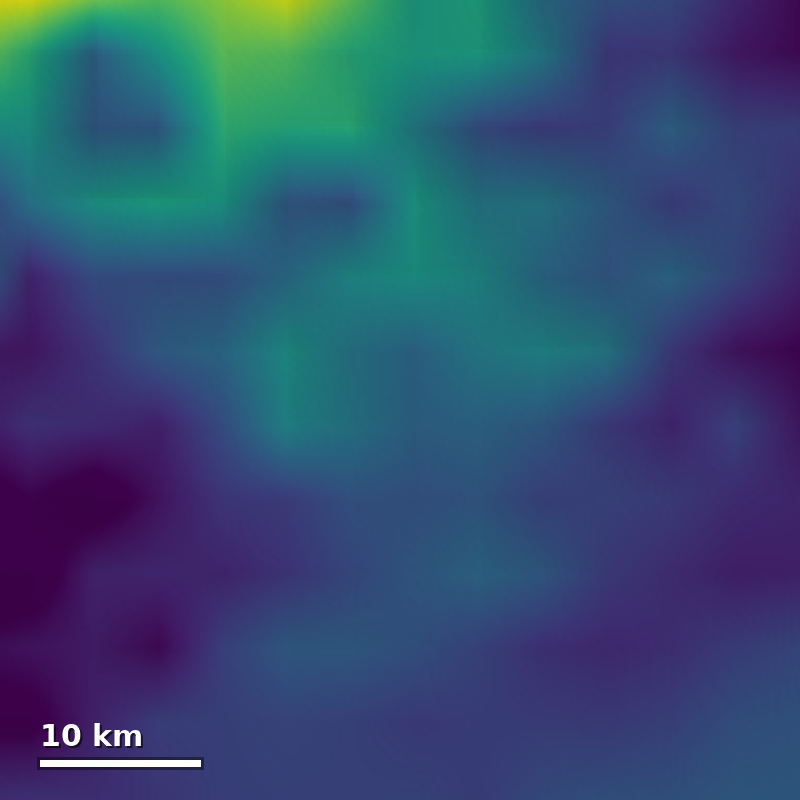
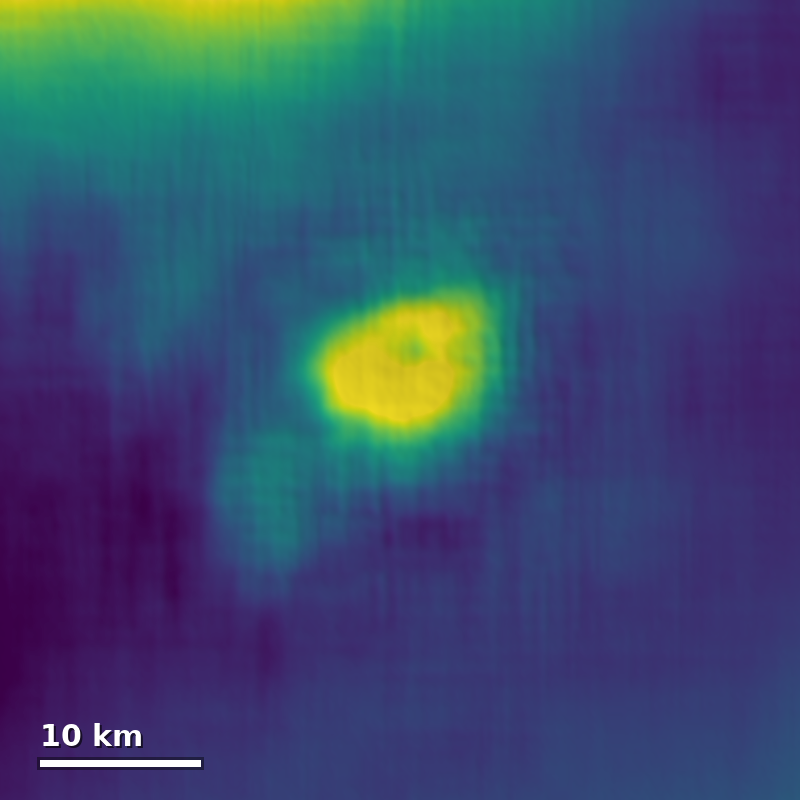
Other reported results — a molecular design hit rate of nearly 50% across 12 targets against a stated 10–15% baseline, GPU kernels up to 2.5× faster — are harder to situate independently. These are vendor figures from a launch announcement, not peer-reviewed results.
What Changed for Developers
Fable 5.1 is not a drop-in replacement for Fable 5. Three behaviours changed, and two of them will surface as HTTP 400s rather than degraded output:
- Forced tool use is gone.
tool_choicevalues ofanyandtoolnow return a 400. The replacements areautoplus an explicit instruction naming the tool,strict: truefor schema-valid arguments, or structured outputs when the forced call only existed to get JSON back. - Thinking blocks are bound to the model that produced them. Other models drop them silently and unbilled; Mythos 5.1 reads them.
- “Preserved thinking” restricts editing earlier turns. Accounts created on or after August 31, 2026 receive a 400 when replaying thinking blocks against an edited history — a distillation protection that effectively requires harnesses to be append-only.
Also new: per-message effort changes that don’t reset the prompt cache, turn-scoped system messages, and a display: "updates" mode that surfaces between-tool-call progress notes without exposing the reasoning itself.
On safeguards, Anthropic reports Claude Code users should see roughly 60% fewer cybersecurity interventions per session than under Fable 5 — vulnerability discovery is permitted, exploit development is not — and that biology safeguards fire 85% less often on benign queries. Both models watermark their text output, with a detection API entering private preview for regulators, researchers, and civil society groups in the EU.
What This Means
The headline capability gains are real but incremental on the benchmarks most readers will recognise. The structural change is the cache-read price. At $0.25 per million tokens, re-reading a large cached context — the dominant cost in any agentic loop that resends its history every turn — is now four times cheaper, and Cognition has said it is moving Devin’s Opus 5 traffic to Fable 5.1 on launch day partly on that basis. A frontier-tier model becomes economical for workloads that previously had to run on a cheaper tier.
The caveats are familiar. Every benchmark above is self-reported, on suites the vendor selected. Fable 5.1 remains a Covered Model — organisations under zero data retention cannot use it without express authorisation from Anthropic, and it is excluded from Priority Tier. And the Fable/Mythos split means the strongest reported agentic scores belong to a model most institutions cannot access.
Related Coverage
- Anthropic Launches Claude Fable 5, Its First Public Mythos-Class Model — the June 2026 release this iterates on
- Anthropic Redeploys Claude Fable 5 as U.S. Lifts Export Controls — the three-week outage that followed
- Anthropic Watermarks All Claude Text Output Worldwide — the watermarking scheme Fable 5.1 inherits
- Anthropic Launches Claude Sonnet 5, Closing the Gap With Opus — the mid-tier alternative
This post was drafted with AI assistance and reviewed by RITS staff.
Sources
- Introducing Claude Fable 5.1 and Claude Mythos 5.1 — Anthropic, September 1, 2026
- System Card: Claude Fable 5.1 & Claude Mythos 5.1 — Anthropic, September 1, 2026
- Models overview — Claude Platform Docs
- Pricing — Claude Platform Docs
- Anthropic Releases Claude Fable 5.1 and Mythos 5.1 — Thurrott.com, September 1, 2026
- Anthropic Launches Claude Fable 5.1 With Lower Costs and Fewer False Positives — MacRumors, September 1, 2026


 沪公网安备31011502017015号