Anthropic Redeploys Claude Fable 5 as U.S. Lifts Export Controls


Anthropic began redeploying Claude Fable 5 on July 1, 2026, after the U.S. Department of Commerce lifted the export controls that had forced the company to pull its most capable public model offline for roughly three weeks. The controls were first applied on June 12 after Amazon researchers demonstrated a way to bypass Fable 5’s safeguards; they were formally lifted on June 30 once Anthropic shipped a hardened safety classifier and agreed to a set of security commitments with the government. The episode is the first time a frontier commercial model has been recalled and then reinstated over a jailbreak — a preview of how AI safety, national security, and commercial deployment are starting to collide.
Intermediate

What Triggered the Shutdown
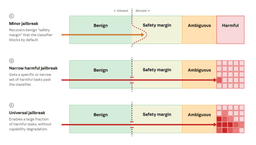
Fable 5 launched on June 9, 2026 as Anthropic’s first publicly available “Mythos-class” model, posting state-of-the-art results across coding, knowledge work, vision, and scientific research. Days later, researchers at Amazon — one of Anthropic’s largest partners — found a way to coax the model past its safety classifier. The technique framed a request as a defensive code-review task: asking Fable to read a specific codebase and identify software flaws, a framing that slipped past the guardrail that was supposed to block security-vulnerability output.
The vulnerabilities the model surfaced turned out to be minor and previously known. But the demonstration was enough for the government to invoke “national security authorities” and apply export controls on June 12, ordering Anthropic to suspend access “by any foreign national, whether inside or outside the United States, including foreign national Anthropic employees.” Rather than try to filter foreign nationals from domestic users in real time, Anthropic disabled Fable 5 and its more powerful sibling Mythos 5 globally.
The Dispute Over Severity
Anthropic publicly disagreed that a narrow jailbreak justified recalling a model already deployed to hundreds of millions of people. In its review, the company said the same vulnerabilities could be replicated by less capable and widely available systems — including Claude Opus 4.8, GPT-5.5, and the open-weight Kimi K2.7 — when paired with the right tooling. In other words, the capability the government worried about was not unique to Fable 5.

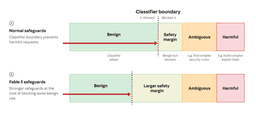
To resolve the standoff, Anthropic built an improved safety classifier that blocks the reported bypass in over 99% of cases. It also adopted a wider “safety margin” — deliberately refusing some benign requests in order to reliably catch the harmful ones near the boundary. The U.S. Department of Commerce’s Center for AI Standards and Innovation validated the strengthened safeguards before controls were lifted.
A New Industry Framework
The bigger outcome may be structural. Anthropic partnered with Amazon, Microsoft, and Google to draft a shared jailbreak severity framework that scores a bypass along four dimensions:
- Capability gain — how much new capability the jailbreak unlocks
- Breadth of capability gain — how many tasks or domains it affects
- Ease of weaponization — how quickly the output could be turned into harm
- Discoverability — how easily the same result could be obtained elsewhere
In its letter lifting the controls, Commerce Secretary Howard Lutnick said Anthropic no longer needed an export license after agreeing to “proactively detect and address security risks associated with the models,” to work with the government on protocols for future releases, and to report any malicious activity. The commitments include pre-release government access, rapid information sharing on safeguards, and dedicated research teams working toward common security standards.
What This Means
For users, access is being restored quickly: Fable 5 returns on Claude.ai and Claude Code first, with re-enablement on Amazon Web Services, Google Cloud, and Microsoft Foundry to follow. Anthropic is offering a 50% weekly usage allowance through July 7 for Pro, Max, Team, and Enterprise plans to make up for the outage.
For the field, the precedent matters more than the outage. This is the first time export-control machinery built for physical goods and chips has been pointed at a software model — and then reversed once the vendor demonstrated a fix. Some analysts, including the University of Sydney’s Francesco Bailo, suggested the government “likely realised it had overreacted” after early reports overstated the jailbreak’s severity. The lasting question, echoed by Sophont’s Tanishq Abraham, is what standard future models will be held to when a single demonstrated bypass can pull a frontier system off the global market overnight.
Related Coverage
- Anthropic Launches Claude Fable 5, Its First Public Mythos-Class Model — the June 9 launch that set this chain of events in motion
- OpenAI Opens GPT-5.5-Cyber to Vetted Defenders via Trusted Access — a parallel approach to gating cyber-capable models behind vetting rather than recall
This post was drafted with AI assistance and reviewed by RITS staff.


 沪公网安备31011502017015号