Anthropic Launches Claude Fable 5, Its First Public Mythos-Class Model


Anthropic released Claude Fable 5 on June 9, 2026 — its most capable widely released model and the first time the public can access a “Mythos-class” system that the company had previously kept behind closed doors. Fable 5 posts state-of-the-art results across coding, knowledge work, vision, and scientific research, but ships with a new layer of safety classifiers that quietly route the riskiest requests to an older, safer model.
Intermediate


Fable and Mythos: Same Brain, Different Guardrails
Fable 5 and its sibling Claude Mythos 5 share the same underlying model. The difference is entirely in the safeguards. Mythos 5 — the successor to the “Mythos Preview” that Anthropic had restricted to roughly 150 vetted organizations — runs without certain safety classifiers and remains in limited release through Anthropic’s Project Glasswing for approved cybersecurity and, later, biology partners. Fable 5 is the version anyone can use: the same capabilities, wrapped in classifiers that detect potential misuse.
Both models carry the API IDs claude-fable-5 and claude-mythos-5, support a 1M-token context window by default, and can return up to 128k output tokens per request. Pricing is $10 per million input tokens and $50 per million output tokens — roughly double Claude Opus 4.8, and described by Anthropic as less than half the price of the earlier Mythos Preview.
Benchmarks: A Step Up, Especially on Hard Tasks
Anthropic reports that Fable 5 is state-of-the-art on nearly every capability benchmark it tested, with the gap over rivals widening as tasks get longer and more complex. It scores 80.3% on SWE-Bench-Pro agentic coding (versus 69.2% for Opus 4.8 and 58.6% for GPT-5.5), 88.0% on Terminal Bench 2.1, and is the first model to break 90% on a core analytics benchmark — a 10-point jump over Opus 4.8.

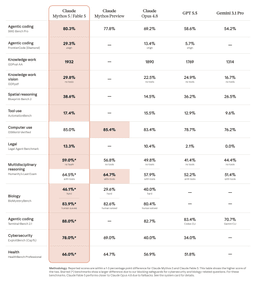
The headline numbers are backed by concrete demonstrations. Anthropic says Stripe used the model to perform a codebase-wide migration across 50 million lines of Ruby in a single day — work the company estimated would have taken a full team more than two months by hand. In other tests, the model completed Pokémon FireRed using vision only (no helper harness), and internal drug-design experts reported accelerating parts of their workflow roughly 10x.
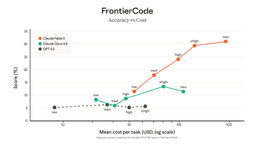
On Anthropic’s FrontierCode evaluation — a set of especially difficult coding problems — Fable 5 not only scores higher than Opus 4.8 and GPT-5.5 but keeps climbing as you spend more on reasoning effort, where the older models plateau.
The Safeguards: Refusals and Fallback
What makes Fable 5 unusual is how it handles dangerous requests. New AI classifiers watch for misuse in three areas — offensive cybersecurity, dangerous biology and chemistry, and model distillation (attempts to extract Fable’s capabilities to train a competitor). When a classifier fires, the request is declined or quietly served by Claude Opus 4.8 instead. Anthropic says this fallback triggers in under 5% of sessions on average.
For developers, this changes the API contract. A refused request returns stop_reason: "refusal" as a successful HTTP 200 response — not an error — and names which classifier declined it. You are not billed for a refusal before any output is generated, and a new fallbacks parameter (in beta) can automatically retry on another model. The models also run “adaptive thinking” as their only reasoning mode, and never return raw chain-of-thought — only optional summarized thinking.
On robustness, Anthropic reports an external bug-bounty effort found no universal jailbreaks across more than 1,000 hours of testing, though it notes the UK AI Safety Institute made progress toward one within its initial testing window.
What This Means
The launch lands days after Anthropic publicly warned that frontier AI is becoming dangerous enough to demand new safeguards — and Fable 5 is, in effect, that argument made into a product. Rather than hold a top-tier model back entirely, Anthropic is shipping it with an automated tripwire that hands sensitive queries to a weaker model. Whether that 5% fallback rate is the right tradeoff between capability and safety will be tested in the wild now that the model is generally available on the Claude API, Amazon Bedrock, Vertex AI, and Microsoft Foundry.
For NYU Shanghai’s developers and researchers, the practical takeaways are concrete: a 1M-token context window and strong long-horizon agentic performance make Fable 5 attractive for large migrations and multi-day autonomous tasks — but the doubled price and the possibility of silent fallback to Opus 4.8 are worth planning around. The models also carry a mandatory 30-day data retention policy and are not available under zero-data-retention terms.
Related Coverage
- Anthropic Releases Claude Opus 4.8 for Longer Agentic Coding — the model Fable 5 now sits above, and the one it falls back to on flagged requests
- Anthropic Ships Agent View: A Multi-Session Dashboard for Claude Code — tooling for the multi-session agentic workflows Fable 5 targets
This post was drafted with AI assistance and reviewed by RITS staff.


 沪公网安备31011502017015号