Anthropic Watermarks All Claude Text Output Worldwide


Anthropic announced on August 11, 2026 that every Claude model will embed an invisible, machine-readable watermark in the text it generates — applied at the model level, active worldwide, with no user opt-out. Files that Claude produces in supported formats (.svg, .png, .jpg) additionally carry digitally signed provenance metadata following the C2PA standard. Models launched on or after August 2, 2026 support marking from release; earlier models are being transitioned. The detection tooling that would let anyone outside Anthropic actually read these marks has been promised but not yet shipped.
Advanced

What Anthropic Shipped
The system is two separate mechanisms, not one. Text gets a statistical watermark baked into the sampling process itself. Files get C2PA metadata — a cryptographically signed manifest recording the asset’s origin and edit history, the same industry standard already used for AI-generated imagery.
The text watermark is the more consequential half, because it is the one that survives the clipboard. Anthropic’s help-centre documentation puts it plainly:
“Because the watermark is part of the text, it will travel with the text when it’s copied and pasted elsewhere, and may persist through some editing. Watermarking will be applied at the model level, which means it will be present no matter which Claude product or surface the text comes from.”
“Model level” is doing real work in that sentence. Coverage spans the Claude Platform API, claude.ai, Claude Code, Claude Cowork, and Claude Tag, and extends to Claude models served through AWS, Google Cloud, and Microsoft Foundry — subject to per-platform limits on metadata support. There is no surface where a developer can turn it off.
Anthropic describes the change as meeting transparency obligations under Article 50 of the EU AI Act, whose rules apply from August 2, 2026. The associated Code of Practice on Transparency of AI-Generated Content operationalises the Article 50(2) marking duty on providers and the Article 50(4) labelling duty on deployers; the European Commission and the AI Board concluded on July 8 and 9, 2026 respectively that the Code is adequate for demonstrating compliance with those obligations. Anthropic is applying the marking globally rather than only within the EU.
How Text Watermarking Works
Anthropic has not published the details of its scheme. The closest documented production system is Google DeepMind’s SynthID-Text, described in Nature in 2024, and it is a reasonable reference point for the class of technique.
A generative watermark has three parts: a seed generator, a modified sampling algorithm, and a scoring function. In SynthID-Text, the seed is a hash of the last H = 4 tokens together with a secret watermarking key. At each step the system draws 2m = 8 candidate tokens from the model’s own distribution and runs them through a multi-layer single-elimination tournament, where each pairwise match is decided by a key-derived g-value. Tokens that win consistently see their sampling probability boosted exponentially. Spread across enough layers, the bias is statistically detectable while leaving text quality essentially unchanged.

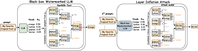
Detection reverses the process: given the text and the key, a scoring function measures how strongly the token sequence correlates with the expected tournament outcomes, and compares that score against a threshold. This is why passage length matters so much — statistical detection needs on the order of 100+ tokens before the score separates from noise. A three-sentence email reply simply does not carry enough signal.
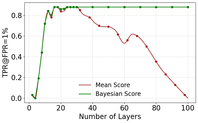
The scheme is also attackable. A 2026 analysis paper demonstrates a “layer inflation” attack that appends extra tournament layers with attacker-chosen g-values. Under mean scoring, true-positive rate at a 1% false-positive rate peaks near 0.88 around 25 layers and then collapses toward zero by 100 layers; Bayesian scoring holds at roughly 0.88 across the range.

What This Means
The limitation Anthropic states most clearly is the one most likely to be misread in practice: a mark means the text may have been processed by Claude, not that Claude authored it. Draft an essay yourself, ask Claude to tighten the prose or fix the grammar, and the output carries the mark — even though the substance is yours. Anthropic further notes that heavy editing, paraphrasing, translation, format conversion, and screenshots can all strip the signal entirely.
That gives two symmetric failure modes. A mark found does not establish that an AI wrote something; a mark absent does not establish that a human did. Any workflow that treats the presence or absence of a watermark as a verdict — an academic-integrity process, a hiring screen, a journal submission check — is reading a probabilistic signal as proof.
The verification gap compounds this. Until Anthropic ships and documents the detector, no external party can independently measure the false-positive rate or check whether it varies across writing populations. That question is not hypothetical: a Stanford study published in Patterns found that an earlier generation of AI-text detectors falsely flagged more than half of essays written by non-native English speakers. Watermarking is a fundamentally different and stronger technique than those stylometric classifiers, but the point stands that error rates need to be published and audited before institutions build policy on top of them.
Reaction from users has been mixed. Forbes reported pushback from writers who use Claude for proofreading rather than drafting — among them blogger Erick Erickson, who wrote: “I had ditched Grammarly for Claude for proofreading because it does a better job. But now the stuff I’ve written will be watermarked.”
Related Coverage
- Anthropic Launches Claude Sonnet 5, Closing the Gap With Opus — the mid-tier model line now covered by model-level marking
- Anthropic Redeploys Claude Fable 5 as U.S. Lifts Export Controls — an earlier instance of regulation reshaping Claude availability
- Anthropic Launches Claude Tag, an AI Teammate That Lives in Slack — one of the surfaces the watermark now covers
This post was drafted with AI assistance and reviewed by RITS staff.
Sources
- How Claude marks AI-generated content — Claude Help Center
- Anthropic says it will watermark text generated by its AI models — TechCrunch, August 11, 2026
- Anthropic watermarks all Claude outputs globally — The Decoder
- Claude Will Put Invisible Watermarks On AI Text And Images — Forbes, August 11, 2026
- Scalable watermarking for identifying large language model outputs — Nature, 2024 (SynthID-Text)
- On Google’s SynthID-Text LLM Watermarking System: Theoretical Analysis and Empirical Validation — Omidi, Dong & Wang, arXiv:2603.03410, March 2026
- Code of Practice on Transparency of AI-generated Content — European Commission
- The EU AI Act’s Transparency Rules: A Practical Guide to Article 50


 沪公网安备31011502017015号