Anthropic Launches Claude Sonnet 5, Closing the Gap With Opus


Anthropic released Claude Sonnet 5 on June 30, 2026 — its “most agentic Sonnet model yet,” bringing performance close to the flagship Opus 4.8 while running at a fraction of the cost. The mid-tier model posts large gains over Sonnet 4.6 in coding, reasoning, tool use, and knowledge work, and ships with introductory pricing of $2 per million input tokens through August 31. It is now the default model for Free and Pro plans and is available across the Claude apps, Claude Code, and the API.
Intermediate


Near-Opus Performance at Mid-Tier Cost
The headline of this release is the shrinking gap between the Sonnet and Opus tiers. On agentic coding (SWE-bench Pro), Sonnet 5 scores 63.2% — up sharply from Sonnet 4.6’s 58.1% and closing in on Opus 4.8’s 69.2%. On Terminal-Bench 2.1 it jumps to 80.4% (from 67.0%), landing just behind Opus 4.8’s 82.7%. On knowledge work (GDPval-AA v2), Sonnet 5 actually edges out the flagship, scoring 1,618 to Opus 4.8’s 1,615 and Sonnet 4.6’s 1,395.

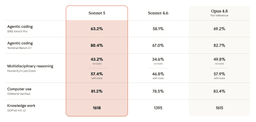
The gains extend to reasoning and computer control. On Humanity’s Last Exam, Sonnet 5 reaches 43.2% without tools and 57.4% with tools — nearly matching Opus 4.8’s 57.9% tool-assisted result and far ahead of Sonnet 4.6’s 46.8%. On OSWorld-Verified, a computer-use benchmark, it scores 81.2%, up from 78.5%.
Built for Agents That Run on Their Own
Anthropic frames Sonnet 5 as an execution engine for autonomous agents. “It can make plans, use tools like browsers and terminals, and run autonomously at a level that, just a few months ago, required larger and more expensive models,” the company wrote. The model completes complex multi-part tasks end-to-end and self-checks its own outputs without being explicitly prompted to do so.
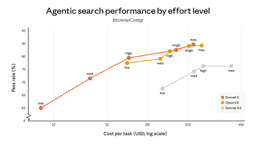
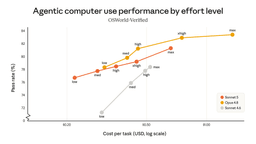
Where Sonnet 5 stands out is the cost-performance curve. Because agentic workloads run the model many times over, price per task matters as much as raw capability. The charts below show Sonnet 5 delivering Opus-tier pass rates at a lower cost per task across effort levels — for many agentic search and computer-use workloads, it sits on or near the Pareto frontier.
Pricing and Safety
Sonnet 5 launches with introductory pricing of $2 per million input tokens and $10 per million output tokens through August 31, 2026, after which standard rates of $3 and $15 take effect. Even at standard pricing, it undercuts Opus 4.8 ($5 / $25) while roughly matching Sonnet 4.6’s old price point. The model supports a 1M-token context window.
On safety, Anthropic reports that Sonnet 5 exhibits lower rates of undesirable behaviors than Sonnet 4.6 — it refuses malicious requests more cleanly, resists prompt-injection attacks better, and hallucinates and sycophants less often. Notably, it is deliberately less capable than the Opus line at dangerous cybersecurity tasks, and ships with cyber safeguards enabled by default.
What This Means
Sonnet 5 continues the pattern established by Sonnet 4.5 and 4.6: the mid-tier model keeps absorbing capabilities that used to be exclusive to the flagship. For developers building agentic workflows, coding assistants, and long-running automation, the practical takeaway is that the default choice for most production traffic can now be the cheaper model without a meaningful quality tradeoff — reserving Opus 4.8 for the hardest tasks. With the introductory pricing running through the end of August, the cost gap is even wider in the near term.
Related Coverage
- Introducing Claude Sonnet 4.6: Flagship Performance at Mid-Tier Cost — the previous Sonnet release, February 2026
- Anthropic Releases Claude Opus 4.8 for Longer Agentic Coding — the flagship Sonnet 5 is benchmarked against
- Introducing Claude Sonnet 4.5 — where the modern Sonnet line began
This post was drafted with AI assistance and reviewed by RITS staff.


 沪公网安备31011502017015号