Qwen-Image-3.0: 4.5k-Token Prompts, No Benchmarks, No Weights


Alibaba’s Qwen team launched Qwen-Image-3.0 on July 21, 2026 — the third generation of its image-generation model, built around a single claim: that generated images can now be useful, not just good-looking. The headline capability is a jump to 4.5k-token prompts, roughly 4.5× the instruction length its predecessors accepted, which the team says lets the model compose newspaper pages, 3×3 infographic grids, and nested UI mockups in a single forward pass. What the launch did not include is equally notable: no benchmark table, no parameter count, no technical report, and no downloadable weights.
Intermediate

Three Claims, One Keyword
The Qwen team frames each generation of the series around a keyword. Qwen-Image-1.0 was “Precision.” Qwen-Image-2.0 added “Variety, Completeness, Beauty, and Authenticity.” Qwen-Image-3.0 reduces the pitch to one word — Real (实) — broken into three dimensions:
- Rich Content — up to 4.5k tokens of instruction, enough to specify newspaper layouts, storyboards, and exam papers in one prompt.
- Authentic Details — text rendered legibly at roughly 10 pixels, plus micro-textures like skin pores and individual hair strands.
- Deep Knowledge — native rendering across 12 languages and 20+ fonts, 100+ artistic styles, simulated web/game/livestream interfaces, and the ability to pull live data from the internet.
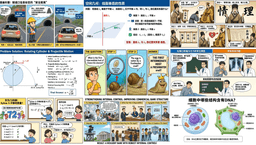
The flagship demonstration is a 3×3 grid in which every cell is a distinct, dense infographic — a tunnel-safety comic, a spatial geometry lesson, projectile-motion physics, a parasitology explainer, the Sylow theorems from group theory, a bank internal-control diagram, and more. Describing the full grid, the team says, consumed 3.7k tokens of the 4.5k budget, and the image was produced in a single pass rather than stitched from nine generations.

Horizontal Breadth and Vertical Depth
Qwen distinguishes two axes of layout difficulty. Horizontal expansion — the grid above — tests “semantic juxtaposition”: how many parallel concepts the model can place on one canvas without them bleeding into each other. Vertical depth tests logical nesting.
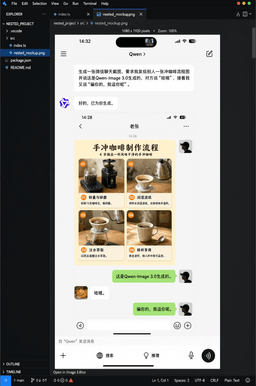
The nesting demo renders, from outer to inner, a VSCode window containing a Qwen Chat interface containing a WeChat window containing a pour-over coffee poster — each layer keeping the authentic visual style of the software it imitates. It is a picture-in-picture-in-picture stress test for whether a diffusion model can hold a hierarchy of contexts in mind at once.

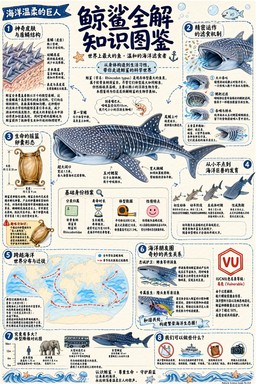
For small-text fidelity, the team points to a generated page of an algebraic-geometry paper — multi-line LaTeX derivations with superscripts, subscripts, Greek letters, fraction bars and aligned equations — alongside a whale-shark knowledge infographic packed with labeled illustrations. Academic typesetting is a reasonable ultimate test here: a single wrong glyph in a formula is immediately visible in a way a slightly-off tree branch never is.

The Missing Half of the Release
Every claim above comes from Alibaba’s own announcement and its own curated examples. The launch shipped without a benchmark score, model card, parameter count, license, or technical report — a clear break from the series’ history. Qwen-Image-1.0 arrived in August 2025 with Apache 2.0 open weights and a same-day technical report; Qwen-Image-2.0 published a technical report but, as of this launch, its weights have still never shipped. Qwen-Image-3.0 is available only through Qwen Chat, with no public API at announcement time.
That fits a broader pattern. Alibaba’s shift began in September 2025 when Qwen3-Max became its first major model to launch without open weights, and frontier releases have largely stayed behind the API since — an awkward turn for the family that became the most-downloaded on Hugging Face by January 2026. For context on where the previous generation actually landed: by Alibaba’s own Qwen-Image-Bench evaluation, Qwen-Image-2.0 Pro placed fifth, behind OpenAI’s GPT Image 2 and GPT Image 1.5 and Google’s Nano Banana models.
Early hands-on reactions have been mixed. Users testing the model through Qwen Chat have reported anatomical errors, typos inside otherwise well-formed Korean text, and Arabic rendering that looked broken even in promotional material — a reminder that “12 languages supported” and “12 languages rendered correctly” are different claims. Several commenters judged output roughly comparable to, not ahead of, GPT Image 2 and Nano Banana Pro.
What This Means
The interesting bet in Qwen-Image-3.0 is not fidelity — it is prompt length. Most text-to-image workflows treat the prompt as a caption: a sentence or two describing a scene. A 4.5k-token budget reframes it as a specification document, closer to how you would brief a graphic designer than how you would query an image model. If the model genuinely holds that much structure without degradation, the practical target shifts from illustration to document generation: storyboards, lecture slides, product explainer pages, research figures.
Whether it does hold up is exactly what the missing benchmarks and weights would let the community verify. Until an API or evaluation numbers arrive, Qwen-Image-3.0 is a set of impressive demos that outside researchers cannot reproduce or measure — which, for a university audience evaluating tools for teaching and research, is the number that matters most.
Related Coverage
- Qwen3.8-Max Preview: Alibaba’s 2.4T-Parameter Bid for the Frontier — announced two days earlier, also without open weights
- Z-Image: Alibaba’s Efficient 6B Open-Source Image Generation Model — the contrast case, a small open image model from Alibaba’s Tongyi MAI team
- Google Launches Nano Banana 2: Pro-Quality Image Generation at Flash Speed — the competitor Qwen-Image-2.0 Pro ranked behind
This post was drafted with AI assistance and reviewed by RITS staff.
Sources
- Qwen-Image-3.0: Rich Content, Authentic Details, Deep Knowledge — official announcement
- Alibaba Launches Qwen-Image-3.0 Without Benchmarks or Weights — Unite.AI
- Alibaba Releases Qwen-Image-3.0, Supporting 4.5K Token Ultra-Long Input — AIbase
- Hacker News discussion — early hands-on reactions
- Alibaba’s Qwen-Image-2.0 doubles compression and cuts generation steps from 40 to 4 — The Decoder


 沪公网安备31011502017015号