Google’s Gemini 3.6 Flash Cuts Agent Token Costs by up to 65%


On July 21, 2026, Google DeepMind released Gemini 3.6 Flash, Gemini 3.5 Flash-Lite, and Gemini 3.5 Flash Cyber — a refresh of the entire Flash tier aimed squarely at teams running AI agents at scale. The headline claim is not a higher intelligence ceiling but a lower bill: 3.6 Flash uses 17% fewer output tokens than its predecessor on the Artificial Analysis Index, and up to 65% fewer on long-horizon software engineering tasks. Conspicuously absent was Gemini 3.5 Pro, the flagship update developers have been waiting on since February.
Intermediate

What Shipped
Gemini 3.6 Flash is the new workhorse model, priced at $1.50 per million input tokens and $7.50 per million output tokens — a cut from the $9.00 output price of 3.5 Flash. It carries a 1M-token context window, accepts text, image, audio, and video input, and has a knowledge cutoff of March 2026. It is available now in the Gemini app, Google AI Studio, Android Studio, Google Antigravity, and the Gemini Enterprise Agent Platform.
Gemini 3.5 Flash-Lite targets high-throughput, low-latency work at $0.30 in / $2.50 out per million tokens, running at roughly 350 output tokens per second. Gemini 3.5 Flash Cyber is a fine-tune for finding and patching security vulnerabilities, shipping inside Google’s CodeMender tool — but only as a limited-access pilot for governments and trusted partners, not general availability.
The Benchmarks
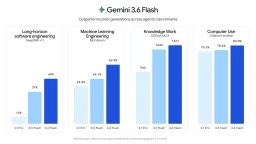
On Google’s own agentic evaluations, the generational jump is substantial. Gemini 3.6 Flash scores 49% on DeepSWE v1.1 for long-horizon software engineering, up from 37% for 3.5 Flash and 12% for 3.1 Pro. On MLE-Bench it reaches 63.9% (from 49.7%), on the GDPval-AA v2 knowledge-work benchmark it scores 1421 (from 1349), and on OSWorld-Verified computer use it hits 83.0% (from 78.4%). SWE-Bench Pro lands at 58.7%, ahead of both 3.5 Flash (55.1%) and the larger 3.1 Pro (54.2%).
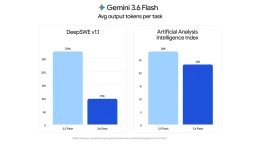
The efficiency story is more striking than the accuracy story. Average output tokens per DeepSWE task fell from 276K to 97K — the 65% reduction Google leads with — while the Artificial Analysis Intelligence Index run dropped from 28K to 23K tokens. For anyone paying per token across thousands of agent runs, that is the number that shows up on the invoice.
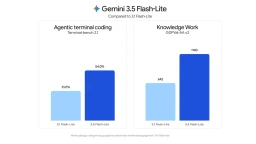
Flash-Lite posts the largest relative gains of the three. Terminal-Bench 2.1 rises from 31% to 54% versus 3.1 Flash-Lite, and GDPval-AA v2 jumps from 642 to 1140 — a near-doubling at the cheapest price point in the family.
Efficiency Is Not Intelligence
Independent measurement complicates the launch narrative. Artificial Analysis scores Gemini 3.6 Flash at 50 on its composite Intelligence Index — the same score it assigns Gemini 3.5 Flash. Output speed improved sharply (275.5 vs. 175.7 tokens per second) and cost fell, but on a broad nine-evaluation composite the model is not measurably smarter than the version it replaces. Some reviewers have read that flat line harshly; a fairer reading is that Google optimized this release for a specific axis — cost, latency, and reliability in multi-step agent loops — and largely hit it, while leaving raw capability gains for the Pro tier.
Which is where the awkward part sits. Gemini 3.5 Pro did not ship. Product lead Logan Kilpatrick said it is testing with partners and should “land soon,” and Bloomberg has reported internal delays tied to unmet performance targets. Meanwhile OpenAI has shipped GPT-5.5 and GPT-5.6, and Anthropic has released Claude Opus 4.8, Claude Sonnet 5, and wider Fable 5 access. Google’s answer is to point past the gap: DeepMind says it has “already started our most ambitious pre-training run yet, for Gemini 4.”
What This Means
For students and researchers building agents on a budget, this is a straightforwardly good release. A 65% token reduction on long-horizon engineering tasks changes what is affordable to run — a multi-step coding agent that cost $10 a session now costs closer to $3, and Flash-Lite makes high-volume classification, extraction, and routing cheaper still. The 1M-token context window and multimodal input remain intact.
The broader signal is that the frontier labs are now competing on two separate curves. One is capability, where Google is visibly behind schedule. The other is cost per completed task, where token efficiency matters more than leaderboard position — and where a model that thinks less but finishes the job can be the better engineering choice. Gemini 3.6 Flash is a bet that, for most production agent workloads, the second curve is the one that pays.
Related Coverage
- Google Introduces Gemini Omni and Gemini 3.5 at I/O — the May 2026 launch of the 3.5 generation this release iterates on
- Google I/O 2026 Pushes Gemini Into Agent Channels — the agent distribution strategy these efficiency gains are meant to serve
- Google Releases Gemini 3.1 Flash TTS with 200+ Audio Tags — an earlier specialized Flash-tier variant
This post was drafted with AI assistance and reviewed by RITS staff.
Sources
- Introducing Gemini 3.6 Flash, 3.5 Flash-Lite, and 3.5 Flash Cyber — Google
- Google releases three new Gemini models — but no 3.5 Pro — TechCrunch
- Google launches Gemini 3.6 Flash and 3.5 Flash-Lite, teases Gemini 4 — 9to5Google
- Gemini 3.6 Flash: Intelligence, Performance & Price Analysis — Artificial Analysis
- Gemini 3.5 Flash: Intelligence, Performance & Price Analysis — Artificial Analysis
- Google Just Released Gemini 3.6 Flash, And It Might Be Its Worst Model To-Date — Wccftech


 沪公网安备31011502017015号