Poolside Releases Laguna S 2.1, a 118B Open-Weight Coding Model


On July 21, 2026, San Francisco-based Poolside released Laguna S 2.1 — a 118-billion-parameter Mixture-of-Experts model built for agentic coding that activates only 8 billion parameters per token. It tops the SWE-Bench Multilingual table at 78.5%, holds its own against models ten to twenty times its size on long-horizon coding benchmarks, and fits on a single NVIDIA DGX Spark when quantized. The weights are on Hugging Face under the permissive OpenMDW-1.1 license.
Intermediate


What Was Released
Laguna S 2.1 is a sparse MoE model: 48 layers (12 with global attention, 36 with a 512-token sliding window), 256 routed experts with top-10 routing plus one shared expert, and grouped-query attention with 8 KV heads. The context window is 1,048,576 tokens — and unusually, that full window is available in both thinking and no-thinking modes rather than being truncated when reasoning is enabled.
Poolside says the model went from the start of training to public launch in under nine weeks, running on 4,096 NVIDIA H200 GPUs. It is the first Poolside model where the reinforcement learning stage ran entirely in FP8 precision. The RL curriculum drew on roughly 409,000 task environments — about 83,000 terminal-oriented and 168,000 software-engineering-oriented — built partly from the real commit history of some 17,000 repositories, with rollouts deliberately spread across multiple agent harnesses to avoid overfitting to any one of them.
Benchmarks
The headline numbers, with thinking enabled: Terminal-Bench 2.1 at 70.2%, SWE-Bench Multilingual at 78.5%, SWE-Bench Pro (public dataset) at 59.4%, DeepSWE v1.1 at 40.4%, SWE Atlas (codebase QnA) at 46.2%, and Toolathlon Verified at 49.7%. Thinking mode does most of the heavy lifting on the agentic tasks — it lifts Terminal-Bench 2.1 from 60.4% to 70.2%, and DeepSWE from 16.5% all the way to 40.4%.

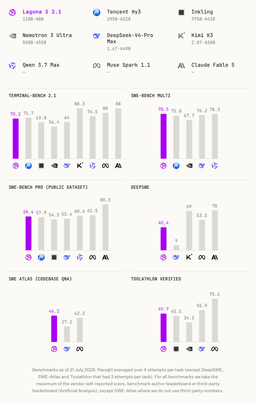
The comparison set is where the size argument lands. On SWE-Bench Multilingual, Laguna S 2.1’s 78.5% edges out Qwen 3.7 Max (78.3%), DeepSeek-V4-Pro-Max at 1.6T total parameters (76.2%), and Tencent Hy3 at 295B (75.8%). On Terminal-Bench 2.1 it scores 70.2% against Thinking Machines’ Inkling at 975B (63.8%), NVIDIA’s Nemotron 3 Ultra at 550B (56.4%), and DeepSeek-V4-Pro-Max (64%) — though the frontier closed models still lead, with Kimi K3 at 88.3% and Claude Fable 5 at 88%. The claim is not that Laguna S 2.1 is the best coding model available; it is that nothing else near 8B active parameters is close.
Poolside is also publishing full agent trajectories for every trial in the final evaluation set at trajectories.poolside.ai — a level of evaluation transparency that remains rare in model releases, and one that lets outside reviewers check for reward hacking rather than taking the scores on faith.
Running It
The deployment story is the practical draw. At INT4 or NVFP4 the model needs roughly 59 GB, which fits a single DGX Spark; FP8 needs about 118 GB (one Spark or one H200); BF16 needs about 236 GB, or two linked Sparks. Poolside ships BF16, FP8, INT4 and NVFP4 weights, with GGUF and MLX conversions available, and day-one support in vLLM, SGLang and Ollama alongside optimized TRT-LLM inference on Blackwell.
vllm serve --model poolside/Laguna-S-2.1 --tensor-parallel-size 4For those who would rather not host it, the model is served through OpenRouter — free at 256K context, and $0.10 / $0.20 / $0.01 per million input / output / cache-read tokens at the full 1M window — as well as Baseten, Vercel AI Gateway, Kilo, Prime Intellect and ZML. There is also a no-login chat interface at chat.poolside.ai.

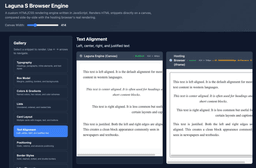
Poolside’s demonstrations lean on persistence rather than raw reasoning: a working HTML/CSS rendering engine in vanilla JavaScript built over 181 steps in about 50 minutes, a 5.2% speedup and 71% memory reduction on Poolside’s own agent harness, and a re-derivation of Erdős problem #397 with a novel construction in 68 minutes. “What we’ve done in this model is not necessarily add more intelligence, but improve the behaviors that lead to a more capable model,” said Pengming Wang, Poolside’s co-head of applied research.
What This Means
Poolside is framing the release geopolitically. “The West needs open-weight models it can trust, run, and build on. Laguna S 2.1 is our answer,” said co-CEO Jason Warner — a direct response to the fact that most of the strong open-weight coding models of the past year have come from Chinese labs. Co-founder and co-CEO Eiso Kant added that the model “does the work of models several times its size because of how we build, not despite it.”
For university and research users, the more interesting number is 59 GB. A model that lands within a few points of trillion-parameter systems on multilingual SWE tasks while running on hardware a single lab can buy changes what kinds of agentic coding research are affordable — no API budget, no data leaving the building. Poolside is candid about the rough edges: the model overfits to some third-party agent harnesses, mangles nested JSON in tool calls, and occasionally overthinks straightforward problems.
Laguna S 2.1 follows Laguna XS 2.1 (33B-A3B, laptop-scale) and the enterprise-focused Laguna M.1 (225B-A23B), both released July 2, 2026.
Related Coverage
- Thinking Machines Releases Inkling, Its First Open-Weight Model — the 975B model Laguna S 2.1 outscores on Terminal-Bench 2.1, covered here on July 16, 2026
- Xiaomi Releases MiMo-V2.5-Pro: 1T-Parameter Open MoE Matches Frontier Coding Models — the scale-up approach to open coding models
- Qwen3.6-27B: A Dense 27B Model That Beats a 397B MoE on Coding — an earlier data point in the small-model-punches-up trend
- GLM-5.2: Z.ai’s Open-Weights Coder Beats GPT-5.5 at 1/6 the Cost — the Chinese open-weight coding models Poolside is positioning against
This post was drafted with AI assistance and reviewed by RITS staff.
Sources
- Introducing Laguna S 2.1 — Poolside blog
- poolside/Laguna-S-2.1 model card on Hugging Face
- Poolside releases Laguna S 2.1, the West’s most capable open-weight model — GlobeNewswire
- Poolside Releases Laguna S 2.1, an Open-Weight Agentic Coding Model Punching Above Its Weight Class — MarkTechPost
- Poolside drops Laguna S 2.1, an open-weight coding model that beats rivals 10x its size — VentureBeat


 沪公网安备31011502017015号