SperidLabs Releases Iris-3B, a Pixel-Space Image Model Without a VAE


Lead — On October 7, 2026, the research lab SperidLabs posted Iris-3B, a 3-billion-parameter text-to-image model that generates pictures with no VAE and no latent space: the network paints every pixel directly. The weights and training code went up on Hugging Face under the Apache 2.0 licence, and the accompanying paper reports that pixel-space generation scales to 3B parameters while matching a 20B latent model on one standard benchmark — and that the fine-detail advantage the VAE-free design was meant to unlock did not appear on the downstream tasks the authors tested.
Advanced

Technical Details
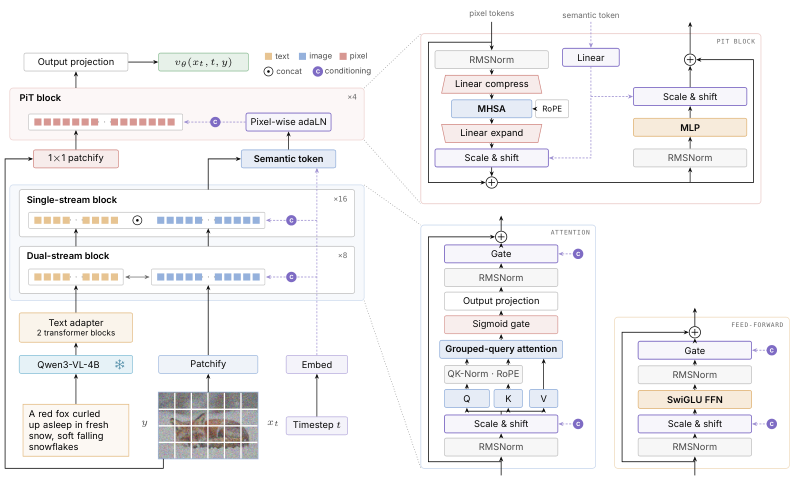
Iris-3B is a flow-matching diffusion transformer that operates on 16×16 pixel patches, giving each token the same footprint a latent model’s codec would have covered. Text conditioning comes from a frozen Qwen3-VL-4B-Instruct encoder. The trunk is a two-stream DiT — text and image tokens keep separate weights — followed by 16 single-stream blocks at width 2560, and a pixel-transformer (PiT) head borrowed from PixelDiT decodes the trunk output straight to pixels. Positional information uses 2D axial RoPE, which carries no parameters tied to resolution, so the same weights run at every stage of the training curriculum.
The model generates at native aspect ratios of about one megapixel with default settings of CFG 3 and 100 denoising steps. The text-to-image weights are roughly 12 GB, and the depth and upscaler fine-tunes add about 12 GB each. Everything ships under the Apache 2.0 licence, and inference needs an NVIDIA GPU with CUDA.
How It Works
Latent diffusion became the dominant paradigm because a pretrained VAE compresses an image into a smaller space where the generator can afford to work; a decoder then reconstructs the picture. That codec is lossy and texture-biased, and it is trained separately from the generator, so its errors compound. Pixel-space generation removes the middleman: the network emits pixels and nothing is discarded to a latent.
SperidLabs trained Iris-3B from scratch through a 256→512→1024 pixel curriculum, after ablating the prediction target and representation alignment at 256² to decide what to scale. As a second route, the team converted a pretrained latent model, FLUX.2 Klein base 4B, to pixel space by stripping its VAE, replacing it with 16×16 pixel patches, and attaching a new pixel head.

Results — and a Deliberate Negative Result
On the official evaluators at 1024², Iris-3B scores 0.798 on GenEval, 86.52 on DPG-Bench, 0.857 on LongText-Bench and 0.540 on OneIG-EN. It comfortably beats FLUX.1-dev 12B and matches Qwen-Image 20B on OneIG-EN, though it trails the larger latent models on GenEval — weakest on position and counting — and on English long-text rendering.
| Model | GenEval | DPG | LongText | OneIG-EN |
|---|---|---|---|---|
| FLUX.1-dev 12B | 0.66 | 83.8 | 0.607 | 0.434 |
| Qwen-Image 20B | 0.87 | 88.3 | 0.943 | 0.539 |
| Iris-3B | 0.798 | 86.52 | 0.857 | 0.540 |
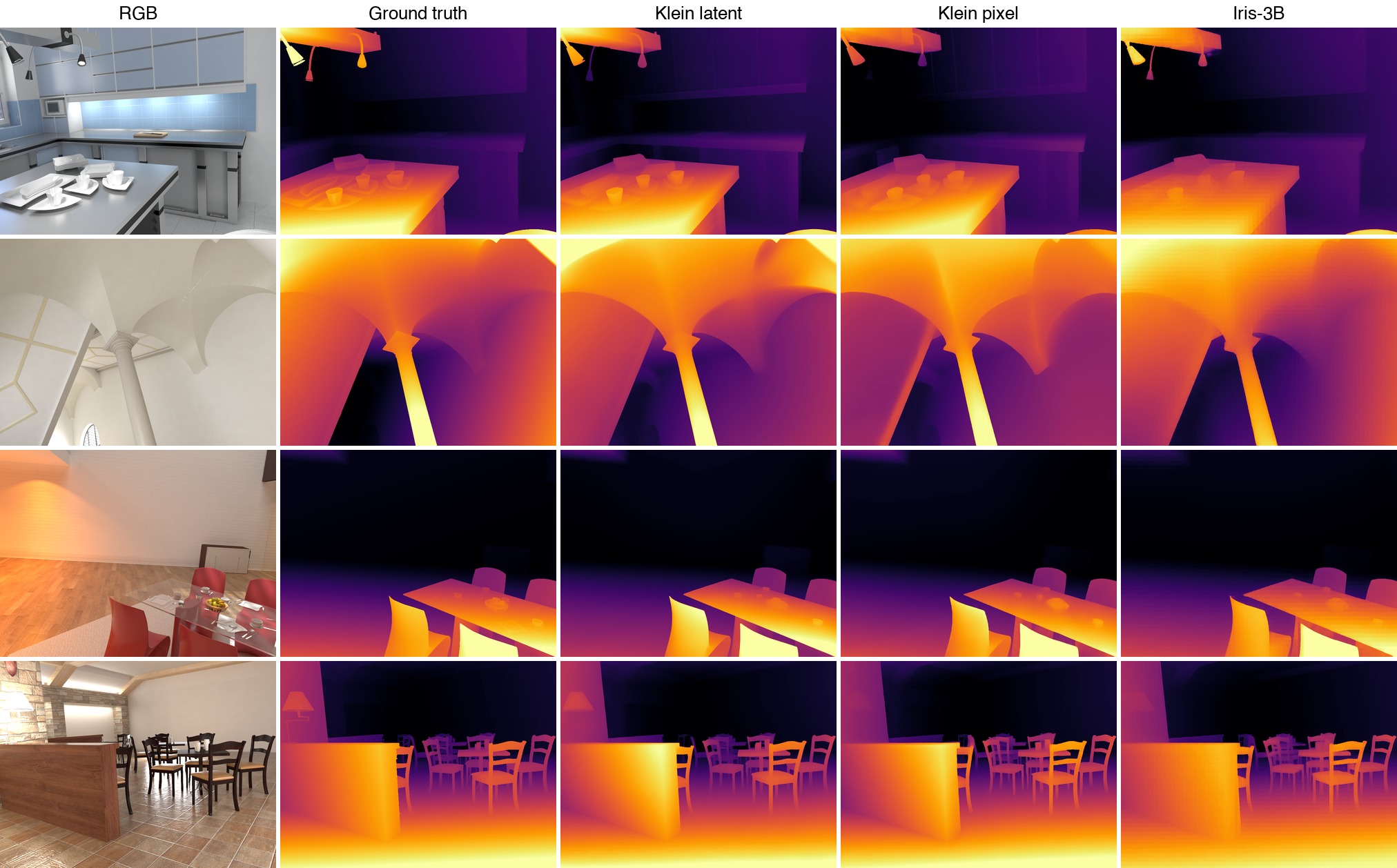
The more interesting finding is what did not happen. The theory behind pixel-space generation is that it should pay off most where fine detail matters, so the authors fine-tuned both model families — with no architectural change — for monocular depth estimation and for 4× image restoration. Across NYUv2, KITTI, ETH3D, ScanNet and DIODE, Iris-3B came out level with the latent FLUX.2 Klein, and the converted pixel model fell behind it. On DIV2K restoration, neither pixel model beat a latent FLUX.2 Klein fine-tune. “We find no significant improvement from using a pixel-space generative prior,” the paper states.
The authors are candid about the test’s limits: each arm is a single run at a short budget with no significance test, and Iris-3B has no size- and data-matched latent twin, so its parity mixes representation space with scale. They also document a patch-grid artifact in the pixel-space depth outputs — Iris-3B “most strongly” — because its PiT head only lets patches exchange information through one compacted token each, and the VAE decoder a latent model carries smooths that artifact away for free.
What This Means
Iris-3B is a useful result presented honestly. It shows that a 3B pixel-space model can reach text-to-image quality competitive with latent systems many times its size, at a footprint small enough to run on a single consumer-class GPU — and it is released openly, weights and training code together, which makes the claim checkable. What it does not show is the dividend the design was sold on. Anyone budgeting training spend on a VAE-free prior as a shortcut to sharper dense predictions should note that the paper the weights ship with argues against that shortcut on the two tasks it tested. The authors name editing and reference-based generation — where latent compression should hurt most — as the next real test. For now, the pixel-space case rests on parity at a smaller scale, not on a demonstrated edge.
Related Coverage
- Qwen-Image-2.1: Native Transparency and 10-Image Editing — the 7B latent model family Iris-3B is benchmarked against.
- PrismML Releases 1-Bit Bonsai Image 4B for Local Generation — another push to make image generation run on modest local hardware.
- Baidu Open-Sources ERNIE-Image, an 8B Diffusion Transformer — an open-weight text-to-image release built on the conventional latent pipeline.
This post was drafted with AI assistance and reviewed by RITS staff.
Sources
- Iris-3B: Going Beyond the Latent with Pixel-Space Diffusion Training, Conversion and Fine-Tuning — Cai & Garabito, SperidLabs (arXiv:2610.09450, October 7, 2026)
- SperidLabs — Iris-3B project page
- Hugging Face — speridlabs/iris-3b model card
- GitHub — speridlabs/iris-3b (weights and training code)
- AI Weekly — SperidLabs Scales Iris-3B to 3B, Finds No Downstream Edge


 沪公网安备31011502017015号