PrismML Releases 1-Bit Bonsai Image 4B for Local Generation


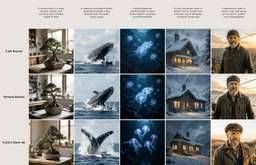
PrismML released Bonsai Image 4B, a 1-bit and ternary text-to-image diffusion transformer family, extending the company’s Bonsai quantization push from language models into image generation. The notable claim is local accessibility: PrismML says the models are small enough to run fully in a browser through WebGPU while still producing competitive text-to-image outputs.
Intermediate


From 1-Bit LLMs to Image Models
PrismML’s first Bonsai release focused on 1-bit language models. Bonsai Image 4B applies the same broad thesis to visual generation: aggressively compress the model so it can run on more devices, then preserve enough quality for practical creative work. The company describes binary and ternary variants, meaning model weights are pushed into very low-bit representations rather than conventional 16-bit or 8-bit formats.
That matters because image generation is usually memory-hungry. Even when an image model is open, local use can require a discrete GPU, careful dependency setup, and large downloads. A browser-capable WebGPU path lowers the barrier for teaching, demonstrations, and lightweight creative tools.

Why It Matters
The release is part of a larger trend: model capability is no longer only about scaling up. Small, compressed models are becoming important because they can run privately, cheaply, and interactively. For classrooms and labs, local image generation also avoids some of the friction around API keys, rate limits, and cloud costs.
The tradeoff is that quantized image models need careful evaluation. Low-bit compression can affect fine details, prompt adherence, typography, faces, and consistency across styles. PrismML’s examples are promising, but the real test will come from broad community usage across difficult prompts and consumer hardware.
What To Watch
If Bonsai Image 4B works reliably in WebGPU environments, it could become a useful base for browser-native creative tools. The bigger question is whether PrismML’s quantization approach generalizes across image editing, control inputs, and video generation, where consistency and temporal stability are harder than single-image synthesis.
Related Coverage
- PrismML’s 1-Bit Bonsai LLMs: 8B Model in 1.15 GB – the earlier language-model release behind the Bonsai line.
- Bankai: Kilobyte-Scale Patches for 1-Bit LLMs – related work on adapting extremely low-bit models.
This post was drafted with AI assistance and reviewed by RITS staff.


 沪公网安备31011502017015号