Meta Releases Muse Glimmer, a 30B Agent Model for a Single GPU


On August 10, 2026, Meta released Muse Glimmer — a 30-billion-parameter open-weight model, licensed Apache 2.0, built specifically to run agent workflows locally on a single consumer GPU. It is distilled from Muse Spark, the closed frontier model Meta Superintelligence Labs launched in April, and it is the clearest statement yet of where Meta draws the line between what it keeps and what it gives away.
Intermediate

What Meta Released
Muse Glimmer is roughly 29.6B parameters: a ~28B text decoder paired with a ~1.8B ViT-G/14 perception encoder that handles images and video frames. The model card lists a context window of 131,072+ tokens, training data drawn from more than 100 languages, and controllable reasoning effort levels. Meta trained it in three phases — logit distillation from Muse Spark during pre-training, an agent-heavy mid-training stage with reasoning traces, then supervised fine-tuning combined with on-policy distillation and reinforcement learning.
The design target is stated plainly in Meta’s announcement: “A local agent is truly useful if it’s fast enough to feel responsive.” Everything else in the release follows from that constraint.
Dense, Not Sparse — On Purpose
The interesting architectural choice is what Muse Glimmer isn’t. Most recent models in this size class are sparse Mixture-of-Experts designs that activate a fraction of their parameters per token. Muse Glimmer is dense: all 30B parameters fire on every token. NVIDIA’s engineering write-up frames the trade-off as predictability — a dense model has “no routing, expert selection, or variance across token pathways,” which matters when an agent’s per-step latency, not its peak throughput, is what the user feels.

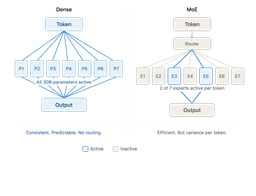
Inside the decoder, Meta leans on cheaper attention rather than sparsity: alternating sliding-window (2,048-token) and full-attention layers across 52 layers, plus grouped-query attention at a 16:1 query-to-KV head ratio that cuts KV-cache memory by the same factor. That last number is what makes a 128K context tractable on a desktop card.
Fitting It on One GPU
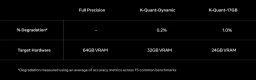
At full precision the model is over 55 GB — well beyond consumer hardware. Meta published two quantizations and, unusually, the accuracy cost of each, measured as an average across 15 benchmarks: K-Quant-Dynamic loses 0.2% and targets 32 GB of VRAM; K-Quant-17GB loses 1.0% and targets 24 GB. Compressing the language model to under 20 GB is what leaves room for the KV cache, the perception encoder, and the speculative-decoding drafter to coexist in the same memory envelope.

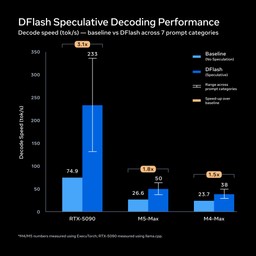
The second half of the speed story is DFlash, a lightweight drafter that proposes 16-token blocks for the main model to verify in parallel — output identical to standard generation, but faster. Meta reports decode speed rising from 74.9 to 233 tokens/second on an RTX 5090 (3.1×, measured with llama.cpp), 26.6 to 50 tok/s on an M5 Max, and 23.7 to 38 tok/s on an M4 Max (both via ExecuTorch).
How It Benchmarks
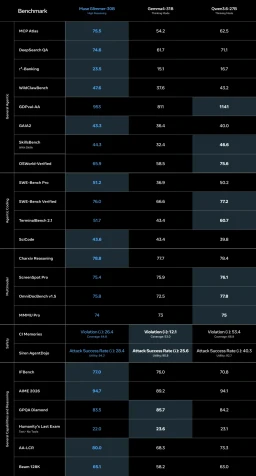
Meta compares Muse Glimmer against Gemma4-31B and Qwen3.6-27B. It leads clearly on agentic tool use — MCP Atlas 75.5 against 54.2 and 62.5 — and on DeepSearch QA (74.6), SWE-Bench Pro (51.2), AIME 2026 (94.7), and long-context retrieval (AA-LCR 80.0 versus 68.3 and 73.3).
It does not sweep the table, and Meta didn’t hide that. Qwen3.6-27B wins OSWorld-Verified (75.6 to 65.9), TerminalBench 2.1 (60.7 to 51.7), SWE-Bench Verified (77.2 to 76.0), and GDPval-AA. Gemma4-31B takes GPQA Diamond and Humanity’s Last Exam. On the two security evaluations, Gemma4 leaks less in the CI Memories privacy test (12.1% violations to Muse Glimmer’s 26.4%) and resists prompt-injection slightly better on Siren AgentDojo (25.6% attack success to 28.4%) — though Muse Glimmer retains higher task utility while under attack.

Meta’s own model card is candid about the limits: the model “may still make errors in multi-step reasoning,” is not explicitly optimized for video, and degrades on languages outside its strongly supported set. Meta rates it “moderate or lower risk” across its chem/bio, cyber, and loss-of-control preparedness domains.
What This Means
The technically notable part of this release isn’t any single benchmark — it’s that Meta shipped the whole local-inference stack as one coordinated thing. A 4-bit quantization with a published accuracy cost, a drafter model tuned for the same weights, a dense architecture chosen for latency predictability, and day-zero support across llama.cpp, MLX, ExecuTorch, Ollama, LM Studio, Unsloth, vLLM, and SGLang. Open weights that require three weeks of community quantization work before anyone can run them are open in a weaker sense than these are.
Strategically, Muse Glimmer sits on the open side of a line Meta has now drawn explicitly. Muse Spark stays closed; its distilled 30B descendant is Apache 2.0. Mark Zuckerberg has framed the on-device tier as a personal agent that “will work 24/7 on your behalf to improve your relationships, health, career, finances, home management, hobbies, and more” — a claim about ambition, not about what the model does today. What the release does establish is that a genuinely useful agentic model now fits on hardware a student can own, and that the gap between the frontier tier and the local tier is a distillation step rather than a category difference.
Related Coverage
- Meta Hasn’t Given Up on Open Source: Muse Spark Launches as Open-Weight Plans Continue — the April 2026 launch of the closed model Muse Glimmer is distilled from, where Meta first promised open-weight versions.
- Meta’s Muse Spark 1.1 Breached a Company During Cybersecurity Testing — the same model family five days earlier, and useful context for the security benchmarks above.
- Poolside Releases Laguna S 2.1, a 118B Open-Weight Coding Model — the sparse-MoE approach to the same “fits on one GPU” goal.
- Jensen Huang’s First X Post: 150+ Companies Sign Open-Weights Letter, Anthropic Doesn’t — the industry argument over downloadable weights this release lands into.
This post was drafted with AI assistance and reviewed by RITS staff.
Sources
- Introducing Muse Glimmer: An Open Agentic Model That Runs on Your Device — Meta AI Research, August 10, 2026
- meta-models/Muse-Glimmer-30B model card — Hugging Face
- Run Local Agentic AI Workflows with Meta’s Muse Glimmer on NVIDIA — NVIDIA Technical Blog
- Meta is back with Muse Glimmer: local, agentic, multimodal, and open source — Hugging Face blog
- Meta’s new Glimmer AI model offers a hint at Zuckerberg’s personal intelligence vision — TechCrunch
- Meta Publishes Muse Glimmer As 30B Open Agentic Model — Phoronix


 沪公网安备31011502017015号