DeepSeek Open-Sources V4-Flash-Vision-Exp Ten Days After API Launch


DeepSeek has published the weights for DeepSeek-V4-Flash-Vision-Exp, the first experimental multimodal model in its V4 family, releasing the checkpoint on Hugging Face under an MIT licence on August 31, 2026 — ten days after the same model went live on the DeepSeek API platform. The model card describes it as a system that “builds on the DeepSeek-V4-Flash architecture by incorporating visual modules and undergoing continued training to unlock visual understanding capabilities,” and DeepSeek’s headline claim is that it closes most of the multimodal-agent gap to Anthropic’s Opus-4.8 while leaving text performance intact.
Advanced

Technical Details
The vision model keeps the V4-Flash backbone unchanged: a sparse Mixture-of-Experts transformer with 284 billion total parameters and roughly 13 billion active per token, routing to 6 of 256 routed experts plus 1 shared expert, across 43 layers at a hidden size of 4,096. The published config.json lists 64 attention heads against a single key-value head — the aggressive KV compression that lets the model hold its 1,048,576-token context window. Weights ship natively in FP8 (e4m3, 128×128 blocks, ue8m0 scale format) rather than as a post-hoc quantisation.
The visual pathway is comparatively small. The encoder is a 32-layer, 1,024-dimensional tower with 16 attention heads and a patch size of 14, feeding an aligner module that projects into the language backbone. Two numbers in the config are worth reading together: vision_min_pixels is 147,456 and vision_max_n_token is 384. That second figure is the same 384 that appears in DeepSeek’s billing note — images are charged “at up to 384 tokens each, at V4-Flash pricing.” The billing ceiling is not a commercial policy layered on top of the model; it is the architectural token budget of the encoder itself.
The Hugging Face repository reports 305B parameters in its metadata against DeepSeek’s own 284B figure for the MoE backbone, the difference covering the vision tower, aligner and auxiliary modules. The repo ships a minimal PyTorch reference implementation that, in DeepSeek’s words, “covers the vision encoder and aligner, DFlash attention, MoE, Hyper-Connections, and the DSpark forward path,” alongside vLLM and SGLang deployment paths.
Reading the Benchmark Table
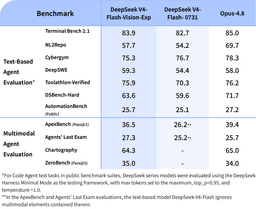
DeepSeek’s own numbers reward close reading, and the company footnotes the most important caveat itself. On ApexBench the vision model scores 36.5 against V4-Flash-0731’s 26.2, and on Agents’ Last Exam 27.3 against 25.2 — but both baseline figures carry an asterisk explaining that “the text-based model DeepSeek-V4-Flash ignores multimodal elements contained therein.” Part of the advertised leap is therefore the arithmetic of scoring a text-only model on tests containing images, not a like-for-like capability gain.
Against Opus-4.8, the model wins three of eleven benchmarks: DeepSWE (59.3 vs 58.0), Agents’ Last Exam (27.3 vs 25.7) and ZeroBench (35.0 vs 34.0). It stays within roughly a point on Terminal Bench 2.1 (83.9 vs 85.0), Toolathlon-Verified (75.9 vs 76.2) and Chartography (64.3 vs 65.0), and falls well back on the two hardest long-horizon tasks — NL2Repo (57.7 vs 69.7) and DSBench-Hard (63.6 vs 71.7). All DeepSeek-series text results were produced using DeepSeek Harness Minimal Mode at top_p=0.95 and temperature=1.0.
The understated result is on text. DeepSeek claims only that the vision variant “maintains comparable performance on text-only agent tasks,” but the table shows it ahead of V4-Flash-0731 on six of seven text benchmarks, including a 5.6-point gain on Toolathlon-Verified and 4.9 on DeepSWE. Cybergym is the sole regression, at 75.3 against 76.7. Bolting on a vision tower did not cost the backbone anything measurable here.
What This Means
The release pattern is the story as much as the model is. Twelve days earlier, Z.ai shipped GLM-5.3-Flash with weights on day one; DeepSeek ran a paid API for ten days before opening the checkpoint. Both arrive at the same place — an MIT- or equivalently-licensed multimodal MoE in the 300B class — by different routes, and the ten-day gap is now short enough that the distinction is about sequencing rather than commitment.
Practical access remains lopsided. At $0.22 per million input tokens and $0.66 per million output, with cached reads at $0.007, the API is inexpensive enough that most researchers will never touch the weights. Running them locally is a different proposition: community GGUF conversions start around 155 GB at 4-bit, which is a multi-GPU or high-memory-workstation problem, not a laptop one. The open weights matter less for casual inference than for the things an API cannot offer — fine-tuning, mechanistic inspection of the aligner, and reproducing the benchmark numbers independently.
The “Exp” suffix should be taken at face value. DeepSeek labels this an experiment, and the evaluation set it chose is narrow — agentic and chart-reading tasks rather than the broad VQA suites most vision-language releases report. Whether the visual modules survive into a non-experimental V4 release is the open question.
Related Coverage
- DeepSeek Releases V4: Open-Source 1.6T MoE with 1M Context — the April 2026 family launch that introduced the 284B V4-Flash backbone this model extends
- DeepSeek V4-Pro Leaves Preview as API Prices Rise — the pricing context two weeks before this release
- DeepSeek Open-Sources Harness, an All-Plugin Agent Runtime — the agent runtime used as the testing framework for the text benchmarks above
- GLM-5.3-Flash: 320B Multimodal MoE, Weights on Day One — the same-week comparison from Z.ai, released the other way round
This post was drafted with AI assistance and reviewed by RITS staff.
Sources
- deepseek-ai/DeepSeek-V4-Flash-Vision-Exp — Hugging Face model card
- DeepSeek-V4-Flash-Vision-Exp Release: Multimodal API Now Live — DeepSeek API Docs, August 21, 2026
- DeepSeek-V4-Flash-Vision-Exp config.json
- DeepSeek V4 Flash Vision Exp — pricing and context window, OpenRouter
- unsloth/DeepSeek-V4-Flash-Vision-Exp-GGUF — quantised community conversions
- DeepSeek launches an experimental multimodal model to rival Anthropic — The Next Web, August 21, 2026


 沪公网安备31011502017015号