Claude Sonnet 5.5 Ranks #2 at 56, Behind Only Opus 5.5


Anthropic released Claude Sonnet 5.5 on September 28, 2026, and independent benchmarker Artificial Analysis ranks it second on its Intelligence Index with a score of 56, two points behind Claude Opus 5.5 and ahead of both GPT-6 Astra and Claude Fable 5.1. The mid-tier model keeps Sonnet 5’s price of $2 / $10 per million input / output tokens. Anthropic says it runs more than 30% faster and costs up to 30% less per task. At maximum effort, though, Artificial Analysis measured the highest token use it has ever recorded.
Intermediate

What Anthropic Reports
Sonnet 5.5 is the second model in the Claude 5.5 family, a week after Opus 5.5. Anthropic presents it as the faster, cheaper complement to Opus, strongest at “well-scoped everyday tasks,” bug fixing and producing documents, slides and spreadsheets. On Anthropic’s own evaluations it comes close to Opus 5.5 across most categories and passes it on one:
- Terminal-Bench 4.0 (agentic coding): 70.6%, against 66.4% for Opus 5.5 and 10.3% for Sonnet 5
- CursorBench 4.0: 55.5% (Opus 5.5: 57.8%; Sonnet 5: 34.1%)
- OSWorld 2.1 (computer use): 80.1% (Opus 5.5: 81.8%; Sonnet 5: 57.0%)
- GDPval-AA v2.1 (knowledge work): 1,844 (Opus 5.5: 1,846; Sonnet 5: 1,449)
- Humanity’s Last Exam: 64.5% (Opus 5.5: 67.7%; Sonnet 5: 54.9%)
- Chartography (chart understanding, no tools): 61.6% (Opus 5.5: 64.4%; Sonnet 5: 15.6%)
Anthropic credits the lower cost per task to fewer tokens and fewer tool calls, not to a price change. Several early-access customers quoted in the announcement report similar results. Box says the model was “more accurate, 2.4x faster, and used 12% fewer total tokens” than its predecessor, and Lovable saw about a third fewer tool calls on coding jobs. The model has five effort levels (low, medium, high, xhigh and max). According to Unite.AI, the default is medium in Claude Code and the Claude apps, and high on the API.
What Artificial Analysis Measured

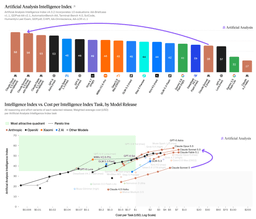
At max effort, Sonnet 5.5 scores 56, an 18-point jump over Sonnet 5 (38). Artificial Analysis finds it level with Opus 5.5 on its knowledge-work evaluations: 1,811 against 1,822 Elo on AA-Briefcase, and 1,844 against 1,846 on GDPval-AA. The gaps are on Humanity’s Last Exam and SciCode, where it trails by about six points, and on factual accuracy (AA-Omniscience), where it scores 54% to Opus 5.5’s 66%. Lower effort settings score much less: 47 at high, 41 at medium and 36 at low.

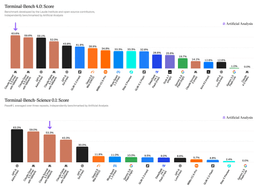
Artificial Analysis’s own Terminal-Bench 4.0 run puts Sonnet 5.5 first at 63.6%, ahead of Opus 5.5 (59.6%) and GPT-6 Astra (59.1%), and up from 14.1% for Sonnet 5. Anthropic reports 70.6% on the same benchmark. The two figures come from different test harnesses and should not be compared directly.
The top score has a cost. Artificial Analysis says Sonnet 5.5 at max effort used “~193k Output Tokens per Intelligence Index Task. This is the highest token use we have measured, around 60% higher than Opus 5.5 (max).” That is roughly seven times GPT-6 Astra at max. The resulting cost is about $7.60 per index task, around 50% more than Sonnet 5, even though per-token prices did not change.
Safeguards
Sonnet 5.5 is the first Sonnet model to ship with the cyber safeguards Anthropic had previously applied only to its top-tier models. Anthropic rates its cybersecurity capability as comparable to Opus 5.5. High-risk cyber requests fall back to Sonnet 5, and Anthropic’s Cyber Verification Program offers tiered access for security work. Unite.AI describes a three-stage classifier pipeline with “99.43% recall on the cyber harm coverage set,” and notes that users should “expect increased refusals even on benign cybersecurity tasks.” It is also the first Sonnet with classifiers that block extraction of its reasoning, which is a defence against distillation, and preserved thinking is tied to the account that generated it.
What This Means
The two claims about cost are not necessarily contradictory, because they measure different things. Anthropic’s “up to 30% less per task” comes from its own testing against Sonnet 5. Artificial Analysis’s $7.60 figure is for max effort specifically, where Sonnet 5.5 spends more tokens than any model the benchmarker has tested. At max effort, Sonnet 5.5 comes within two points of Opus 5.5 while costing somewhat more per index task than Opus does. At high effort it scores 47, close to GPT-6 Sol at about the same cost per task.
For researchers and course builders on a budget, the effort setting now matters about as much as which model you pick. The same Sonnet 5.5 spans roughly 20 index points between low and max effort. The benchmark to watch is the one run at the setting you will actually deploy. Claude Haiku 5.5, which Anthropic describes as built for high-volume, cost-sensitive work, is due “in the coming weeks.”
Related Coverage
- Claude Opus 5.5 Takes the Top Spot on Artificial Analysis at 58: the model Sonnet 5.5 now trails by two points
- Anthropic Launches Claude Sonnet 5, Closing the Gap With Opus: the predecessor, released June 30
- Claude Fable 5.1 Arrives: Flat Token Pricing, 75% Cheaper Cache Reads: Anthropic’s premium model, which Sonnet 5.5 now outscores on the index
- Introducing Claude Sonnet 4.6: Flagship Performance at Mid-Tier Cost
This post was drafted with AI assistance and reviewed by RITS staff.
Sources
- Anthropic: Introducing Claude Sonnet 5.5
- Artificial Analysis: Claude Sonnet 5.5 reaches #2 on the Artificial Analysis Intelligence Index
- Unite.AI: Anthropic Releases Claude Sonnet 5.5 at Unchanged Sonnet 5 Pricing
- VentureBeat: Anthropic launches Claude Sonnet 5.5 with 30% cost reduction per task
- The Next Web: Anthropic releases Claude Sonnet 5.5 with the cyber limits it reserved for its best models


 沪公网安备31011502017015号