IntermediateAI
Alibaba’s DAMO RADAR Beats Most Radiologists on CT Scans
- Medical Imaging
- alibaba
- computer vision
- healthcare
- open source
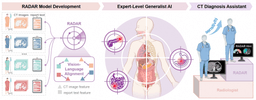
Alibaba’s DAMO Academy has open-sourced RADAR, a vision-language AI model that reads abdominal CT scans and flags nearly 150 clinical findings — including cancers — in a single pass. Published in Science on September 18, 2026, the model averaged an AUC of 0.913 across 146 findings in real-world testing and outperformed 23 of 26 expert radiologists in a head-to-head comparison, a result the DAMO Academy team calls “the world’s first expert-level generalist medical imaging model.”

Technical Details
RADAR is a vision-language model trained on more than 400,000 contrast-enhanced abdominal CT examinations, paired with 15 million anatomy-aware image-text pairs that DAMO Academy derived directly from clinical reports — without manual annotation. Rather than treating a CT scan as a single flat image, the team’s approach converts each scan into three-dimensional anatomical units and aligns them precisely with the corresponding report text, which the researchers say is key to the model’s accuracy across a broad range of findings rather than just one disease at a time.
The model covers 18 abdominal organs and 146 distinct clinical findings, from malignant tumors to conditions like fatty liver disease and acute appendicitis. Tested against nearly 40,000 real-world examinations, it posted a mean AUC of 0.913 — with 1.0 representing perfect diagnostic accuracy. In a separate comparison against 26 expert radiologists from different hospitals, RADAR’s diagnostic accuracy exceeded that of 23 of them.
How It Works
The clinical value DAMO Academy is emphasizing isn’t just standalone accuracy — it’s what happens when radiologists use RADAR as an assistant. In that setting, the study reported a 10% reduction in missed diagnoses and more than a 30% cut in examination time, suggesting the model’s more immediate role is augmenting radiologist throughput rather than replacing the read entirely.
DAMO Academy has released RADAR’s training and inference code on GitHub and Hugging Face under an Apache 2.0 license, with model weights separately licensed under CC BY-NC-SA 4.0 — permitting research use while withholding commercial deployment rights pending a separate agreement. Zhang Ling, a senior algorithm expert at DAMO Academy, said the model “has strong generalization capabilities and broad applicability,” and that the team’s approach could extend beyond abdominal CT to other forms of medical imaging.
This post was drafted with AI assistance and reviewed by RITS staff.


 沪公网安备31011502017015号