IntermediateAI
Midjourney Unveils FBUCT: A Full-Body Ultrasound Scanner
- AI
- Emerging Technologies
- Hardware
- Medical Imaging
- midjourney
On June 17, 2026, Midjourney — the company best known for AI image generation — announced its first hardware product and an unexpected new division: Midjourney Medical. The product is a full-body scanner that the company calls FBUCT (Full Body Ultrasonic Computational Tomography), a machine that uses sound and water instead of radiation or magnets to reconstruct a high-resolution view of the human body. CEO David Holz framed the ambition simply: make imaging “as powerful as an MRI” but “as casual as a trip to the spa.”

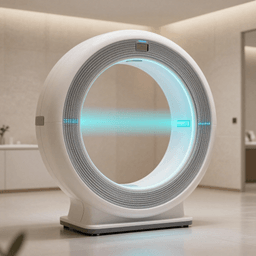
It is a striking pivot. Midjourney is self-funded, has no outside investors, and built this prototype with a team of fewer than ten people. Roughly a dozen people have been scanned on the Gen 1 machine so far. Yet the company is already talking about deploying tens of thousands of units and reshaping how routine body imaging is done.
What the FBUCT Scanner Does
Conventional whole-body imaging means an MRI (slow, expensive, magnetically intense) or a CT scan (fast, but uses ionizing radiation). Midjourney’s claim is that ultrasound — long limited to handheld probes and single-organ views — can be scaled into a full-body modality through sheer transducer density and computation.
The scanner is built around a ring roughly 70 cm in diameter that a person passes through while immersed in water, which couples the sound waves to the body. The ring is lined with sand-grain-sized ultrasonic transducers: each imaging chip carries 8,960 elements, and 40 such systems combine into a ring of roughly 358,000 transducers firing and listening in concert.
The Numbers Behind It
The engineering story here is mostly a data and compute story:
- Resolution: ~0.5 mm for internal tissue detail
- Capture rate: ~17 GB/s of raw ultrasonic data, with roughly 40 GB needed to reconstruct a single cross-sectional slice
- Reconstruction: a back-end of ~21 servers, with the company citing on the order of 2 PFLOPS of compute and ~806 TB of raw data per scan session
- Speed: the Gen 1 prototype currently takes about 20 minutes, bottlenecked by bandwidth and algorithms; the stated goal is several hundred slices in about 60 seconds
- No radiation, no magnetic fields — just transducers, water, and computational tomography
That “computational” half is where Midjourney’s background plausibly matters: turning a flood of raw acoustic signals into a clean cross-sectional image is fundamentally a large-scale reconstruction and inference problem, the kind of work the company’s image pipeline expertise maps onto.


The Spa, the Hardware, and the Partnership
The first deployment is unusual: a 25,000-square-foot, four-floor “Midjourney Spa” near Union Square in San Francisco, complete with hot tubs, saunas, cold plunges, and a gym, alongside roughly ten scanners. It is slated to open at the end of 2027. The framing is deliberate — Midjourney wants the scan to feel like wellness, not a hospital procedure, and plans to start with the easier regulatory path of body-composition analysis before pursuing diagnostic claims.
The hardware isn’t entirely homegrown. Midjourney licensed Butterfly Network’s ultrasound-on-chip technology in November 2025, reportedly for $15 million upfront plus around $10 million in annual fees over five years. The company has also hinted at four more hardware projects and four software projects in its pipeline, and hired a former Apple Vision Pro engineer to lead hardware.
What This Means
Midjourney’s stated long-term vision is aggressive: 50,000 scanners worldwide and on the order of a billion full-body scans per month, with a scaling capex estimate near $20 billion. The company contrasts a few dollars per scan against $400–$4,000 for an MRI, and claims that fewer than a dozen of these machines at full speed could perform more scans than every MRI on Earth combined.
Those are extraordinary claims, and they deserve extraordinary scrutiny. A Gen 1 prototype that scans in 20 minutes is a long way from a 60-second consumer experience, and the leap from “body composition” to genuine diagnostic-grade imaging runs straight into FDA regulation, clinical validation, and patient-privacy questions that the company has not yet answered. Whole-body screening also carries a well-documented risk of incidental findings that lead to anxiety and unnecessary follow-up procedures.
Still, the underlying bet is interesting: that the bottleneck in medical imaging is increasingly compute and reconstruction software rather than exotic physics, and that an AI company is therefore a credible entrant. Whether or not Midjourney delivers, FBUCT is a notable signal that the line between “AI lab” and “medical-device company” is getting blurrier.
This post was drafted with AI assistance and reviewed by RITS staff.
Sources
- Latent Space — Midjourney Medical: scan your organs like you step on a scale
- Glitchwire — Midjourney Unveils Full-Body Medical Scanner
- Crypto Briefing — Midjourney unveils first hardware product, an ultrasonic scanner
- Shacknews — Midjourney Medical is a new division from Midjourney
- explainX — Midjourney Hardware Announcement June 2026


 沪公网安备31011502017015号