Xiaomi Streams MiMo-V2.6 Reinforcement Learning Runs Live


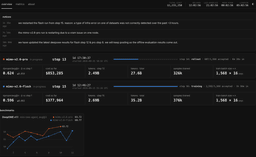
Xiaomi’s MiMo team is running the reinforcement learning (RL) stage of its next models in public. A dashboard at mimo.xiaomi.com/rl streams metrics from two runs, mimo-v2.6-pro and mimo-v2.6-flash, as they happen. Both runs started on September 15, 2026. The page shows reward curves, rollout counts, step timings, running compute cost and mid-training coding scores. The dashboard’s own description is brief: “We are streaming our RL big runs. The mimo-v2.6 series is coming soon.” Frontier labs usually report post-training only after it is finished. Here, anyone can watch it while it is still running.
Advanced

What the Dashboard Shows
All figures below come from the dashboard as it stood around noon Beijing time on September 17, 2026. The numbers change continuously.
- Run progress.
mimo-v2.6-prohad completed 13 RL steps andmimo-v2.6-flashhad completed 15. The pro run had processed 27.6 billion tokens and the flash run 35.2 billion. Each step now takes about 2.5 billion tokens. - Batch shape. Both runs use a training batch of 1,568 prompts, with 16 sampled attempts (rollouts) per prompt.
- Cost. A running counter showed about US$1.23 million spent across both runs: roughly $853,000 on pro and $378,000 on flash.
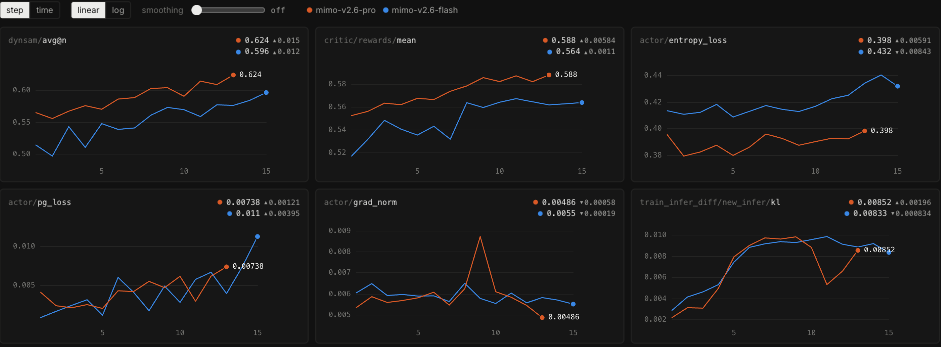
- Reward. The headline metric,
dynsam/avg@n, averages scores across each prompt’s rollouts. It had reached 0.624 for pro (+0.059 since step 1) and 0.596 for flash (+0.083). - Mid-training evaluation. The team periodically scores checkpoints on DeepSWE v1.1, Datacurve’s benchmark of 113 long-horizon software engineering tasks. The scores use the mini-swe-agent harness and average three attempts per task (avg@3). The latest plotted results were 63.72 for pro at step 10 and 60.77 for flash at step 12.
The model sizes and architectures of the V2.6 series are not given on the dashboard. For reference, the previous flagship, MiMo-V2.5-Pro, is a 1.02-trillion-parameter Mixture-of-Experts model with 42 billion active parameters.
How the Runs Work
The metrics give an unusually detailed picture of a large agentic RL setup.
- Long, multi-turn episodes. The average rollout context was about 100,000 tokens (99.6k for pro, 107k for flash). An average episode ran 65 turns on pro and 57 on flash.
- Where the time goes. A single step took 2 hours 36 minutes on pro and 2 hours 5 minutes on flash. Generating rollouts took about half of that: 1 hour 22 minutes on pro and 58 minutes on flash.
- Sandboxes. The
env/activechart showed about 23,700 environments running for pro and 37,800 for flash. - Asynchronous training. Metrics such as
partial/avg_stalenessandtrain_infer_diff/new_infer/klshow that the policy keeps training while rollouts are still being generated. They also track how far the inference engine drifts from the trainer. That KL divergence was around 0.0085 for both runs. - Filtering by outcome. About 15% of prompts had no successful rollouts (
passrate/zero), and about 23% had every rollout succeed (passrate/one). A prompt whose rollouts all score the same gives a group-relative policy gradient nothing to learn from. The “dynamic sampler” (dynsam) panel appears to handle this: it keeps judging prompts until it has accepted 1,568 per step. - Task mix. The sampler’s per-dataset targets list 50 datasets in five groups: code, visual, general, cybersecurity and chat. Code datasets make up about two-thirds of the targets. Visual and general tasks are about 13% and 12%, cybersecurity about 4% and chat about 3%.
The dashboard also shows problems as they happen. One notice said the pro run was “restarting due to a vram issue on one node.” Another said the flash run was restarted from step 15 because “a type of infra error on one of datasets was not correctly detected over the past ~3 hours.” A separate chart tracks the rate of infrastructure errors per sequence, which was 0.85% for pro and 0.51% for flash.
What This Means
Open-weight releases have gradually disclosed more about how models are made. Some labs, such as IFM with K2 Horizon, now publish training logs alongside the weights. Xiaomi’s dashboard makes that information public during training rather than after it. Researchers can see what a production RL run on agentic coding costs: more than $1 million in about two days across two runs. They can also see how slowly the reward curve rises, and how much of the engineering work goes into rollout infrastructure rather than the learning algorithm.
Some caution is warranted. Xiaomi reports the numbers itself, and outsiders cannot audit them. The DeepSWE figures are intermediate checkpoints run by Xiaomi’s own evaluation setup. They are not independent leaderboard entries. Scores from different harnesses or attempt counts are not directly comparable. The series names and the “coming soon” note do suggest a V2.6 release. Xiaomi has not published model sizes, licenses or a release date.
Related Coverage
- Xiaomi Releases MiMo-V2.5-Pro: 1T-Parameter Open MoE Matches Frontier Coding Models: the predecessor generation, released in April 2026
- Xiaomi Shows AI Cube Prototype: Three Chips, 1.22TB/s: Xiaomi’s local-inference hardware effort
- IFM Releases K2 Horizon: Six Open Models With Data, Code, and Logs: another lab that publishes its training logs
- GLM-5.3: Z.ai Scales Post-Training, Holds the Weights Back: another Chinese lab’s bet on scaling post-training
This post was drafted with AI assistance and reviewed by RITS staff.


 沪公网安备31011502017015号