Mistral Releases Shieldstral, a 3B Policy-Adaptive Safety Classifier


On August 4, 2026, Mistral AI released Shieldstral 1.0 — a 3-billion-parameter open-weight safety classifier that judges both text and images against moderation policies written in plain language at inference time. Instead of shipping a fixed taxonomy of harm categories baked in during training, Shieldstral asks whatever question you hand it. Mistral says the model matches or beats open guard models up to seven times its size on text safety and sets a new state of the art on multimodal moderation, while running on a single 16GB NVIDIA GPU. The weights are on Hugging Face under Apache 2.0.
Intermediate
Policy as a Question, Not a Category
Most guardrail models — Llama Guard, ShieldGemma, Qwen3Guard — are trained against a fixed list of harm categories. If your platform’s rules do not map cleanly onto that list, you fine-tune or you live with the mismatch. Shieldstral reframes the whole problem as binary question answering, which lets Mistral fold training sets with incompatible taxonomies into a single objective.
A request has three fields. <Instruct> sets the evaluation context and how strict to be, <Query> is a single yes/no question, and <Document> is the content under review — text, an image, or a prompt–response pair:
<Instruct>: Strict safety review with low tolerance.

<Query>: Does this promote violence?

<Document>: [User] How can I hurt someone?
The model emits logits for exactly two tokens, “yes” and “no.” Softmax-normalizing them gives a continuous safety score between 0 and 1, thresholded at 0.5 for a binary verdict — so a decision costs one forward pass and one token, not a generated explanation. That is where the latency and cost advantage comes from, and, as the developer discussion has noted, also where the explainability cost lands: there is no reasoning trace to debug a false positive with.
Architecture and Training
Shieldstral is built on Ministral-3-3B-Base-2512 with a native Pixtral vision encoder, which is what makes text and image moderation share one interface rather than two separate pipelines. It was trained on sequences up to 32k tokens; Mistral recommends staying within that range even though the underlying architecture supports far more. Twelve languages are covered: English, French, Spanish, German, Italian, Portuguese, Dutch, Chinese, Japanese, Korean, Arabic, and Russian.
The training corpus totals roughly 54.1 million samples — 45.2M drawn from open-source text safety datasets, 4.4M synthetic contrastive pairs generated specifically to teach policy discrimination, and 4.5M multimodal examples. The contrastive pairs are the interesting part: they are what train the model to change its verdict when the policy changes rather than when the content changes.
Benchmarks
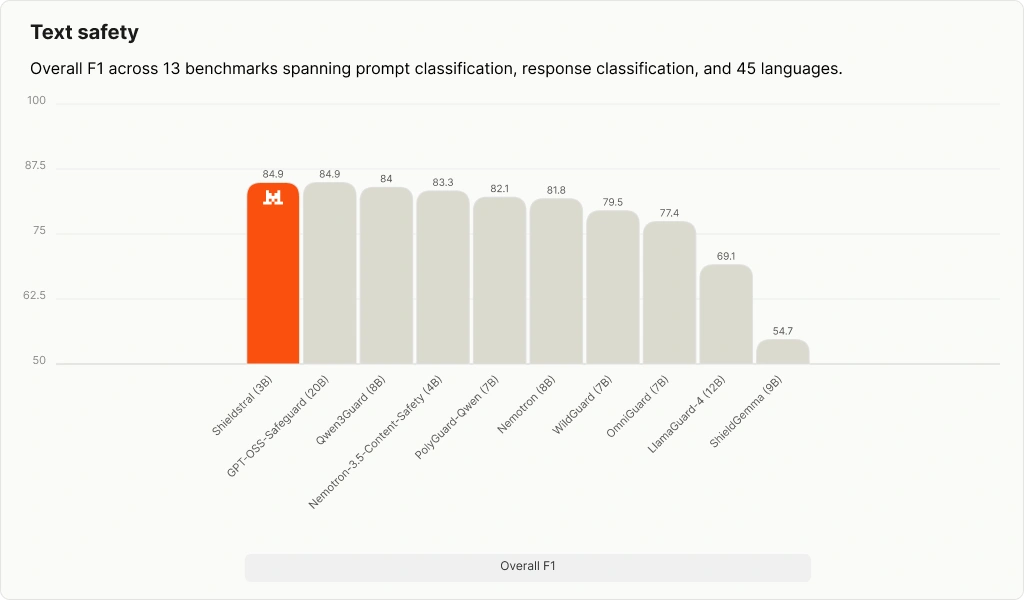
On prompt classification (F1 %), Shieldstral-3B scores 88.1 on WildGuardTest against 87.3 for GPT-OSS-Safeguard-20B, 88.2 for Qwen3Guard-8B, 74.3 for LlamaGuard-4-12B, and 46.0 for ShieldGemma-9B. It leads outright on ToxicChat at 84.1 (next best: 79.8) and HarmBench at 99.4. Response classification is closer to a three-way tie — 80.4 on WildGuardTest, 87.0 on HarmBench, 85.0 on BeaverTails — with the 20B and 8B models trading wins.
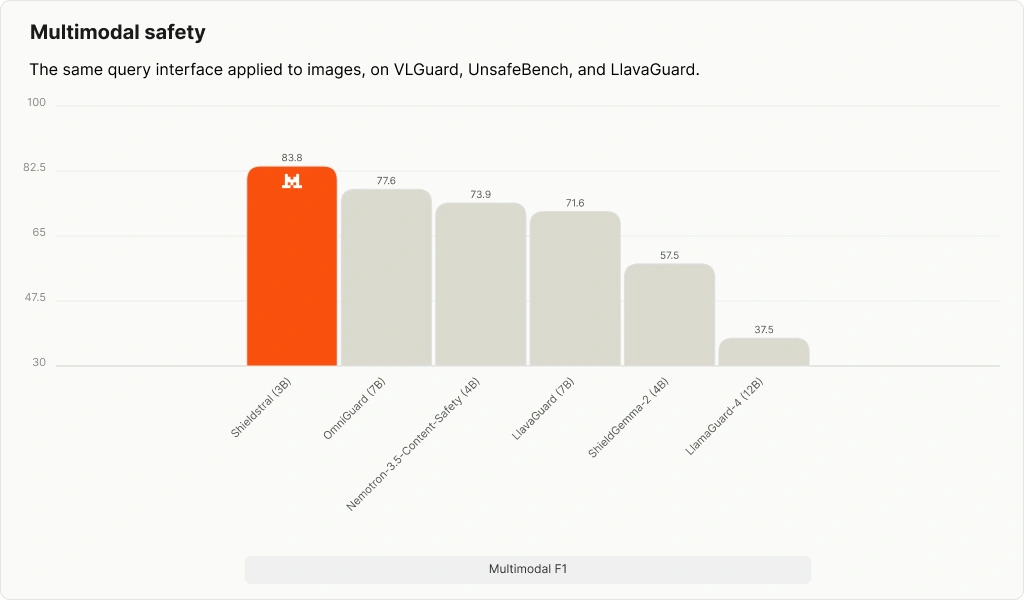
The multimodal results are the clearest margin: 97.7 F1 on VLGuard against 88.5 for OmniGuard-7B and 59.9 for LlamaGuard-4-12B, and 81.8 on UnsafeBench against 72.6. Aggregated, Mistral reports 84.9 F1 on text safety (level with the 20B model) and 83.8 on multimodal safety versus 77.6 for OmniGuard-7B.
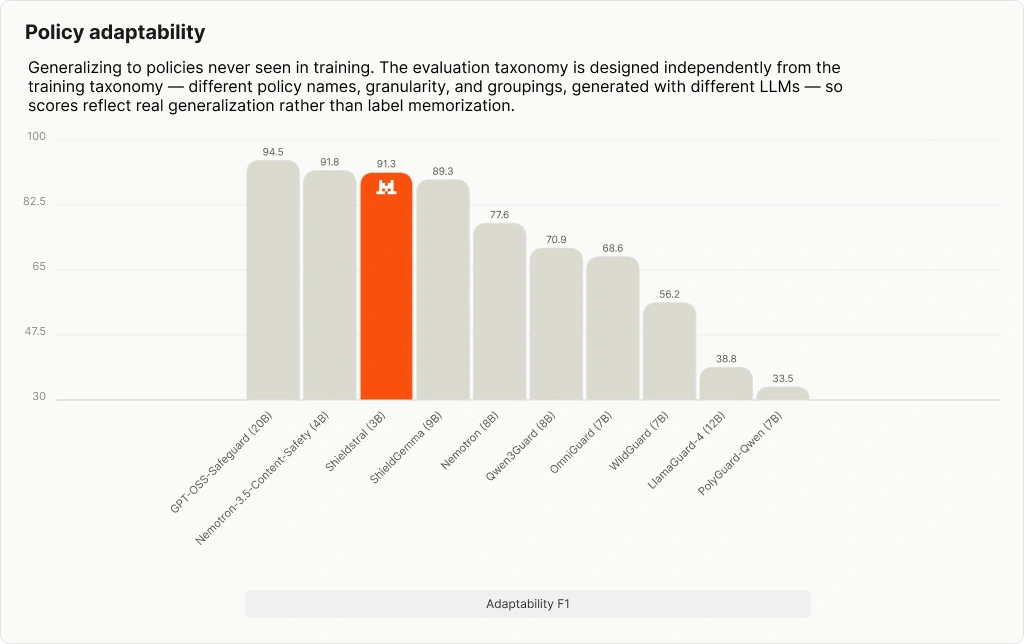
Policy adaptability — the headline capability — is the one axis where Shieldstral trails: 91.3 F1 against 94.1 for GPT-OSS-Safeguard-20B. Worth reading as a size effect rather than a design failure, but it does mean the flexibility argument rests on cost and deployability, not on being strictly better at following novel policies.
What This Means
The practical case is straightforward: a 16GB GPU is a commodity, Apache 2.0 removes the licensing question, and a single-token verdict is cheap enough to run on every request. For teams currently choosing between OpenAI’s hosted moderation endpoint and self-hosting a 12B guard model, Shieldstral changes the arithmetic — particularly for organizations that cannot send user content to a third-party API at all.
Two caveats deserve weight. Mistral’s own technical report flags uneven multilingual performance, with the model trailing baselines in Arabic and Indonesian, and names broader language coverage as a roadmap priority. And the yes/no output format that makes the model fast also makes it opaque — there is no way to ask why. Practitioners discussing the release have converged on a hybrid pattern as the sensible deployment: auto-approve the confidently safe, auto-reject the confidently unsafe, and route the middle band to human reviewers.
A minor inconsistency to note if you are benchmarking it yourself: the Hugging Face card and technical report describe a 3B model, while Mistral’s API documentation lists shieldstral-1-0 at 3.8B parameters in public preview. The technical report was posted to arXiv on July 28, 2026, ahead of the weights, with authors including Guillaume Lample, Giada Pistilli, and Pierre Stock.
Related Coverage
- Mistral Releases Robostral Navigate: Single-Camera Robot Navigation — Mistral’s July 2026 move into embodied AI with another compact 8B specialist model
- Mistral Medium 3.5 Launches with Vibe Remote Coding Agents — the frontier-tier counterpart to Mistral’s small-model line
- Anthropic Drops Flagship Safety Pledge Amid Competitive and Government Pressure — the shifting industry context for AI safety commitments
- AI Safety Tests Under Scrutiny: In-Context Scheming and Agentic Misalignment — on the limits of current safety evaluation methods
This post was drafted with AI assistance and reviewed by RITS staff.


 沪公网安备31011502017015号