MiniMax Ships H3 Weights — With the US and EU Excluded


MiniMax published the MiniMax-H3 weights to Hugging Face on August 3, 2026 — three days after announcing the omni-modal video model and promising an open release “in the coming days.” The checkpoints are real, the quantized build is small enough to matter, and ComfyUI shipped day-0 support. But the accompanying MiniMax H3 Community License carves out four jurisdictions from its grant of rights, and the United States is one of them.
Advanced

What Actually Shipped
H3 generates 4–15 second clips at up to 2K resolution, 24 FPS, with native 32 kHz stereo audio — voice, music, and sound effects generated jointly with the video rather than dubbed on afterward. It accepts text, images, video, and audio as reference input in a single request, across six aspect ratios and eleven languages.
Two inference variants are released. FL2VA handles text-to-video and first/last-frame conditioning with zero to two images. Ref2VA is the omni-reference mode: up to nine images, three videos, and three audio clips, capped at twelve files total.
The Architecture
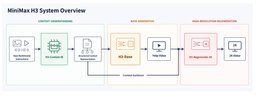
The system is three stages, not one model. H3-Context-IR interprets free-form multimodal input and emits a structured context representation. H3-Base generates at 768p. H3-Regenerate-2K then feeds that low-resolution result back through the base model in-context to reach 2K — an in-context regeneration pass rather than a bolt-on super-resolution network, which is how MiniMax says it preserves small text and fine product detail.

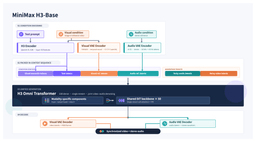
H3-Base is a 33B dense, single-stream transformer — a shared DiT backbone repeated 50 times, performing joint video–audio denoising on one packed sequence. Text conditioning comes from layer-50 features of Qwen3-VL-32B. The visual VAE compresses 16× spatially and 4× temporally; the audio VAE reduces 32 kHz stereo to 40 Hz tokens per channel. Roughly 13B of the 33B parameters sit in AdaLN modulation branches, and because those outputs can be precomputed and cached, they never need to be loaded for inference-only deployment.
What It Takes to Run
That AdaLN trick is the load-bearing optimization. MiniMax replaced the modulation weights — about 40% of parameters — with lookup tables, applied int8 convrot quantization to the shipped weights, and added custom kernels plus dynamic VRAM offloading.

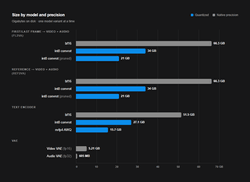
The arithmetic works out to 123.6 GB across all components at native precision, down to 42.5 GB choosing the smallest variant of each — a 66% cut. ComfyUI claims this puts H3 within reach of a 12 GB RTX 3060. Worth reading carefully: 42.5 GB of weights does not fit in 12 GB of VRAM, so that claim rests entirely on dynamic offloading, and the throughput cost of streaming weights on a consumer card is not something the day-0 post quantifies. SGLang, vLLM, and Diffusers are also supported, with SGLang recommending four GPUs and Ulysses parallelism.
On Artificial Analysis, H3 ranks #1 in video editing, #2 in text-to-video at 1241.5 Elo (3.3 points behind Gemini Omni Flash), and #3 in image-to-video behind Seedance 2.0 and Gemini Omni Flash. Those are early figures — human-preference arenas need weeks of blind votes to stabilize, so treat them as indicative rather than settled.
The License Is the Story
H3’s weights ship under the MiniMax H3 Community License, which is not an open-source license in the OSI sense. Two clauses stand out. Commercial users whose products generate more than US$20 million in yearly revenue must obtain separate written authorization from MiniMax. And the grant is bounded by an “Applicable Territory” defined as worldwide excluding the European Union, the United Kingdom, the Republic of Korea, and the United States of America.
That exclusion is new. The license on MiniMax M3, released in June, contains no territorial clause at all. The company also has recent history here: after publishing M2.7’s weights in April 2026, it revised the terms shortly afterward to require written authorization for commercial use, drawing criticism for labeling the result “Modified-MIT.” Anyone building on H3 should read the LICENSE file themselves rather than inferring terms from the “open weights” framing — and should expect the text to be a moving target.
The practical upshot is a genuine capability release with a genuinely narrow legal footprint. For researchers in most of the world, H3 is the strongest openly downloadable video model available. For anyone in Brussels, London, Seoul, or New York, the weights are on Hugging Face and the license says the grant does not reach them.
Related Coverage
- MiniMax Releases H3: 2K Video With Native Audio, Open Weights Promised — our July 31 coverage of the announcement, when the weights were still a promise
- MiniMax M3: Frontier Coding, 1M Context, and Sparse Attention — the company’s June language model, released under a license with no territorial restriction
- Jensen Huang’s First X Post: 150+ Companies Sign Open-Weights Letter, Anthropic Doesn’t — the broader fight over what “open weights” should mean
This post was drafted with AI assistance and reviewed by RITS staff.
Sources
- MiniMaxAI/MiniMax-H3 — model card, architecture, and deployment guide (Hugging Face)
- MiniMax H3 Community License (full text)
- MiniMax H3 Day-0 Support in ComfyUI: Open Weights, Native Audio, and 2K Video
- MiniMax Releases MiniMax H3: An Omni-Modal Video Model (MarkTechPost)
- MiniMax Drops State-of-the-Art AI Agent Model — Then Quietly Changes the License (Decrypt)
- MiniMax M3 license, for comparison


 沪公网安备31011502017015号