MiniMax Opens Music 3.0 Weights — No Territorial Carve-Out This Time


MiniMax published the weights for Music 3.0 on August 13, 2026, releasing an ~11.1B-parameter text-to-music model that generates complete five-minute songs — vocals, arrangement, and production — in a single pass. The weights are on Hugging Face, GitHub, and ModelScope, and ComfyUI shipped support the same day. Notably, the accompanying MiniMax-Music3 Community License contains no territorial exclusion, unlike the H3 video licence that carved out the US, EU, UK, and South Korea eleven days earlier.
Advanced

Two Release Dates, One Model
Music 3.0 is not new as a hosted product. MiniMax’s release notes list music-3.0 as shipping through the API on July 16, 2026, alongside music-2.6 (April 2026) and a lineage running back to Music-1.5 in June 2025. What landed on August 13 is the open-weights drop — the checkpoints themselves, plus inference code.
The Hugging Face repository MiniMaxAI/MiniMax-Music3 is roughly 57.4 GB and contains the condition encoder, language model, RVQ depth decoder, tokenizer, scheduler, and transformer components. The model card gives 24 GB+ of VRAM for full precision, about 22 GB with CPU offloading, and — with layer-by-layer streaming — a path down to 8 GB. The reference implementation in the GitHub README splits inference across two CUDA GPUs: “GPU 0 runs Qwen3 and RVQ generation; GPU 1 runs Flow Matching and waveform decoding.” Inference is supported through SGLang-Omni, diffusers, and ComfyUI 0.33.0 or later.
How It Works
Music 3.0 uses a hierarchical autoregressive design that splits the problem along the time axis and the codebook axis, which is the interesting part.
Audio is compressed by an eight-layer residual vector quantizer. The first layer carries semantic structure and uses a large 16,384-entry codebook; the seven acoustic layers beneath it use 1,024 entries each. Generation is then split between two language models:
- Global LLM (8B), initialized from Qwen3-8B, predicts the first RVQ codebook frame by frame — this is the component carrying long-range musical progression across a whole song.
- Local LLM (0.6B), randomly initialized, predicts the remaining seven acoustic codebooks within each frame.
The fused hidden states then pass through a 2.4B flow-matching module and a 123M Flow-VAE decoder that produces the waveform. Output is 32 kHz, 16-bit stereo WAV, at 25 frames per second with a ceiling of 9,000 acoustic frames. Training ran in two stages: global alignment, then joint training.

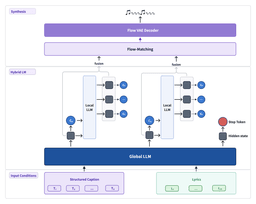
The split is a practical answer to a real constraint. A single autoregressive model over all eight codebooks would need to emit 60,000 tokens for a five-minute track at 25 fps, and 72,000 at the model’s 9,000-frame ceiling. Delegating the seven acoustic layers to a small in-frame model keeps the expensive 8B forward pass running once per frame rather than once per token.
Prompting and Control
Conditioning comes in two channels: a structured caption and lyrics. The caption is organised in three parts — global metadata, vocal details, and arrangement — covering timbre, delivery, breathiness, falsetto, harmony arrangement, and effects such as delay and Auto-Tune, plus instrument entry and exit points and production character.
Lyrics are the creator’s exact words, with structural tags — [Verse], [Chorus], [Bridge], [Pre-Chorus], [Hook], [Intro], [Outro] — placed before each section so the model shapes intensity and phrasing to match. The hosted API accepts 10–1,000 characters of lyrics, exposes an is_instrumental flag, and returns MP3 at 44.1 kHz. It is priced at $0.15 per generation of up to five minutes, the same as music-2.6, at 120 requests per minute.
The Licence, and What Isn’t There
The MiniMax-Music3 Community License is effective August 6, 2026. It grants permission “free of charge, to any person obtaining a copy of this Software … to deal in the Software, including without limitation the rights to use, copy, modify, merge, publish, distribute, sublicense.” Companies with aggregate yearly revenue above $20 million USD need separate prior written authorization from MiniMax before commercial deployment.
What the text does not contain is a geographic restriction. There is no “Applicable Territory” definition and no named excluded countries — a direct contrast with the MiniMax H3 Community License of August 2, 2026, which excluded the United States, the European Union, the United Kingdom, and South Korea from local deployment. MiniMax has not stated a reason for the difference between the two licences.
The acceptable-use policy does carry an obligation worth flagging for anyone publishing output: distributing machine-generated content in public spaces requires “clearly and prominently disclosing” its origin. It also prohibits military applications, election-targeted disinformation, and high-risk automated decisions in domains affecting individual safety or rights.
What This Means
For researchers and student projects, the removed territorial clause is the difference between a model you can run and one you cannot. The H3 licence made that model legally unavailable to a large share of the academic world; Music 3.0 has no such barrier, and the $20 million revenue threshold sits far above anything a university lab or independent artist will encounter.
The honest caveat is evaluation. MiniMax has published no controlled listening test for Music 3.0 — no MOS scores, no A/B comparison against Suno, Udio, or the open ACE-Step line. Claims about vocal realism and arrangement quality are the developer’s own, and 57.4 GB of weights is a large commitment to make on that basis. The upside of an open release is precisely that this is now checkable: unlike the closed commercial systems it competes with, Music 3.0 can be evaluated independently, and that work has yet to be done.
Related Coverage
- MiniMax Ships H3 Weights — With the US and EU Excluded — the video-model licence whose territorial carve-out Music 3.0 does not repeat
- ACE-Step 1.5: Open-Source Music Generation That Rivals Commercial AI — the open music model Music 3.0 now sits alongside
- Foundation-1: A Producer-Focused AI Model for Structured Music Sample Generation — a contrasting approach targeting samples rather than full songs
- MiniMax M3: Frontier Coding, 1M Context, and Sparse Attention — the company’s text-model line
This post was drafted with AI assistance and reviewed by RITS staff.
Sources
- MiniMax Music 3.0: Next-Generation Open-Weights, Production-Ready & Versatile Music Model — MiniMax Research, August 13, 2026
- MiniMaxAI/MiniMax-Music3 — model card and weights on Hugging Face
- MiniMax-Music3 Community License — effective August 6, 2026
- MiniMax-AI/MiniMax-Music3 — reference implementation on GitHub
- MiniMax Music 3: State of the Art Open Weight Music Generation — ComfyUI blog, August 13, 2026
- MiniMax model release notes — API version history
- MiniMax music generation API guide — parameters and prompt format


 沪公网安备31011502017015号