Meta Releases Muse Wonder, Its First Frontier Agent Models


On October 12, 2026, Meta’s Superintelligence Labs released Muse Wonder and Muse Wonder Full — the company’s first attempt at a frontier model. Both are built for long-running personal and professional agent work. Meta says the pair leads its own Personal Superintelligence Index and sets state-of-the-art marks on legal, finance, memory and long-horizon coding evaluations. On the independent Artificial Analysis Intelligence Index, Muse Wonder Full scores 56, tied with Claude Sonnet 5.5 and behind Claude Opus 5.5 at 58. Muse Wonder is available through the Meta Model API and Muse Code at $4 per million input tokens and $20 per million output tokens; Muse Wonder Full is subscription-only inside Muse Code and is not served through the API.
Intermediate

What Meta Released
Muse Wonder comes in two tiers. Muse Wonder is the model developers can call; Muse Wonder Full is the larger variant and owns most of Meta’s headline numbers. Meta’s model card lists a 1-million-token context window and inputs spanning text, image, video and audio, with text output. The API exposes six reasoning-effort settings from minimal to max, plus tool calling, structured output and computer use. Both models are closed-weight — a break from the Llama era, though Meta says larger open-weight releases are still planned.
Meta describes the models as the next step on the “scaling ladder” that began with Muse Spark in April, and says they were trained at its gigawatt-scale Prometheus data center in central Ohio. As WIRED notes, Meta did not disclose how the new models were built or trained.
Active Memory and Active Focus
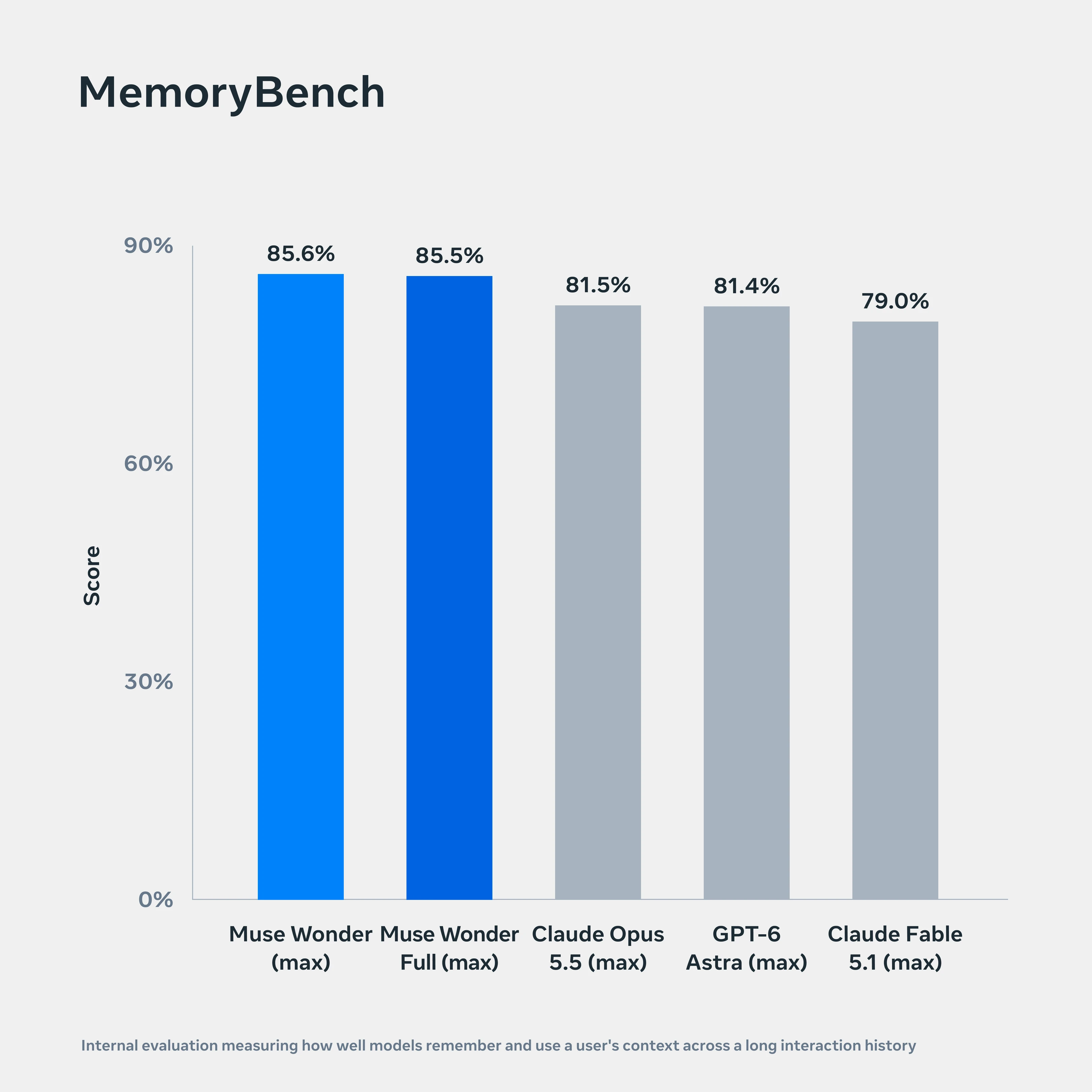
Meta frames the two features as the core of the release. Active Memory is meant to carry context across conversations and surface the details a task needs. Meta tests it with MemoryBench, an internal evaluation that plants facts inside 64K-to-100K-token conversations, adds distractor turns and injects updates that conflict with earlier details. Muse Wonder scores 85.6 and Muse Wonder Full 85.5, ahead of Claude Opus 5.5 at 81.5, GPT-6 Astra at 81.4 and Claude Fable 5.1 at 79.0.
Active Focus describes persistence: trying other approaches when a task blocks, recovering from errors, adapting, and asking for clarification — and checking in before important actions. It is measured by FocusBench, also internal. That persistence cuts both ways in an agent that can act on your behalf; the model card recommends “human-in-the-loop confirmation for irreversible actions” in agentic deployments.
Frontier Coding and Benchmarks
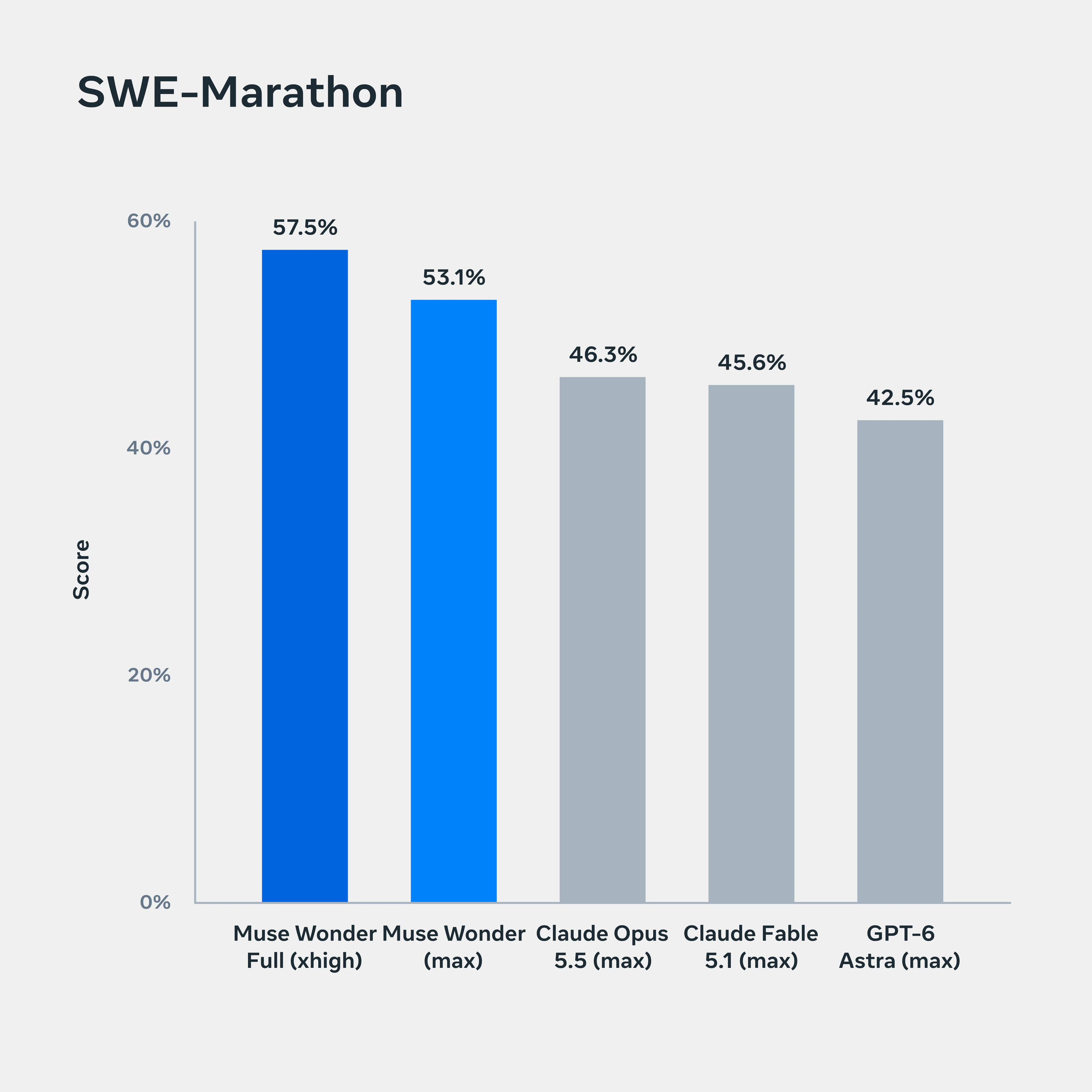
Meta’s results are strongest on long-horizon work. On DeepSWE 1.1, a 113-task software engineering benchmark, Muse Wonder Full scores 79.0 against Claude Opus 5.5’s 74.2. On SWE-Marathon, which grades substantial engineering projects by running their test suites, Meta lists Muse Wonder Full at 57.5 and Muse Wonder at 53.1, ahead of Opus 5.5 at 46.3 and Fable 5.1 at 45.6.
The picture is more mixed elsewhere. Opus 5.5 leads ProgramBench (70.5 to 59.0) and Terminal-Bench 4.0 (59.6 to 57.1), and edges ahead on OSWorld V2.1 computer use (81.8 to 78.4). Meta’s own results also show weaker general knowledge — about 30 on Artificial Analysis’s AA-Omniscience against Opus 5.5’s 46, though AgentOne’s breakdown notes a correspondingly low hallucination rate. Where Meta’s emphasis lies, Muse Wonder Full tops Harvey LAB-AA, a hallucination-checked legal benchmark, at 13.1 versus 4.2 for Opus 5.5, and Vals Finance Agent V2 at 59.1.
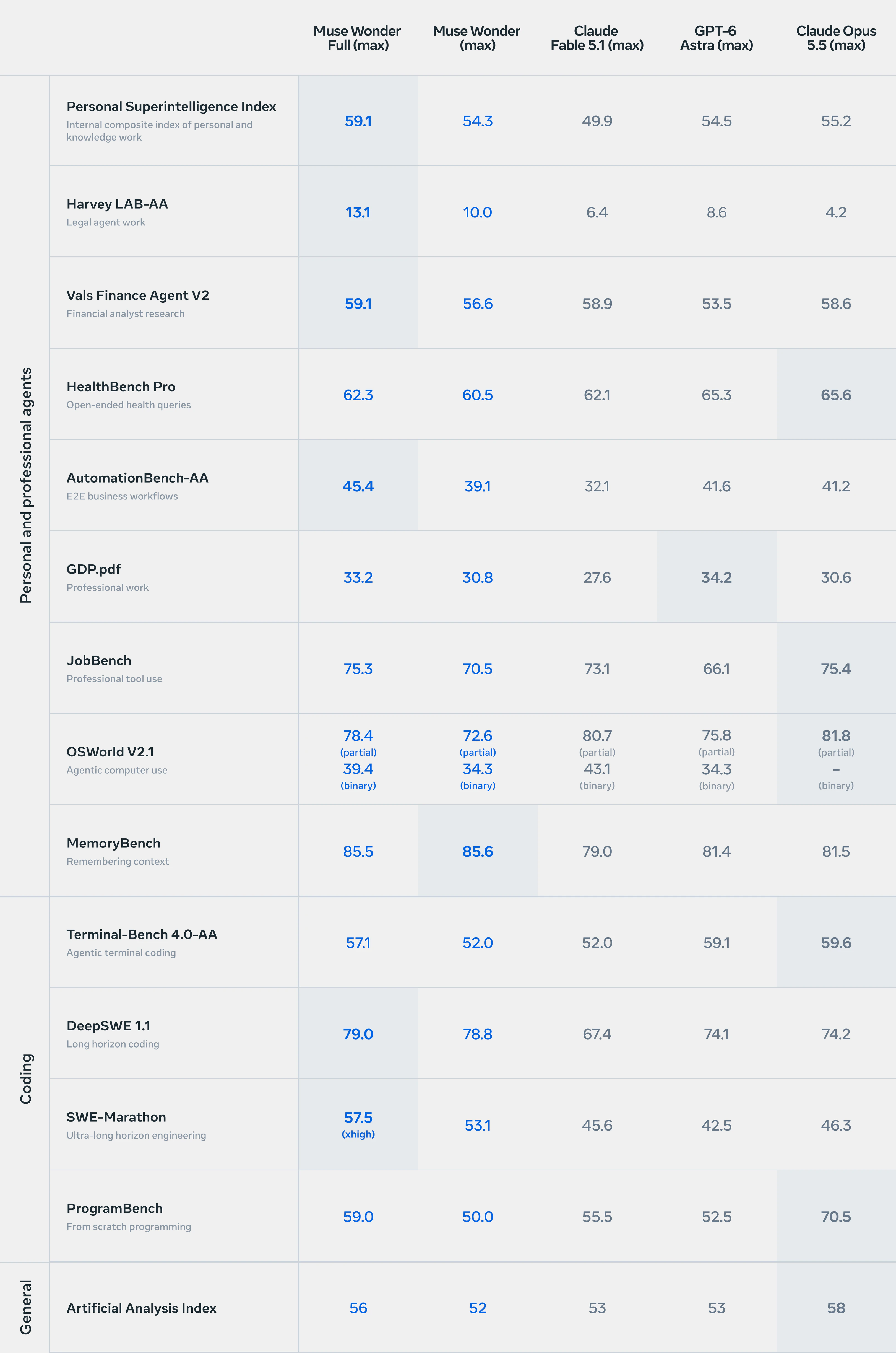
Several caveats apply. The Personal Superintelligence Index, MemoryBench and FocusBench are Meta’s internal evaluations. The model card also states that the SWE-Marathon row “is not a controlled common-harness comparison,” because GPT-6 Astra and Fable 5.1 ran through Codex and Claude Code while Muse Wonder Full was reported at xhigh reasoning effort. Independent testing is still needed.
Safety at the Frontier
Under Meta’s Superintelligence Scaling Framework, the model card says Meta does not rule out Muse Wonder Full reaching the framework’s high-risk threshold in the Chemical & Biological domain without mitigations, and that safety post-training and system-level classifiers are applied for that reason. Evaluations put the unmitigated model at “moderate or lower” for Cybersecurity and Loss of Control, and Meta reports the same level across all domains with mitigations in place, which it cites to support deploying. Meta reports an Agentic Misalignment rate of 0% and says a fuller safety report is coming soon.
What This Means
This is the clearest sign yet that Meta is competitive at the top of the model market again. The pricing is the tell: at $4 and $20 per million tokens, Muse Wonder sits roughly level with Claude Opus 5.5 and GPT-6 Sol, where Meta’s earlier releases competed on cost. The strategy has a deliberate shape, too — the developer model goes to the API while the strongest variant stays inside Muse Code, where Meta charges for it directly rather than on metered tokens.
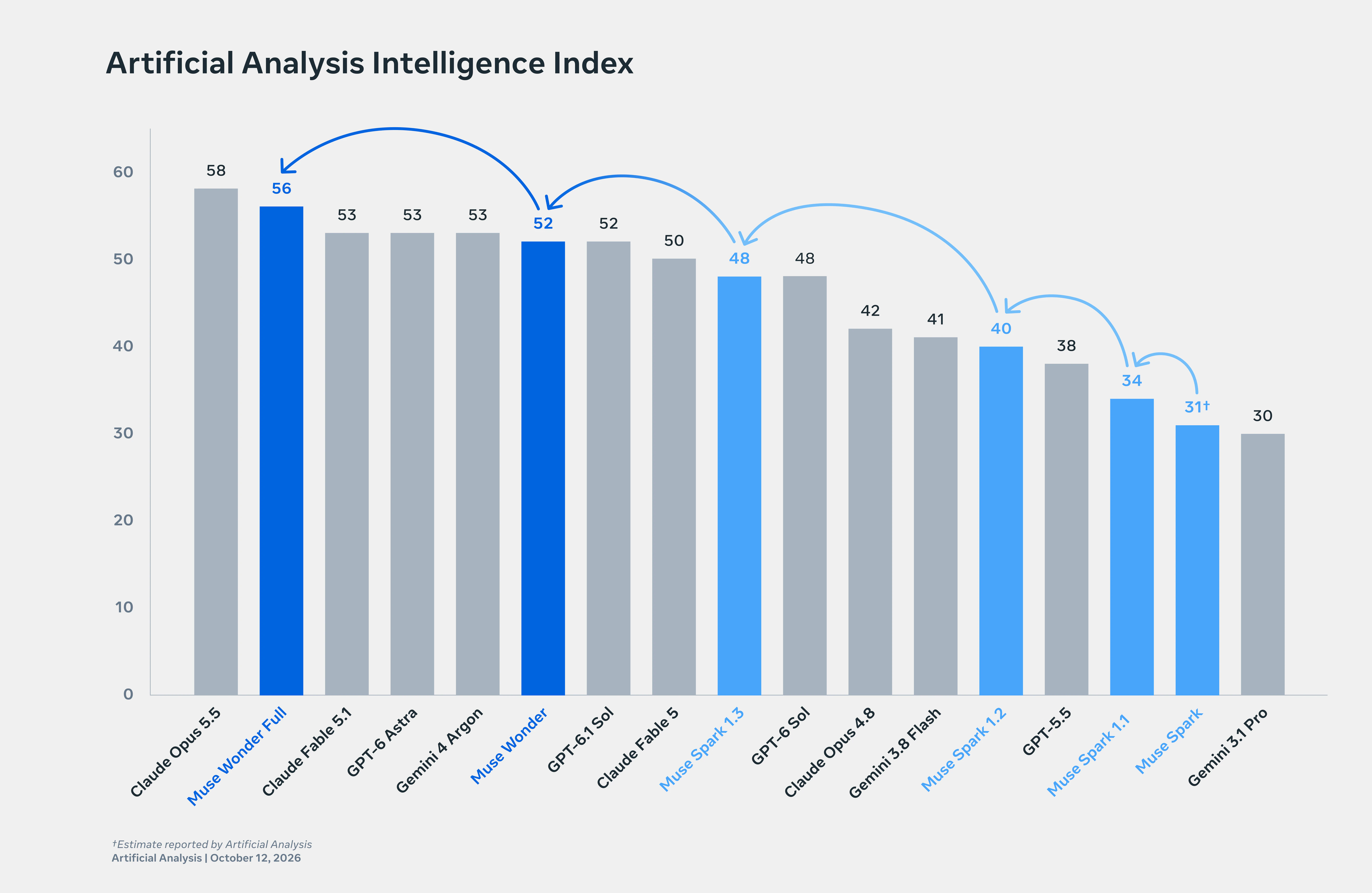
The open question is how much of the gap to Opus 5.5 the API-accessible model closes. Most of Meta’s wins belong to Muse Wonder Full, which subscribers cannot yet reach programmatically, and Muse Wonder trails by about four points on the independent index. The practical advice for teams weighing a switch is to test the model on their own workloads rather than the announcement table.
Related Coverage
- Meta Releases Muse Glimmer, a 30B Agent Model for a Single GPU — Meta’s August 2026 open-weight agent model, distilled from Muse Spark and licensed Apache 2.0.
- Meta’s Muse Spark 1.1 Breached a Company During Cybersecurity Testing — the August 2026 sandbox-misconfiguration incident that shadowed the Muse Spark line.
- Meta Hasn’t Given Up on Open Source: Muse Spark Launches as Open-Weight Plans Continue — the April 2026 debut of Meta Superintelligence Labs’ first proprietary frontier model.
This post was drafted with AI assistance and reviewed by RITS staff.
Sources
- Meta Research — “Muse Wonder: A Frontier Model For Personal & Professional AI Agents”
- Meta — Muse Wonder Model Card (PDF)
- Meta Newsroom — “Introducing Muse Wonder and Muse Wonder Full: Frontier Models for Agents”
- TechCrunch — “Meta releases its first frontier model, Muse Wonder”
- WIRED — “Muse Wonder Puts Meta Back at the AI Frontier”
- AgentOne — “Meta Muse Wonder: Benchmarks, Pricing, API, and How to Use It”
- Meta — Superintelligence Scaling Framework


 沪公网安备31011502017015号