Google Open-Sources WeatherNext: Cyclone Forecasts Gain a Day


On August 6, 2026, Google DeepMind released the code and model weights for its WeatherNext forecasting family on GitHub, alongside a Nature paper reporting that its cyclone model gives forecasters roughly an extra day of warning on tropical storm track, intensity, and size. The release covers three variants — WeatherNext Cyclones, the general-purpose WeatherNext 2, and a compact WeatherNext 2-mini that runs in a free Colab notebook — and marks the first time DeepMind has shipped weather model weights under terms that permit commercial use.
Intermediate

What the Nature Paper Reports
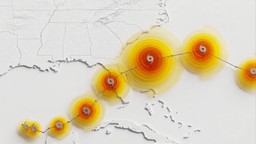
The paper, “Operational Tropical Cyclone Forecasting with AI”, evaluates WeatherNext Cyclones (WN-C) against leading operational systems on tropical cyclones from 2023 through 2025. Across track, intensity, and wind-radii predictions, the authors report “a day or more of lead time advantage” — a three-day WN-C forecast is about as accurate as what prior systems delivered at two days. DeepMind characterises the jump as roughly a decade of conventional forecasting progress arriving in a single model.
The work was co-authored with NOAA/NWS/NCEP’s National Hurricane Center in Miami, the UK Met Office, and the Cooperative Institute for Research in the Atmosphere at Colorado State University, with equal-contribution lead authors Ferran Alet, Tom R. Andersson, Ilan Price, Stratis Markou, Andrew El-Kadi, and Dominic Masters. The model was not evaluated only in retrospect: the National Hurricane Center ran it operationally during the 2025 Atlantic hurricane season, including on Hurricane Melissa’s rapid intensification and landfall in Jamaica.
Technical Details
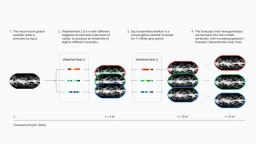
WN-C consumes global analysis data at 0.25° resolution — grid cells of roughly 28×28 km, about a hundred times coarser in area than the regional models traditionally used for hurricane work — and rolls forecasts out to 15 days. Rather than producing a single trajectory, it generates large ensembles of possible storm scenarios: up to 1,000 members, against the 50 typical of conventional ensemble systems. A full 15-day forecast takes under a minute on a single TPU.
The underlying WeatherNext 2 model, announced in November 2025, uses Functional Generative Networks (FGN), which inject noise into the network’s parameters rather than its inputs. The model is trained only on marginal distributions of individual weather variables, yet the ensemble it produces captures the joint structure across variables and locations — the correlations that determine whether a storm’s worst-case scenario is physically coherent.
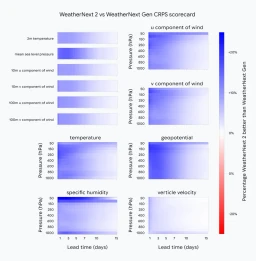
Against its predecessor, WeatherNext Gen, Google reports WeatherNext 2 winning on 99.9% of variables and lead times across the 0–15 day range, and generating forecasts eight times faster. The CRPS scorecard below shows the margin holding across temperature, geopotential, wind components, humidity, and sea-level pressure at every pressure level, with the largest gains concentrated in the first few days.

What You Can Actually Run
The weathernext repository ships checkpoints for both families. WeatherNext 2 arrives as four ensemble-member checkpoints at 0.25°, fine-tuned on ECMWF HRES data. WeatherNext Cyclones ships in operational 2025, 2024, and 2023 variants at 0.25°, plus 1° (~111 km) Mini versions that reproduce the paper’s results at reduced fidelity.
Hardware requirements split along the same line. The full models want a TPU, or an H100 if you are on GPUs; the Mini checkpoints run on a P100 and fit inside Colab’s free v5e-1 TPU runtime, which is what the bundled demo notebook defaults to. Larger checkpoints need a v5p accelerator.
Licensing is the part worth reading closely. The repository places the Colab notebooks and associated code under Apache License 2.0 and the remaining materials under Creative Commons Attribution 4.0 — both permitting commercial use with attribution. DeepMind’s earlier weather releases, GraphCast and GenCast, carried non-commercial weight licences, so this is a genuine loosening rather than a re-publication of the same terms.
What This Means
For research groups, the practical significance is that a state-of-the-art operational cyclone model now runs on hardware a university lab already has — or on none at all, via Colab. The 1° Mini checkpoints in particular turn what was a supercomputing problem into a teaching exercise, and the 2023 and 2024 variants exist specifically so published results can be reproduced rather than taken on trust.
The licence change matters more than it might appear. Weather forecasting has an unusually direct path from model output to commercial product — insurance, shipping, agriculture, energy trading — and non-commercial weights kept that path closed. CC BY 4.0 opens it, which means the interesting question over the next year is less whether the model is accurate than who builds on it, and whether operational meteorological services outside the three that co-authored the paper adopt it.
Two caveats are worth keeping in view. WN-C still takes its initial conditions from conventional numerical analysis — it replaces the forecast step, not the global observing system that feeds it. And the headline lead-time gains are measured over 2023–2025 storms; whether they hold on the seasons that follow is exactly what operational deployment at the National Hurricane Center will establish.
Related Coverage
- Google Ships Gemma 4 QAT Models: 72% Less VRAM, Same Quality — an earlier DeepMind open-weights release aimed at cutting the hardware bar for running its models locally
- Google’s Gemini 3.6 Flash Cuts Agent Token Costs by up to 65% — the most recent DeepMind model refresh on the proprietary side of the house
This post was drafted with AI assistance and reviewed by RITS staff.
Sources
- Operational Tropical Cyclone Forecasting with AI — Nature, 6 August 2026 (DOI: 10.1038/s41586-026-10953-2)
- AI model achieves breakthrough in forecasting cyclones — Google DeepMind
- WeatherNext 2: Our most advanced weather forecasting model — The Keyword
- google-deepmind/weathernext — GitHub repository, code and model weights
- WeatherNext models — Google for Developers


 沪公网安备31011502017015号