DeepSeek Founder Details AGI-First, Compute-Bound Strategy in Investor Meeting


A lightly edited transcript of a nearly four-hour investor meeting with DeepSeek founder Liang Wenfeng, published by Tencent Tech in late July 2026, offers the clearest look yet at the reasoning behind China’s most closely watched AI lab. Across 118 numbered remarks, Liang lays out an AGI-first strategy, frames compute as the single variable separating China from the United States, and defends “restraint” as DeepSeek’s core weapon against far larger tech giants. The disclosure lands alongside reports of DeepSeek’s first external fundraise, a round exceeding 50 billion yuan (~$7.4 billion).
General Audience


A record fundraise, and a philosophy of “restraint”
According to the reporting, DeepSeek’s first external financing round exceeded 50 billion yuan (~$7.4 billion) at a pre-money valuation reported near $54 billion, with further talks and a 2027 IPO said to be on the table. DeepSeek has not officially confirmed the figures. But the meeting’s most quoted theme was not money — it was self-limitation. Liang repeatedly argued that pursuing maximum profit is self-defeating: “If your vision is to take more, you’ve already lost,” and “those who take more will be beaten by those who take less.”
That restraint shows up in pricing. Liang said DeepSeek’s API is designed to recoup equipment costs in roughly ten months, and that despite relatively inelastic demand the company recently cut one model’s price to a quarter of its original level rather than charge what the market would bear. He described DeepSeek as commercializing without commercialization as the goal, and placed a full pivot to profit-seeking “quite far away.”
Compute is the whole game
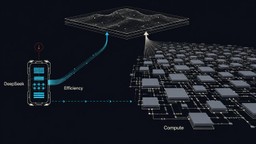
The sharpest claim in the transcript is that nearly every gap between Chinese and American AI reduces to one thing: available compute. “All differences can be attributed to differences in compute resources,” Liang said, adding that “the talent gap is fundamentally a compute gap.” By his framing, DeepSeek is roughly two years behind the U.S. frontier while using about one-twentieth of the compute — a gap he hopes to compress toward six to twelve months.
The binding constraint is procurement, not capital. Liang said money is “not a problem” for survival, but chip scarcity caps what DeepSeek can buy, sketching an annual spend target near 20 billion yuan if the hardware were available. On domestic silicon he was blunt about the current ratio — roughly four Huawei accelerators to match one Nvidia card — while wagering that China’s domestic chip ecosystem will prove itself in real-world deployment within a year. He also noted a striking internal constraint: with annotation budgets tight, about half of DeepSeek’s core researchers were handling data labeling themselves.

The AGI roadmap and staying open source
Liang described a staged path toward AGI: chain-of-thought reasoning (done), agents (the current focus), continual learning (the next priority), a self-iterating “singularity,” and eventually embodied intelligence. “Once the model can learn continuously, it can already do everything humans can do,” he said. Notably, he ruled out chasing video generation, 3D, and world models, keeping DeepSeek narrowly on the main AGI track.
On open source, Liang was emphatic that DeepSeek would release its strongest models, not hold back a better version for itself: “We won’t open-source a weaker model and then use a better one ourselves. Same model.” He cast open sourcing not as charity but as a strategic bet that raises the odds of reaching AGI, arguing that real deployment barriers keep competitors from simply copying the weights.
What this means
The transcript is a bet, made in public: that discipline beats scale, that open weights beat moats, and that China’s compute deficit is temporary. Liang’s forecast of eventual consolidation to “two large, two small” players — with the lowest-margin operators winning — reads as both a market prediction and a description of how DeepSeek intends to compete. Whether the domestic-chip wager pays off inside a year is the most testable claim here, and the one worth watching. As with any founder pitch delivered to investors, the framing is aspirational, and DeepSeek has not confirmed the reported financials.
Related Coverage
- DeepSeek Releases V4: Open-Source 1.6T MoE with 1M Context — the flagship model behind the commercialization strategy discussed here.
- Anthropic Exposes Industrial-Scale Distillation Attacks by DeepSeek, Moonshot, and MiniMax — context on the open-source and IP debates around DeepSeek.


 沪公网安备31011502017015号