IntermediateAI
Apple’s M5 Ultra Mac Studio: 512GB of Unified Memory for Local AI
- AI Chips
- Apple Silicon
- apple
- local inference
- memory bandwidth
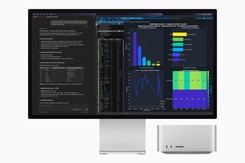
On August 25, 2026, Apple announced a new Mac Studio built around the M5 Max and the quad-die M5 Ultra — a desktop configurable with up to 512GB of unified memory and 1.2TB/s of memory bandwidth. Apple is pitching it explicitly at people running large language models locally: the company says the M5 Ultra configuration can hold models with hundreds of billions of parameters entirely in memory, and that four machines can be clustered over Thunderbolt 5 with RDMA into a single shared memory pool.


Technical Details
The M5 Ultra is the first M-series part to use a quad-die design. Apple builds it by joining two dual-die M5 Max chips with a next-generation UltraFusion interconnect, which MacRumors reports carries more than 4.4TB/s of inter-die bandwidth. The result scales to a 36-core CPU (12 “super” cores and 24 performance cores), an 80-core GPU with Neural Accelerators, and a 32-core Neural Engine. Memory tops out at 512GB with 1.2TB/s of bandwidth — a 50% increase over the M3 Ultra it replaces.
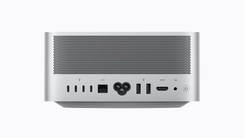
The M5 Max sits well below that: an 18-core CPU (6 super, 12 performance), up to a 40-core GPU, up to 128GB of unified memory, and 614GB/s of bandwidth — roughly half the M5 Ultra’s memory throughput. Both configurations move to PCIe Gen 6 storage, which Apple rates at up to 2x the previous generation’s speed, and carry Thunderbolt 5 ports at 120Gb/s alongside Wi-Fi 7 and Bluetooth 6 via Apple’s N1 wireless chip.

The Inference Numbers
Apple’s headline AI claim is up to 4.3x faster AI performance on the M5 Ultra versus the M3 Ultra, and up to 3.9x on the M5 Max versus the M4 Max. More concretely, Apple cites LM Studio prompt processing as up to 9.8x faster than a Mac Studio with M1 Ultra and up to 4x faster than the M3 Ultra generation. General-purpose gains are far more modest by comparison — 1.25x single-threaded and 1.3x multithreaded against the M3 Ultra, with graphics about 40% faster.
That gap between the AI figures and the CPU figures is the story of this release. The chip is not dramatically faster at ordinary work; it is much wider at the specific thing local inference depends on, which is moving weights out of memory. Johny Srouji, Apple’s chief hardware officer, called the machine “the ultimate desktop for on-device AI” in the announcement.

Clustering Over Thunderbolt
The other new capability is RDMA — remote direct memory access — over Thunderbolt 5, which lets one machine read another’s memory without going through the usual networking stack. Apple says a four-system cluster delivers up to 3x the AI inference performance of a single machine. That is a sublinear return on four times the hardware, which is what you would expect once weights are sharded across an interconnect an order of magnitude narrower than on-package memory, but it does raise the ceiling on model size beyond what one box can hold.
What This Means
For a lab weighing local inference against API spend, the relevant number is not 512GB but 1.2TB/s. Capacity determines which models fit; bandwidth determines how fast they run. A dense model whose weights occupy most of that 512GB would be reading close to half a terabyte per token, which puts single-digit tokens per second within reach at best — the capacity is far more useful for sparse Mixture-of-Experts models, where only a fraction of the weights are touched per token, and for long-context work where the KV cache is the thing that will not fit elsewhere.
The pricing reflects that positioning. The M5 Max Mac Studio starts at $2,499 ($2,299 education) and the M5 Ultra at $5,499 ($5,099 education), with pre-orders open now and most configurations shipping September 22. The 512GB configuration arrives separately in late October; MacRumors expects it to start well above $10,000. That is a serious capital purchase for a research group, but it is also a one-time cost against a machine that keeps data on-premises — a consideration that matters more for some datasets than any tokens-per-second figure does.
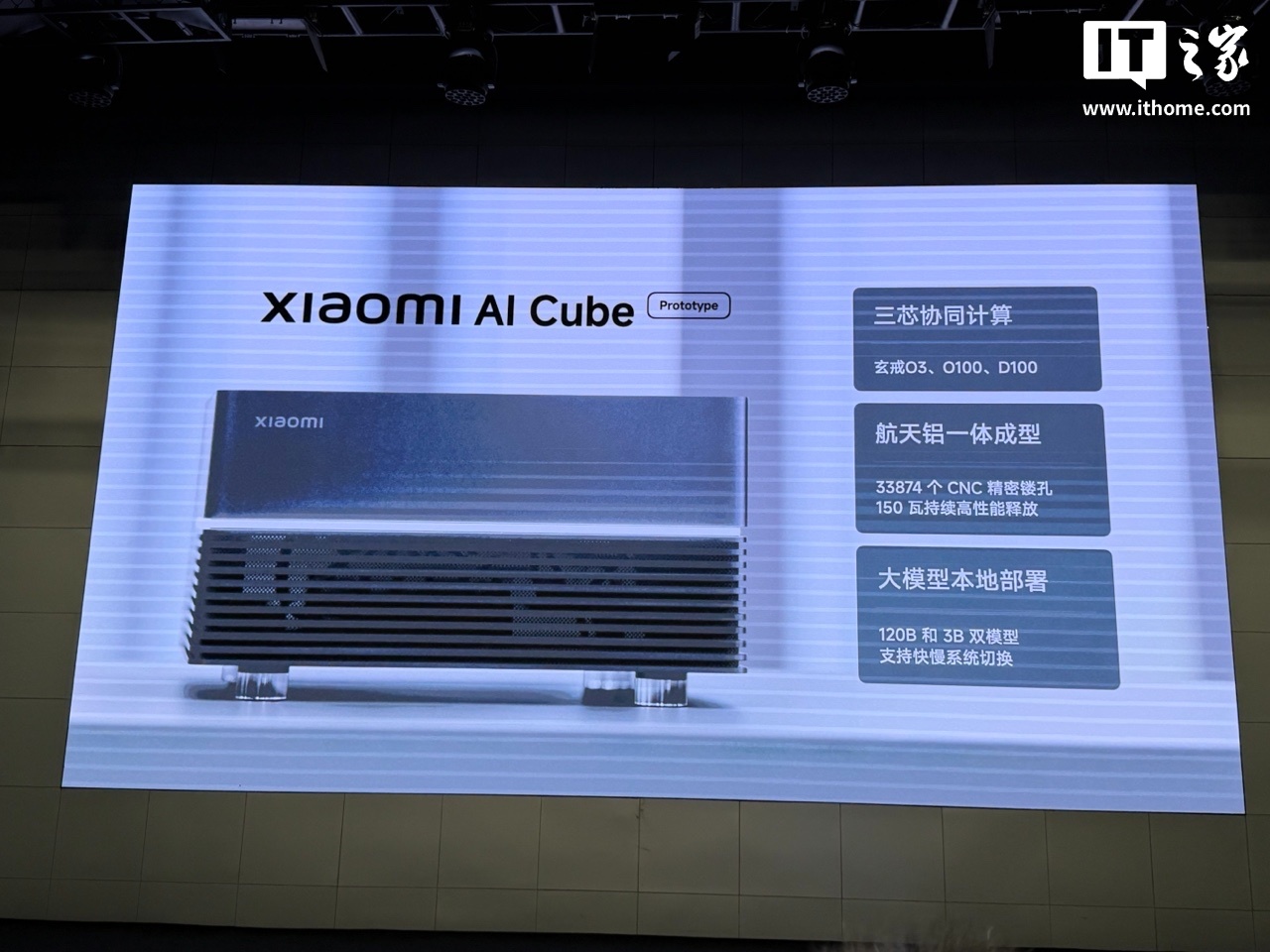
It is worth noting how crowded this niche has become. Xiaomi’s AI Cube prototype, shown the day before Apple’s announcement, targets almost exactly the same bandwidth figure at 1.22TB/s using three of the company’s own chips. The high-memory local-inference desktop is no longer a single-vendor category.
This post was drafted with AI assistance and reviewed by RITS staff.
Sources
- Apple introduces new Mac Studio with M5 Max and M5 Ultra — Apple Newsroom, August 25, 2026
- Apple introduces M6 and M5 Ultra for a big leap in performance and AI compute — Apple Newsroom, August 25, 2026
- Apple Unveils New Mac Studio With M5 Max and M5 Ultra Chips — Hartley Charlton, MacRumors, August 25, 2026




 沪公网安备31011502017015号