AdvancedAI
ISTA Deletes Half of DeepSeek’s Experts and Keeps 95% of SWE-bench
- deepseek
- inference
- mixture of experts
- open weights
- quantization
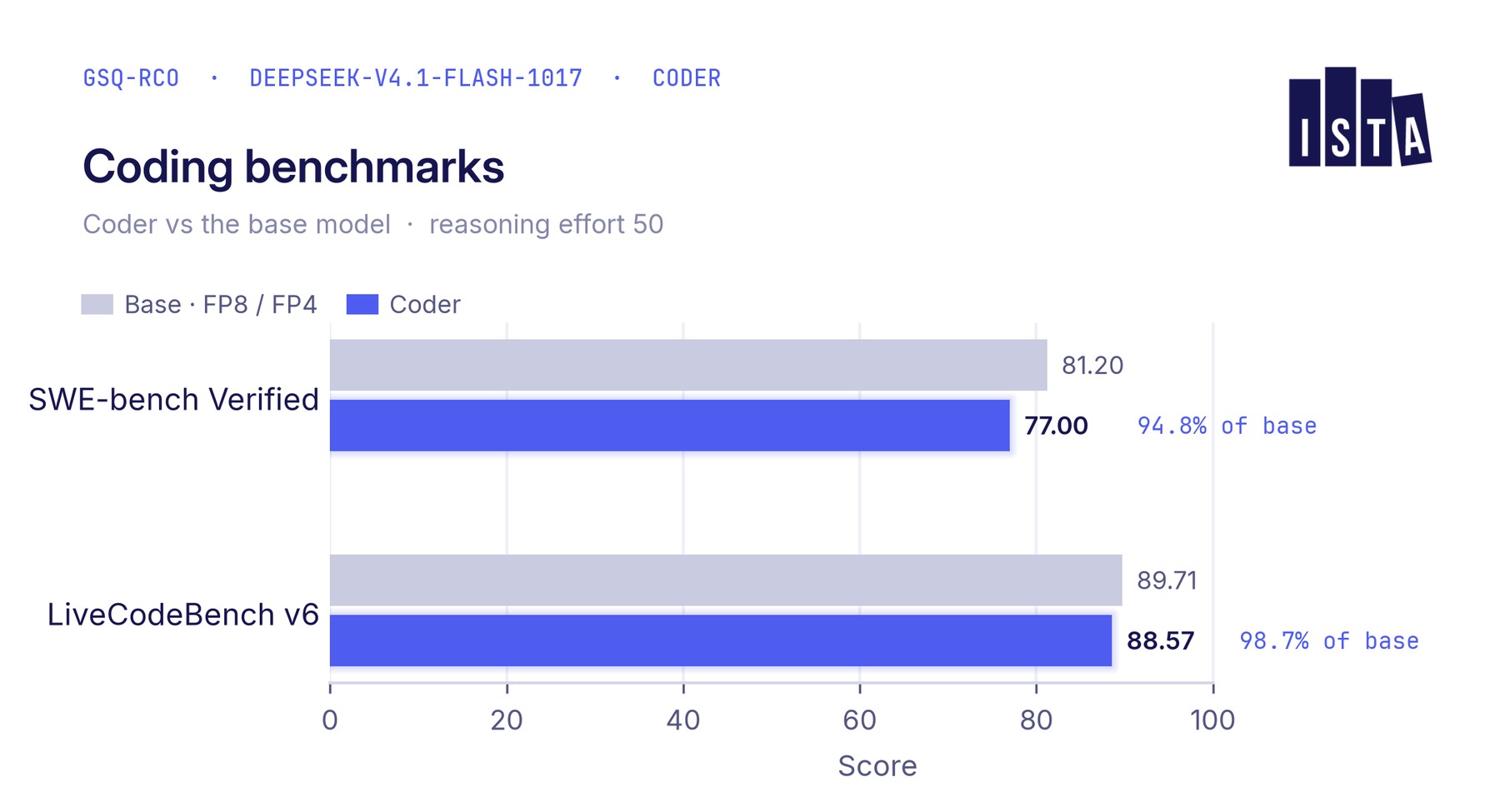
Researchers at IST Austria’s Deep Algorithms and Systems Lab published a 72.1 GB build of DeepSeek-V4.1-Flash-1017 on November 2, 2026 that deletes half of the model’s experts rather than compressing them. The Coder build removes 192 of 384 routed experts in every layer and quantises the rest, cutting the transformer file from 138.2 GB to 72.1 GB while keeping 94.8% of the base model’s SWE-bench Verified score.
Pruning is not quantization
The model is a mixture of experts with 384 routed experts per layer and 6 active for any given token, so the experts hold most of the parameters while only a fraction runs at a time. Quantization keeps every one of those parameters and stores it in fewer bits. Pruning removes parameters outright, which cuts both the file and the resident memory and shrinks the pool the router can choose from. The Coder does both: 192 experts per layer are gone, and the survivors keep the per-tensor types of the lab’s earlier IQ2_XXS build.
The arithmetic in the card is unusually careful about what the headline number means. The 72.12 GB of transformer weights divided by the original model’s 551.9B transformer parameters gives 1.05 bits per parameter, because each deleted expert counts as zero. Measured against the 280.1B parameters the build actually keeps, the rate is 2.06 bits. Counting the Engram lookup tables as well puts the whole download at 1.92 bits per parameter.
Choosing which experts to delete
An expert’s importance is not intrinsic: experts specialise, so which ones matter depends on the inputs you care about. ISTA used its RCO method to pick them, optimising the KL divergence between the pruned and unpruned model on calibration data rather than ranking experts by a heuristic score. The search runs on the quantised build, which is both the model being pruned and the reference, so it keeps the experts whose removal changes that build’s outputs least under the quantization it ships with.
The GGUF format forces one constraint that shapes the method. It stores a single expert count for the entire model, so every layer has to keep the same number, even though the right answer would remove more from insensitive layers and fewer from sensitive ones. RCO handles that by treating one exact budget per layer as a constraint on a smooth manifold: the constraints decompose by layer, while the loss still couples them, so the layers are optimised jointly and only budget enforcement is local.
What survives, and what is being traded away
The calibration data is tilted towards code, agentic tool use, long context and vision, and the retained experts are those that support it. The card is explicit that capability outside that set is an accepted cost, and that general-purpose users should take the unpruned release instead. The two headline benchmarks show the same asymmetry: single-problem code generation barely moves, while sustained multi-step work on real repositories loses about five points, which the authors read as error accumulating across turns.
What This Means
This is the first compression release from this lab that treats which parameters to keep as a design decision rather than a property of the format. Deciding that a frontier model should become a coding model, and then deleting the parts that are not, is a different claim from “the quantized build loses nothing” — and a more honest one, because it names what is being given up.
The practical catch is memory, not disk. A 182.72 GB download still needs the Engram table memory-mapped and read a row at a time, and the lab’s own tooling points at a single NVIDIA GPU through the Strata engine or a recent llama.cpp build. Half the transformer in an eighth of a byte per weight is a real saving; it is not the same as fitting a 763B model into a workstation.
This post was drafted with AI assistance and reviewed by RITS staff.
Sources
- Hugging Face — ISTA-DASLab/DeepSeek-V4.1-Flash-1017-GSQ-RCO-Coder-GGUF (model card, file table, expert-selection notes, MIT licence; repository created November 2, 2026)
- arXiv 2605.00649 — Model Compression with Exact Budget Constraints via Riemannian Manifolds
- arXiv 2604.18556 — GSQ: Highly-Accurate Low-Precision Scalar Quantization for LLMs via Gumbel-Softmax Sampling
- GitHub — IST-DASLab/RCO and IST-DASLab/GSQ



 沪公网安备31011502017015号