IntermediateAI
Google’s Orbital TPU Answers Its First Prompt From Space
- Hardware
- inference
- space
Google reported on October 30, 2026 that its Project Suncatcher prototype satellite returned the first AI response generated by a data-centre-class TPU in orbit. During a ground-station pass over Svalbard, Norway, the team uplinked a prompt to an onboard Gemma 4 model asking for a haiku about being in space, and the answer came back down the same link. The satellite itself launched on October 1 aboard a SpaceX rideshare mission.

What the satellite actually did
The commissioning sequence matters more than the poem. Since launch the team had powered up the host and TPU trays and run early machine-learning tests, and the October 30 pass was the first time a full response was generated on orbit and downlinked. After the haiku, Google says it tested space-themed limericks and telemetry prompts reporting the status of the payload systems — ordinary inference, in other words, not a single staged demo.
Google frames the milestone as proof that its accelerators can execute workloads in space at all. The next round of tests is aimed at thermal stress and radiation exposure in orbit, which are the two failure modes that cannot be fully simulated on the ground.
The three problems: launch, radiation, cooling
Google’s September write-up of the mission lists what it had already tried before launch. A ride to low Earth orbit lasts about ten minutes, with the spacecraft seeing sustained loads up to 10 g and individual components up to 50 to 100 g; the team shook the satellite on all three axes to mimic launch frequencies and reported that the hardware held up. Radiation was tested by running AI workloads on TPUs in a proton beam at UC Davis’s Crocker Nuclear Laboratory while watching for bitflips, and Google says its Trillium chips survived a total ionizing dose greater than a five-year mission would deliver.
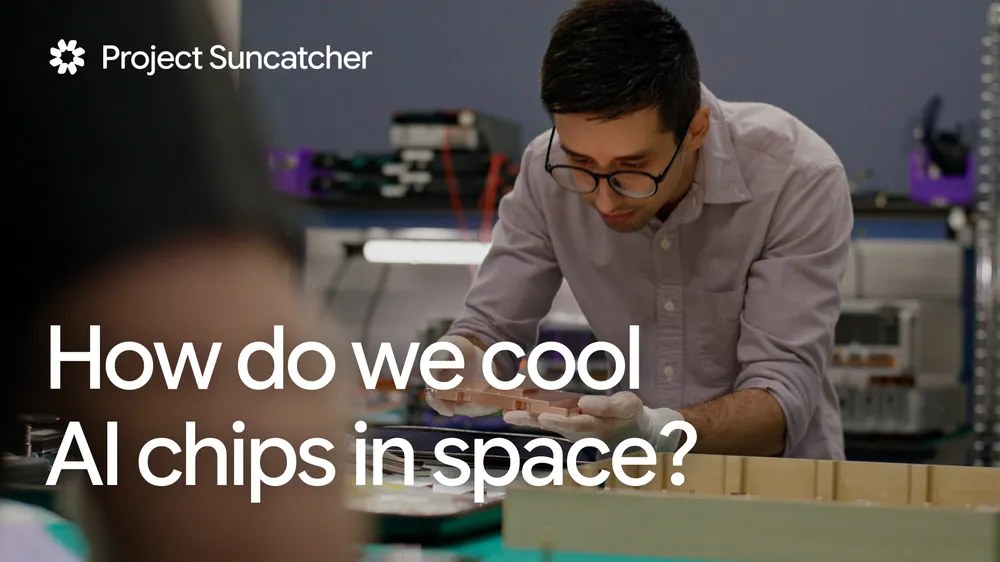
Cooling is the part that has no terrestrial shortcut. There is no airflow in vacuum, so heat has to leave through radiators, and the team is working on a combination of heat pipes and radiator panels validated in a thermal vacuum chamber. That work is why the orbit tests matter: a design that passes on the ground still has to reject heat across the day-night cycle of an orbiting spacecraft.
The hard milestone is the laser link
One satellite running one model is a demonstration. The architecture Google describes is clusters of satellites, each carrying dozens of TPUs, which only works if the spacecraft can talk to each other at high bandwidth over short distances. Google’s own comparison is hitting a coin-sized target from miles away while both points are moving, and it says the free-space optical links it needs are a different problem from the long-range, low-bandwidth laser systems already flying. Two interconnected satellites are scheduled for 2027.
The economic argument is straightforward: in low Earth orbit a satellite can see near-constant sunlight and generate up to eight times more solar power than the same panel on the ground, with radiative cooling into deep space instead of chillers. The Independent reported that critics question whether the economics hold and warn that the satellite numbers involved would raise collision and debris risk, and noted that SpaceX has floated up to a million satellites for orbital data centres. Google’s own posts present the work as a long-term research programme rather than a product plan.
What This Means
The interesting result is not the haiku but the fact that the arithmetic of orbital compute has moved from a paper to a payload. Radiation tolerance and launch survival were the two questions that could be answered cheaply on the ground, and Google answered both before flying. What remains genuinely unknown is thermal behaviour in orbit, link precision between spacecraft, and whether servicing or replacing failed hardware in a constellation can ever be affordable.
For the AI infrastructure debate, this is a long-horizon option rather than a near-term answer to data-centre power. The launch costs, the radiators and the interconnect all have to work at constellation scale before orbital inference competes with a terrestrial campus. But a working TPU in orbit changes the burden of proof: the remaining objections are now engineering and economics, not physics.
This post was drafted with AI assistance and reviewed by RITS staff.
Sources
- Google — We’ve received our first response from the Project Suncatcher prototype satellite (Travis Beals, October 30, 2026)
- Google — Behind Project Suncatcher, our moonshot to put AI in space (September 24, 2026; launch loads, radiation testing, cooling, interconnect)
- Google — the Project Suncatcher prototype launch announcement (October 1, 2026)
- The Independent — Google’s space AI is online and writing poetry (Anthony Cuthbertson, November 2, 2026)


 沪公网安备31011502017015号