General AudienceAI
Qwen Restates Its Open-Weight Promise, Max Tier Still Closed
- llm
- open source
- open weights
- qwen
Qwen’s open-source numbers were put back into circulation this week: more than 460 open models, over 3 billion downloads and over 300,000 derivative models, presented as proof that the series will keep opening its weights. The figures and the commitment behind them date from Alibaba’s Yunqi conference on September 22, 2026, where Qwen’s new head said the value of AI “should not belong only to a few enterprises”. What the week added was a reading of that commitment — that Qwen 4 and Qwen 5 will both be open — that is firmer than anything Alibaba has actually published.
What was actually said
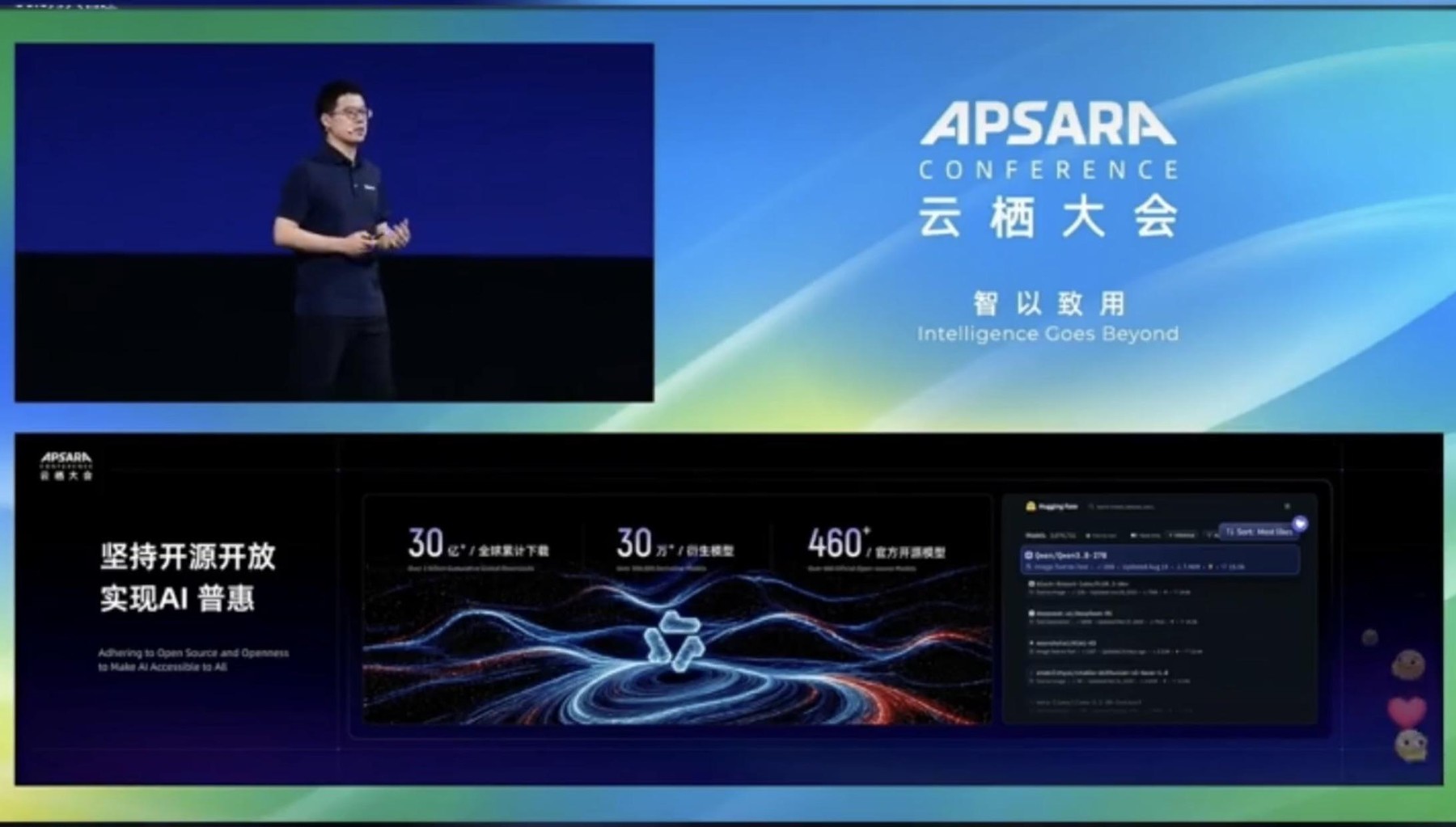
Dayiheng Liu took the stage at Yunqi in Hangzhou on September 22 in his first public appearance as head of Qwen, and set out a five-part roadmap. Openness was the fourth part. His argument was that “the value of AI should not belong only to a few enterprises, but should become a basic capability that users all over the world can access, use and create”, and he then said Qwen would continue to adhere to open source and openness.
The evidence offered alongside it was the slide above: more than 460 models open-sourced, more than 3 billion cumulative downloads worldwide, and over 300,000 derivative models, which Alibaba has described as the largest such ecosystem. Those counts were reported independently in August, when Qwen passed 3 billion downloads and overtook the open-weight families from Meta and Google on the same measure.
The roadmap the promise sits in
The same presentation put a date-free shape on what comes next. Qwen 4 is training on a new-generation architecture, with the 27B tier named as the first model to be opened. Qwen 4.5 and Qwen 5 are planned at 5 to 10 trillion parameters, which is a statement about scale rather than about licensing.
That is the whole of the published commitment. There is no licence, no parameter count for the Max, Plus or Flash tiers, no timetable, and no statement that every model in those generations will carry weights. On November 2 there was also no Qwen 4 model card, no API identifier and no repository — the family had been announced as in training six weeks earlier and had not shipped.
Why the doubt had somewhere to land
The Max line has not carried weights for over a year. Qwen3-Max-Preview in September 2025 shipped API-only, and Qwen3.6-Max-Preview in April, Qwen3.7-Max in May and Qwen3.8-Max-Preview in July did the same. Through that stretch the open releases were the smaller tiers, most recently the 27B dense models under Apache 2.0, and there were months in mid-2026 with no new open general-purpose checkpoint at all.
So the split is not a rumour; it is the operating policy. The flagship is a hosted product and the open tier is a smaller, downloadable model. What the September slide establishes is that the second half of that policy continues. It does not establish that Qwen 4’s flagship will be downloadable, and Alibaba has not said that it will.
What This Means
Open-weight commitments are cheap to restate and expensive to keep, and the useful signal is not the sentence but the tier it applies to. Read that way, Qwen’s position is consistent and fairly clear: a 27B-class open model per generation, a hosted flagship above it, and no promise that the gap will close.
For anyone planning around Qwen, that makes the practical question narrow. The self-hostable ceiling is the 27B line and whatever Qwen 4’s 27B tier turns out to be, not the Max model whose benchmark scores get quoted. Labs that need frontier capability are buying API access from Alibaba either way, and a restated commitment does not change the licence terms of a model that has not shipped.
This post was drafted with AI assistance and reviewed by RITS staff.
Sources
- 36Kr — Qwen’s new top leader makes his debut, can Liu Dayiheng withstand the pressure? (September 23, 2026; the Yunqi roadmap, the open-source commitment and the download counts)
- Fortune — Alibaba AI models hit 3 billion downloads, passing Meta, Google (August 15, 2026)
- Business Standard — Alibaba’s Qwen AI models cross 3 billion downloads (August 15, 2026)
- Digital Applied — Qwen’s Closed-Flagship Pivot: The Open-Weight Retreat (July 22, 2026; the API-only Max lineage)
- OrcaRouter — Qwen 4: CTO Set the Week of November 2, Nothing Shipped (November 2026; what Alibaba has and has not published for Qwen 4)


 沪公网安备31011502017015号