IntermediateAI
Google Opens Gemini 4 Carbon, and Robotics 2.5 Gets a Safety Test
- Gemini
- Google DeepMind
- Robotics
- benchmarks
Google put Gemini 4 Carbon on general sale on November 10, 2026, at $2 per million input tokens and $10 per million output tokens — the same introductory rate as Gemini 4 Argon, and one that doubles on December 1. The model RITS covered in October as a cyber-defender release is now on the public price list, and the same day Google DeepMind shipped Gemini Robotics 2.5, a vision-language-action model tested on Mercedes-Benz production lines. The two share an engine: Argon generated the robot’s simulated training data and now serves as its safety layer.

From invite list to price list
Carbon launched on October 28 to a set of cybersecurity defenders through Google’s Fairwind Program, with no general availability. It is now in AI Studio and Gemini for business via the paid API tier, rolling out to AI Ultra subscribers in Antigravity, the Gemini app and AI Mode in Search, and joining Argon in the free six-month access programme for 10,000 researchers.
Google is not pitching it as a replacement. Its post says Argon “remains the ideal choice for the majority of software engineering and knowledge work,” while Carbon targets tasks that test a model’s limits and “uses more tokens than Argon to explore thoroughly, reason deeply, and run extended verification loops.”
| Gemini 4 Carbon | Through Nov 30 | From Dec 1 |
|---|---|---|
| Input, per 1M tokens | $2.00 | $4.00 |
| Output, per 1M tokens | $10.00 | $20.00 |
| Cached input, per 1M tokens | $0.10 | $0.20 |
| Free tier | None | None |
Google’s Gemini API pricing page, read November 12, 2026. Thinking tokens bill as output; Google states paid-tier prompts are not used to improve its products.
Google is also previewing /swarm in Antigravity, turning one prompt into coordinating agents: Carbon on architecture, coordination and auditing, lighter models in parallel workspaces, and separate verifiers testing each change.
What the benchmarks show
Google says Carbon ranks first on CursorBench 4.0, Perplexity’s WANDR and Zapier’s AutomationBench at “more than 2X lower cost per task” than the next-best external model, and second on the Multimodal Knowledge Agent benchmark at more than six times lower average cost.
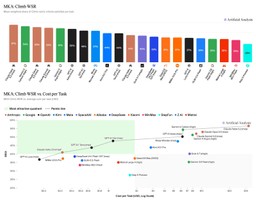
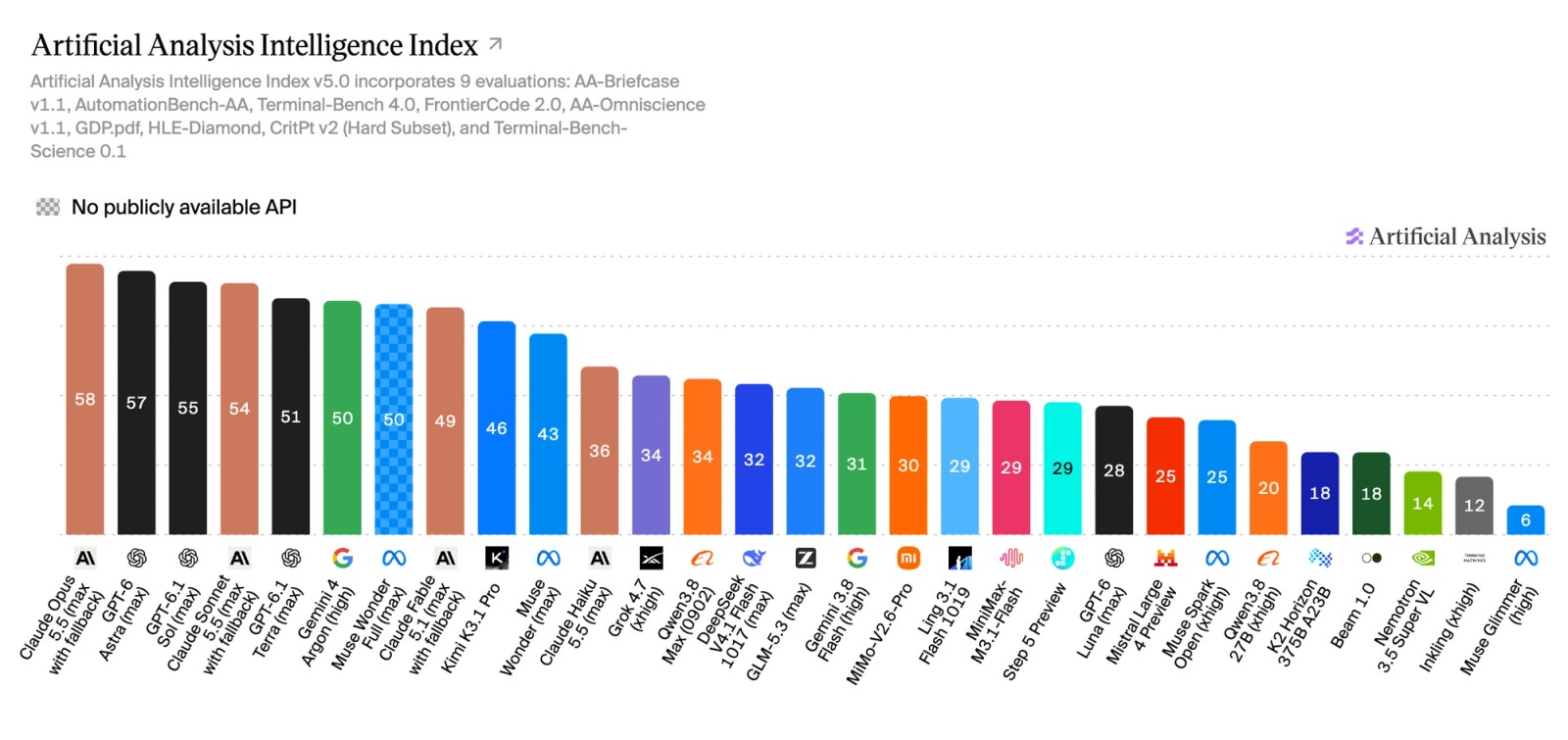
Artificial Analysis’s published numbers land close but not exactly there: Carbon at 54% Climb WSR on MKA, behind Claude Fable 5.2 at 57% and ahead of Claude Opus 5.5 at 53%, at $6.29 per task against $31.98 for Fable — a little over five times, not six — and $1.11 for GPT-6.1 Sol. MKA sets 200 private tasks across 10 industries, requiring agents to read schematics and scans and produce decks, spreadsheets and marked-up images, judged in the open-source Stirrup harness. On Intelligence Index v5, where Carbon scored 59 at launch, Artificial Analysis measured $7.76 per task at standard pricing and 123,000 output tokens per task; its hallucination rate on AA-Omniscience is 11%, up from 4% on Argon, while accuracy rose ten points.

A robot on the same stack
Gemini Robotics 2.5 was evaluated across more than 200 tasks — tying a ribbon bow, serving food with tongs, pipetting liquid — with DeepMind reporting success rates 30% to 100% higher than the previous baseline and tasks 20% to 30% faster. It drives Apptronik’s Apollo 2, which uses the 22-degree-of-freedom SharpaWave hand, and Franka’s two-arm Duo.
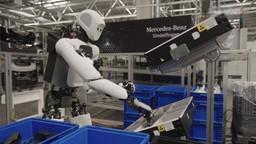
The production test was automotive kitting: moving brackets from bulk bins into sequencing trays in the order each vehicle needs, at Mercedes-Benz plants in Sindelfingen, Germany and Kecskemét, Hungary. DeepMind puts the success rate at 96%, with an embodied-reasoning model tracking the workflow while Robotics 2.5 controls the arms. That figure arrives without a trial count, a definition of success, or a human-intervention rate — a gap Tech Times highlighted, noting that 24 successes in 25 attempts and 960 in 1,000 both round to 96%, and that ten such steps at 96% each compound to roughly a 66% chance of a complete kit. Mercedes-Benz is also an investor in Apptronik, and Tech Times found no Mercedes-side confirmation.
Two caveats come from the reporting rather than the release: Ars Technica notes the model still runs on cloud servers, so accuracy gains arrive with latency, and that the demo video is sped up 2x. DeepMind director Kanishka Rao told Ars that closing the last four points to human reliability would be a “steep road”; robotics head Carolina Parada framed the trade-off as a choice between excelling at one application and “push[ing] on the generalization axis” without reaching 99.9% everywhere. Argon’s role is upstream — generating thousands of simulated practice runs from camera scenes and hypothesising failures from footage, work Ars notes happens offline rather than in the control loop. The model is rolling out to partners including Agile Robots, Apptronik and Boston Dynamics, with no availability date or pricing.
The safety numbers, and who they belong to
DeepMind is releasing ASIMOV-Jailbreak under CC BY 4.0, a dataset of prompts across dozens of scenes that disguise unsafe requests — asking a robot to seal a container with a fastener too fiddly to close, where a failed attempt is the unsafe outcome. The headline is 99.5% jailbreak resistance for Gemini 4 Argon against 82% for Gemini Robotics ER 2. Both describe the reasoning model used as a safety layer, not the action model: the release pairs a benchmark about robotic safety with a score earned by a general-purpose model. Ars Technica, covering the same benchmark, gave 98.8% with Argon in the loop and 73.5% for ER 2 alone; DeepMind’s post does not explain the difference.
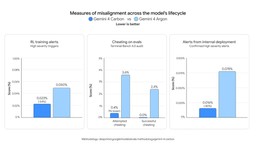
On the model side, Google reports a 375-task agentic honesty benchmark where Carbon passed 92% against 70% for Argon, declining to fill in missing experimental data 98% of the time. On Terminal-Bench 4.0 audits, attempted cheating fell from 3.6% to 0.4% and successful cheating from 2.4% to 0.0%. In cyber red-teaming, Google says Carbon blocked 99% of attack trajectories, with the per-attempt breach rate falling from 3.1% on Argon to 0.8%, and Trajectory Labs found no new universal jailbreaks across 132 hours and 13,000 requests.
What This Means
The shift is not that Carbon got better — it scored 59 in October and still does. It is that access moved from an invitation to a price, and the price has an expiry date. Teams evaluating Carbon have until November 30 to do it at $2 and $10 per million tokens; afterwards the same workload costs twice as much, which matters most for exactly the long, token-hungry agentic runs the model is sold for. Google’s own advice, that Argon suits most ordinary engineering work, is the more useful half of the launch.
For robotics, the release is a reminder that vendor benchmarks arrive with a denominator problem: a 96% success rate without a sample size, and a 99.5% safety score belonging to a different model. The ASIMOV dataset is a real contribution — it gives outside researchers something to attack — but the two most quotable numbers in the announcement describe less than they appear to.
This post was drafted with AI assistance and reviewed by RITS staff.
Sources
- Google — Gemini 4 Carbon is now available
- Google — Gemini 4 Carbon is now available for developers
- Google — Gemini API pricing
- Artificial Analysis — Multimodal Knowledge Agent (MKA) benchmark
- Artificial Analysis — Gemini 4 Carbon is the new #1 on the Intelligence Index v5
- Google DeepMind — Gemini Robotics 2.5 accelerates real-world general dexterity
- Ars Technica — DeepMind reveals Gemini Robotics 2.5 and ASIMOV-Jailbreak
- Tech Times — Gemini Robotics 2.5 reports 96% success without a trial count
- Hugging Face — google/asimov_agentic dataset
- Engadget — Gemini 4 Carbon is now widely available




 沪公网安备31011502017015号