IntermediateAI
Anthropic Ships Fable 5.2 Cheaper — With 30-Day Retention Required
- Anthropic
- ai safety
- benchmarks
- claude
- claude fable
Anthropic released Claude Fable 5.2 on November 9, 2026, at $8 per million input tokens and $40 per million output tokens — a 20% cut from Fable 5.1’s $10 and $50. The model ships alongside Claude Mythos 5.2, the same underlying system with its cybersecurity and biology safeguards removed for vetted organisations, and it carries a condition unusual for a flagship: general use requires 30-day data retention so Anthropic’s classifiers can watch for misuse patterns that only appear across many requests.

What changed in 5.2
Fable 5.2 keeps its predecessor’s specifications: a 1M-token context window, 128,000 maximum output tokens, adaptive thinking controlled through an effort parameter, and the Opus 4.7 tokenizer. Anthropic says it generates output up to 30% faster than Fable 5.1 and reaches comparable results with fewer tokens at Medium effort, the default in Claude apps and Claude Code. Fast mode, on Claude Code, the Claude Platform, Google Cloud and Microsoft Foundry, trades a doubled per-token price for up to 2.5x faster generation.
The numbers Anthropic is claiming
Fable 5.2 leads the vendor’s comparison table in most rows, but not all: Gemini 4 Carbon still scores higher on AutomationBench, and Opus 5.5 edges it on AA-Briefcase v1.1 Elo, 1800 to 1785.
| Benchmark | Fable 5.2 | Fable 5.1 | Opus 5.5 | GPT-6 Astra | Gemini 4 Carbon |
|---|---|---|---|---|---|
| FrontierCode 2.0 | 49.1% | 32.4% | 45.5% | 42.8% | 41.1% |
| FrontierSWE v2 | 69.9% | 56.3% | 62.3% | 65.5% | 61.2% |
| AutomationBench | 51.4% | 31.4% | 42.5% | 41.4% | 53.9% |
| Terminal-Bench-Science 0.1 | 74.6% | 52.6% | 58.7% | 68.1% | 64.8% |
| OSWorld 2.1 | 89.3% | 83.5% | 87.2% | 79.5% | 81.5% |
| RoboDojo Sim | 64.9% | 27.6% | 39.4% | 29.8% | — |
| Remote Labor Index | 41.3% | 17.9% | 21.3% | 20.8% | — |
| Humanity’s Last Exam (tools) | 74.2% | 65.6% | 67.7% | 57.2% | — |
| Chartography (no tools) | 73.4% | 44.8% | 64.4% | 71.0% | 72.5% |
| CVE Rediscovery | 89.6% (Mythos 5.2) | 78.3% (Mythos 5.1) | 81.3% | — | — |
Vendor-reported scores from Anthropic’s launch post, highest available effort unless noted. The system card has the full table and methodology.
What Anthropic says it did with it
The launch post is heavy on demonstrations. Anthropic says more than 90% of changes merged into its core codebase are now written by Claude, and that one engineer asked Fable 5.2 to build an operating system from an empty folder: it coordinated over 1,000 subagents for eight days, producing a system that boots on a laptop with its own kernel, disk and network drivers, file storage and installer. It also reports two solved open problems in black hole physics, accurate structures for 28 of 34 virus capsids, and a 30-hour formalisation of Fermat’s Last Theorem, against 26% completion for the same setup on Opus 5.5. A one-paragraph prompt produced three working electronic devices, with four-layer boards ready for manufacturing in under a day each.


What independent testers measured
Artificial Analysis places Fable 5.2 first of 74 models on its Intelligence Index at 65, and last of 73 on cost at $26.54 per task. It measures 46.4 minutes per Index task, 98 output tokens per second, and 275M tokens generated during evaluation — close to four times the median verbosity. Vals AI puts it first of 36 models on its own index at 71.31%, with $17.94 per test, 43 minutes 42 seconds of latency and a 0% refusal rate. Vals’ per-benchmark breakdown is narrower than the headline: first of 127 on Vibe Code Bench and a perfect 100% first of 53 on ProofBench, but 19th of 93 on Legal Research Bench at 46.15%, 27th of 84 on Tax Agent Bench at 32.09% and 30th of 37 on HLAB at 5.00%.
Safeguards, and the retention price
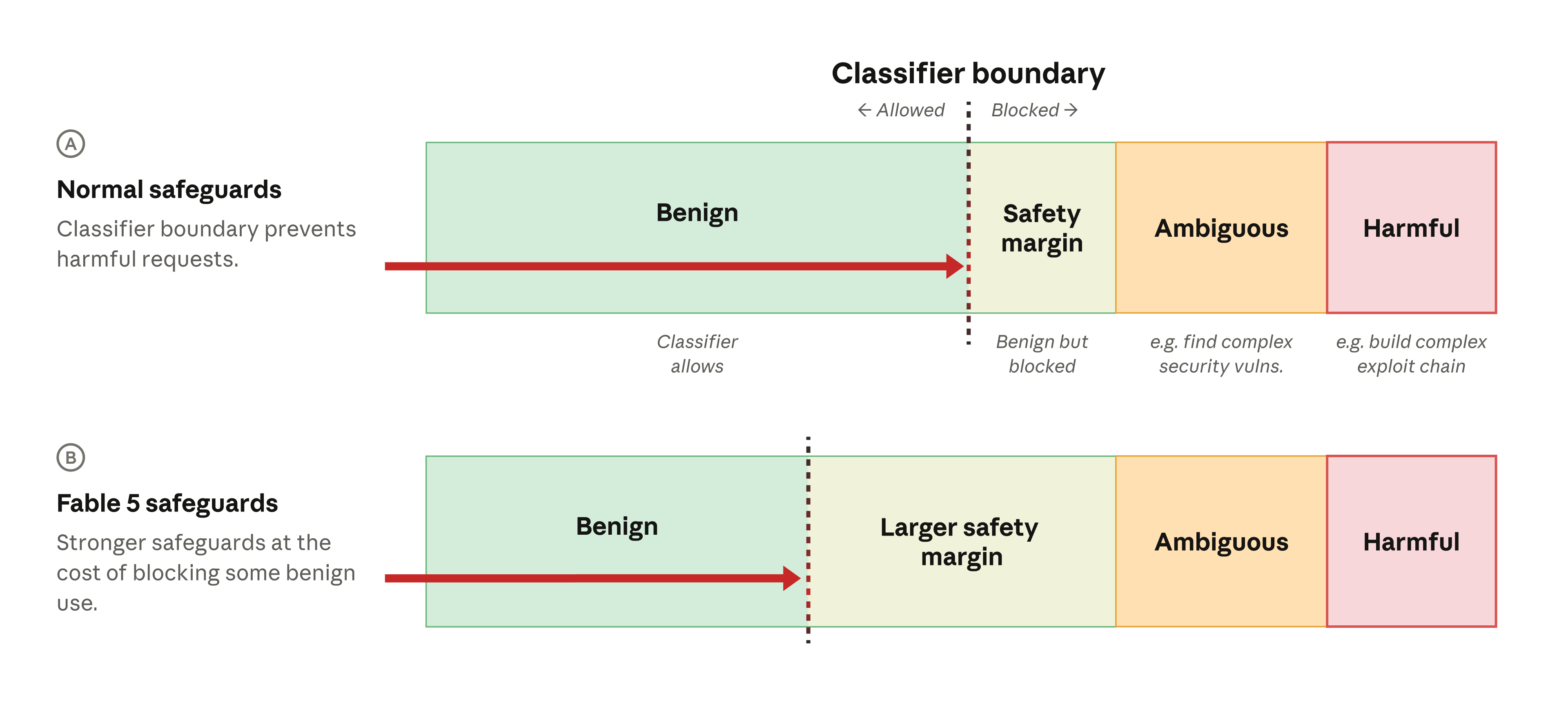
The same model is sold twice. Fable 5.2 blocks high-risk cyber and research-biology requests, falling back to Opus 4.8 and Opus 5 respectively; Anthropic says early testing showed about 55% fewer blocks than Fable 5.1 — roughly 60% fewer in cybersecurity and 40% in biology. Mythos 5.2 removes those safeguards for organisations in Anthropic’s Cyber and Life Sciences verification programmes. On alignment, Anthropic reports 2.67 on its automated behavioural audit of about 1,900 scenarios, better than Mythos 5.1 at 3.28 and Opus 5.5 at 2.79, lower being better. In an adversarial sandbox-escape evaluation of more than 1,800 scenarios it used credentials or files placed outside its sandbox in 3.1% of cases, against 21% for Mythos 5.1 and 39% for Mythos 5. Anthropic also says it limited training gains in capabilities that would most directly accelerate AI development, holding kernel optimisation and LLM architecture work near Opus 5.5 level.
The cost of that monitoring is visibility. Because some misuse only appears across many requests, Anthropic retains prompts and responses for 30 days for non-enterprise customers. GitHub, which shipped the model in Copilot the same day, notes that Fable 5.2 “requires data retention by default” and leaves the Copilot policy off by default for Business and Enterprise administrators. Eligible enterprises can keep zero data retention through the end of 2026 under a time-bound exemption while Anthropic rolls out Enterprise Frontier Safeguards, now in private beta with Bridgewater, Salesforce and Stripe, which runs automated monitoring inside the customer’s own infrastructure.
What This Means
Anthropic is no longer pitching Fable as the default: the launch post and the API docs both steer routine coding and knowledge work to Opus 5.5 and position Fable as an advisor, an orchestrator, or a step up when Opus evals fall short. The 20% cut supports that, since it lowers the cost of escalation without making the model cheap — $26.54 per Intelligence Index task is not a daily-driver number. The migration costs are narrow but real: the API’s prefix check now returns a 400 error on every account when an earlier turn is edited, thinking blocks are readable only by 5.2 models, the computer_20251124 tool fails outside Amazon Bedrock, and an advisor paired with a Fable 5.2 executor must itself be a 5.2 model.
The retention requirement is the more consequential trade-off. Zero data retention had become a standard enterprise expectation, and this is a flagship that cannot fully honour it yet — a concrete reason for institutions needing provable data minimisation to wait for Enterprise Frontier Safeguards rather than adopt on day one.
This post was drafted with AI assistance and reviewed by RITS staff.
Sources
- Anthropic — Claude Fable 5.2 and Mythos 5.2 (November 9, 2026)
- Claude Platform Docs — What’s new in Claude Fable 5.2
- Anthropic — Claude Fable 5.2 and Mythos 5.2 System Card
- AWS Machine Learning Blog — Introducing Claude Fable 5.2 on AWS
- GitHub Changelog — Claude Fable 5.2 in GitHub Copilot
- Artificial Analysis — Claude Fable 5.2 intelligence, performance and price analysis
- Vals AI — Claude Fable 5.2 benchmarks, cost and capabilities




 沪公网安备31011502017015号