AdvancedAI
Gemini 4 Hydrogen and ERNIE 5.5 Flash Race for the Agent Workhorse
- Baidu
- Gemini
- Google DeepMind
- benchmarks
- ernie
- mixture of experts
- open weights
Google put Gemini 4 Hydrogen on sale on November 12, 2026, and Baidu opened ERNIE 5.5 Flash Preview a day earlier — two models from opposite ends of the industry, shipped into the same slot. Neither is a frontier system. Both are the cheap, fast tier that agent workflows are meant to spend most of their tokens in, and both vendors make the same argument: the expensive model plans, the cheap model executes.

What Google shipped
Hydrogen is the first Gemini 4 model that arrives without a wait. Carbon spent its opening weeks with vetted cyber defenders and Argon went through the Fairwind programme; Hydrogen went straight to the Gemini API, AI Studio, Gemini for business, the Gemini app, Antigravity and Google Search on announcement day, free tier included. Google also dropped the “Flash” label that had covered this tier since Gemini 3.5 — a fair signal that the positioning changed. Hydrogen is not a smaller Argon; it is a different job.
The model card is unusually direct: Hydrogen is “adapted from Gemini 4 Carbon”, and for architecture, training data, hardware and acceptable use it points at Carbon’s documentation. It inherits the 1M-token context and adds a 64K default synchronous output limit, extendable to 1M through background long decode; knowledge cutoff is March 2026. Pricing is flat across the full window at $1.50 per million input tokens and $7.50 per million output — below Argon’s introductory $2 and $10, which themselves double on December 1.
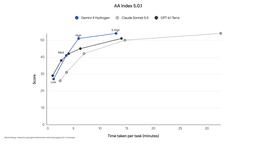
The more consequential change is four thinking levels rather than one: low, medium, high (the default) and a new xhigh tier. Artificial Analysis, which re-runs models itself rather than accepting vendor numbers, plots the four configurations almost along a straight line of intelligence against time. At xhigh Hydrogen scores 54 on the Intelligence Index, sixteenth of 78 models tracked; at high, 51; at medium, 41. Time per task runs from 1.3 minutes at low to 13.7 minutes at xhigh, and cost per task from $0.29 to about $3.16 — an eleven-fold spread inside one model name. Google’s headline is that Hydrogen beats Argon at its default setting, 51 to 50; the same leaderboard adds the context Google left out, with Carbon at 60 and Gemini 3.8 Flash at 31.
What Baidu shipped
ERNIE 5.5 Flash Preview is the first post-trained checkpoint built on ERNIE 5.5 Flash Base, whose weights Baidu released on November 5. The shape is familiar from the Chinese open-weight camp: 280 billion total parameters, 14 billion activated per token, 1M-token context, and text-only input. Baidu announced the preview at its Baidu World keynote on November 12, alongside a token marketplace and a set of application models.

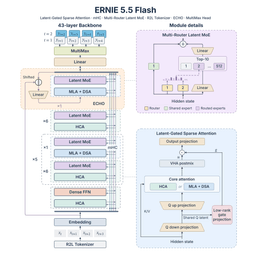
The base-model write-up is the most technically specific document either company published this week. The backbone is 43 layers with a hidden size of 4096 and 64 attention heads, and most layers never see individual tokens from the distant past: six of every seven use Heavily Compressed Attention, which folds each 128 tokens into one cached entry and attends over those plus a short uncompressed window. The remaining layers keep token-level access through Multi-head Latent Attention, with sparse top-k selection inside them so per-query cost stays flat as context grows.
Feed-forward blocks route each token to 10 of 512 experts plus one shared expert, and the experts run in a 2048-dimensional latent space rather than the full 4096, roughly halving dispatch traffic and expert FLOPs. Instead of one router, Baidu uses several independently initialised sigmoid routers that score experts jointly, on the argument that a single router’s errors reinforce themselves. ECHO reuses the backbone’s final layer to predict future tokens instead of attaching a separate prediction module, and that layer doubles as the draft model for speculative decoding. Pre-training was 33.5T tokens with the Muon optimiser in FP8, at a 128K context extended to 1M for inference.
What the Preview adds is post-training, plus a very large output allowance: 921,600 tokens against a 1,024,000-token input window, which is what makes an eleven-hour single run conceivable at all. Qianfan lists RMB 1 per million input tokens, RMB 4 per million output and RMB 0.04 per million cached input; the aggregator llm-stats tracks the same endpoint at $0.28, $1.13 and $0.028. A free endpoint is live on OpenRouter. Reasoning is always on at a single high effort level, with no way to switch it off.
Two claims, two kinds of evidence
Both releases lead with speed and cost against a predecessor. Google says Hydrogen finishes tasks 2.5 times faster than Gemini 3.8 Flash at the default setting and more than triples its Terminal-Bench 4.1 score, 57.0% against 18.2%. Baidu’s framing is duration rather than difficulty: one Unreal Engine 5.8 game, written entirely in C++ across an eleven-hour single task, with the model converting playtest problems — a character hovering above the ground, a camera in the wrong place — into tests in code, because it cannot see the screen.

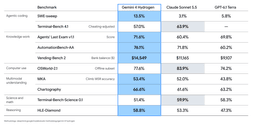
Set the vendor tables side by side and the same shape appears in both. Hydrogen wins its class on SWE-sweep (13.5% against Claude Sonnet 5.5’s 3.1% and GPT-6.1 Terra’s 5.8%), Agents’ Last Exam v1.1, AutomationBench-AA, Vending-Bench 2, MKA and HLE-Diamond, and loses on Terminal-Bench 4.1, OSWorld-2.1 and Terminal-Bench-Science 0.1. ERNIE’s twenty-row appendix splits along almost the same line: strong where a task ends in a checkable artefact, weaker where it ends in a judgement.
| Benchmark | ERNIE 5.5 Flash Preview | Strongest rival in Baidu’s table |
|---|---|---|
| Terminal-Bench 4.0 | 46.5 | 66.4 — Claude Opus 5.5 |
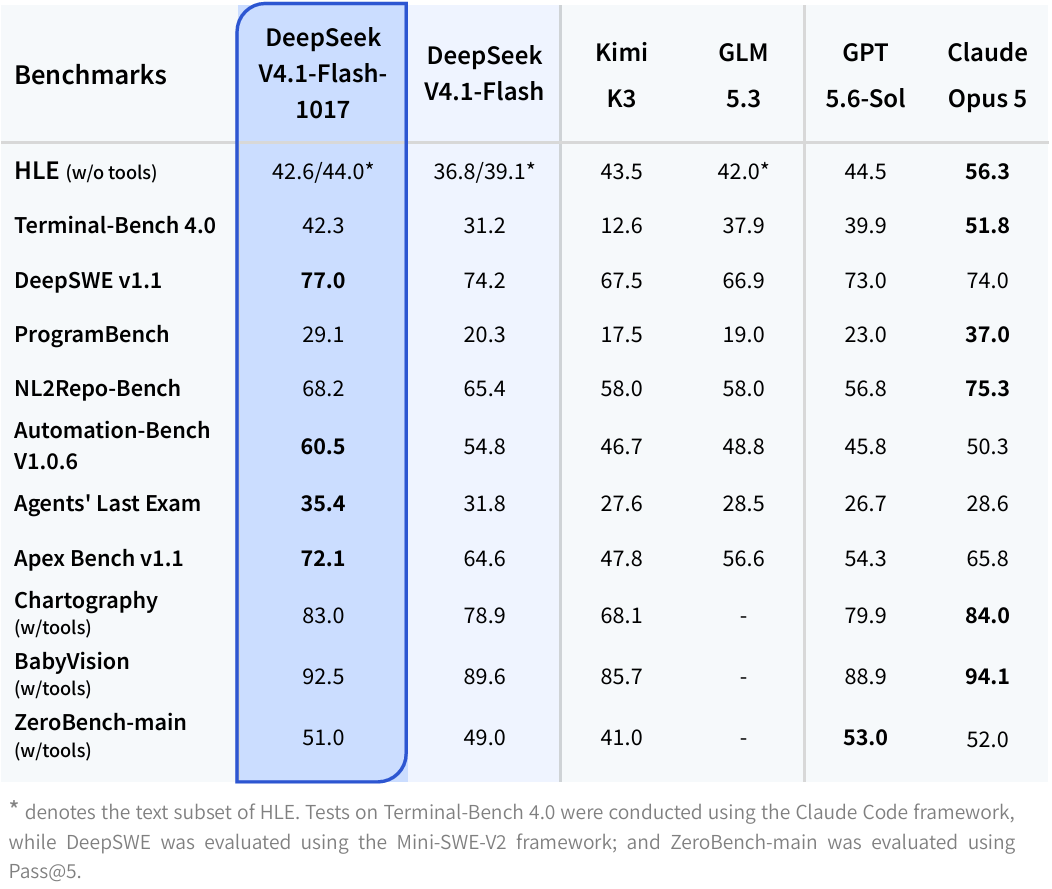
| DeepSWE v1.1 | 71.2 | 77.0 — DeepSeek-V4.1-Flash-1017 |
| ProgramBench (Almost Solved) | 29.5 | 65.0 — Claude Opus 5.5 |
| Terminal-Bench-Science 0.1 | 21.0 | 63.3 — Claude Opus 5.5 |
| AutomationBench | 61.9 | 58.0 — Claude Opus 5.5 |
| MCP-Atlas | 84.6 | 84.2 — Claude Opus 5.5 |
| BrowseComp | 87.4 | 91.8 — Hy4 |
| AA-Omniscience-Public | 25.2 | 62.0 — Claude Opus 5.5 |
| HLE (without tools) | 46.4 | 61.4 — Claude Opus 5.5 |
The difference is who ran the tests. Hydrogen’s vendor table is backed by an independent leaderboard entry, and Cognition published its own FrontierCode 2.0 result the day before launch: 38.2% for Hydrogen at $2.40 per task, against 40.0% for Carbon at $4.04 and 39.0% for GPT-6.1 Sol. ERNIE has no counterweight. Its results arrive as a single image rather than a table, Baidu’s runs of the two Artificial Analysis benchmarks are Baidu’s own, and as of November 13 there is no ERNIE 5.5 row on the Artificial Analysis leaderboard, no model card, no knowledge cutoff and no latency figure. The only ERNIE 5.5 repositories on Hugging Face are the base checkpoint and its BF16 variant.
Two details in Hydrogen’s paperwork are worth keeping. The model card reports that unjustified refusals rose 5.57 percentage points against Gemini 3.8 Flash, “particularly for multimodal prompts”, even as image-to-text safety improved by 7 — an honest regression most launch posts would leave in a footnote. And DeepMind’s Frontier Safety assessment found no material capability change over Argon, though Hydrogen still reaches the alert thresholds for the biological CBRN and cybersecurity critical capability levels.
What This Means
The rate cards are not comparable and should not be compared. Hydrogen costs roughly five times what ERNIE costs on input and nearly seven times on output, but cost per task depends on how many tokens a model spends getting there. On that measure Hydrogen is the least economical model Artificial Analysis tracks on verbosity — 304 million output tokens across the index, 76th of 77 — and $3.16 per task against a $1.50/$7.50 rate card. Baidu publishes no tokens-per-task figure at all. Anyone choosing between these two on price is comparing numbers that were never on the same axis.
What is genuinely new is that the middle tier has become where vendors compete. Three Gemini 4 models have shipped in six weeks, and the last two were framed as partners rather than replacements: Orchestrator in Antigravity switches between Carbon and Hydrogen inside one session and reaches near-Carbon success on Terminal-Bench 4.0 while spending 24% less quota and finishing 19% faster. Baidu’s pitch is the same shape one tier down, with an efficiency-designed architecture and a text-only model that hands visual work to other tools.
The open-weights question is where they diverge most sharply. Baidu’s release page says the preview’s weights will be open-sourced under Apache 2.0, and its press release names November 25. Its own base checkpoint, already on Hugging Face, ships under the ERNIE 5.5 Flash Base Model License v1.0 instead: the licensed territory excludes the European Union, the United Kingdom and South Korea, commercial use is free below $50 million of related annual revenue with a “Powered by ERNIE” notice, and anything above needs Baidu’s written authorisation. Whether the preview lands under Apache 2.0 or inherits that licence is the thing to check on November 25; it changes who can build on the model far more than any benchmark row does.
This post was drafted with AI assistance and reviewed by RITS staff.
Sources
- Google: Introducing Gemini 4 Hydrogen
- Google DeepMind: Gemini 4 Hydrogen model card
- Artificial Analysis: Gemini 4 Hydrogen release page
- Cognition: Gemini 4 Hydrogen in Devin (FrontierCode 2.0)
- Baidu: Introducing ERNIE 5.5 Flash Preview
- Baidu: ERNIE 5.5 Flash Base (architecture and pre-training)
- Hugging Face: baidu/ERNIE-5.5-Flash-Base (model licence)
- Baidu press release: ERNIE 5.5 Flash Preview at Baidu World 2026
- LLM Stats: ERNIE 5.5 Flash Preview pricing
- SiliconANGLE: Google releases Gemini 4 Hydrogen
- OrcaRouter: What the eleven-hour ERNIE build proves



 沪公网安备31011502017015号