TypeSafe AI Launches Jev, a Model That Returns Decisions, Not Text


On September 15, 2026, TypeSafe AI came out of two years in stealth with Jev, a model that does not generate text at all. Instead of writing a reply, Jev takes unstructured input and returns typed decisions with probabilities attached. Each output is picked from a set of options the developer defines in advance. TypeSafe calls this a “System One Model” and pitches it as the missing piece for software automation. The company says it is two orders of magnitude faster and cheaper than frontier LLMs on the kinds of questions a program asks many times a day. Jev is available now in early access.
Intermediate

A Model That Gives Up Strings
Founder Diogo Almeida opens the announcement with the question behind the company: “Models have been superhuman at chat for years, so where is all the automation?” Almeida writes that at OpenAI he “helped build the methods that made language models useful at following instructions and talking with people,” work that fed into ChatGPT. The Register reports that TypeSafe has raised $40 million.
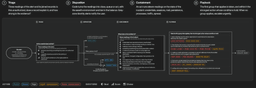
TypeSafe argues that the problem is the output format. An LLM produces a string, and before other software can act on it, that string has to be parsed and validated, with some risk that the model goes off script. Jev drops string generation entirely. Developers declare the questions and the allowed answers up front: a boolean, a score, or a choice among up to 255 options. Jev returns a probability for every option in a single parallel pass rather than token by token. The Register’s example is a support-ticket router returning {"billing": 0.08, "technical": 0.85, "sales": 0.07} with a confidence score of 0.82. TypeSafe describes the model as “a frontier-intelligence function call: unstructured state in, typed probabilistic decisions out.”
The model is trained with a method TypeSafe calls Reinforcement Learning for Calibrated Decisions (RLCD). RLHF optimizes for answers human raters prefer, and RLVR optimizes for answers that can be checked automatically. RLCD instead targets what the company calls “epistemically honest probabilities”: when Jev reports higher confidence, it should be right more often. The name nods to Kahneman’s fast “System 1” thinking and to economist William Stanley Jevons, whose paradox holds that efficiency gains tend to increase total consumption.

The Numbers and Their Caveats
TypeSafe’s published figures:
- Latency: 70–500 ms end to end, against the 3–329 seconds TypeSafe cites for frontier models, or 40–200x faster on “System One shaped” queries. In The Register’s Doom demo, Jev answered in 0.114 s and GPT-5.6 Terra in 8.566 s.
- Price: $0.042 per million input tokens ($42 per billion). Output tokens are free.
- Errors: 0% structured-output and tool-call error rates, which is true by construction because the model cannot emit an off-schema value.
- Headline claim: “193.6x faster, 444.6x cheaper” on TypeSafe’s four workflow evals.
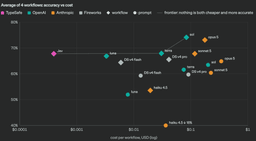
The announcement is unusually candid about the limits of these figures. TypeSafe says the headline multipliers are “on the higher end of real world gains.” Its own capabilities team wrote the eval workflows. And “accuracy” in those evals means agreement with a reference answer: the average output of GPT-6 Astra and Fable 5.1. TypeSafe also says it cannot yet prove its pricing isn’t subsidized. On the chart above, Jev sits at roughly 68% accuracy, level with GPT-5.6 Terra and Sonnet 5 at a small fraction of their cost. The most accurate configurations, OpenAI’s Sol and Anthropic’s Opus 5 in workflow mode, score several points higher.

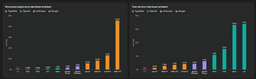
Outside testers found similar tradeoffs. The Register notes that “can’t hallucinate” is a claim about format, not correctness: a well-typed answer can still be wrong. In a hands-on review for Every, Mike Taylor had Jev answer 21 questions over 37 documents in under 0.7 seconds for about a quarter of a cent. In a side-by-side test by Every CEO Dan Shipper, Jev ran 25x faster and 580x cheaper than Fable 5.1 but caught 6 of 7 planted writing defects to Fable’s 7 of 7. Taylor wrote that he would “want a more thorough accuracy check before putting it into production.”
What This Means
Jev is a bet that much of what developers now ask an LLM to do — classify, route, score, extract, flag — never needed free-form text. For those tasks, a narrow typed interface is an advantage: no JSON repair, no retry loops, and a probability that code can compare against a threshold. At TypeSafe’s quoted prices, checks too expensive to run on every item become affordable: guardrails on each agent action, scores for every row of a large dataset, decisions inside a real-time UI.
The constraint is scope. Jev cannot write, summarize or reason out loud, so it complements a chat model rather than replacing one. And its headline results come from evals its makers designed. The claim that matters most for automation is calibration, meaning that a 0.95 really is right about 95% of the time. That is also the claim teams will need to verify on their own data before trusting the probabilities in production.
Related Coverage
- Mistral Releases Shieldstral, a 3B Policy-Adaptive Safety Classifier — another model that returns judgments rather than prose, aimed at moderation
- Thesys Releases OUI-1, a Diffusion Model That Writes UI Screens — a narrow, non-autoregressive model built for one structured output
This post was drafted with AI assistance and reviewed by RITS staff.
Sources
- Introducing System One Models & Jev — TypeSafe AI Blog, Diogo Almeida, September 15, 2026
- TypeSafe AI debuts model for machines that plays Doom — The Register, September 16, 2026
- Mini-Vibe Check: TypeSafe’s Jev Judged Everything I’ve Written in 0.7 Seconds — Every, Mike Taylor, September 15, 2026


 沪公网安备31011502017015号