JetBrains Ships Mellum2.1, a 12B Open Model for Coding Agents


JetBrains released Mellum2.1 on October 8, 2026 — the next version of the 12-billion-parameter mixture-of-experts model it open-sourced in June. The architecture is unchanged, the license is still Apache 2.0, and the weights are on Hugging Face. What changed is everything after pre-training: JetBrains says the update was driven by scaling up reinforcement learning in real repository environments, and the largest gains landed in agentic coding.
Intermediate

What Changed
Mellum began as a 4B dense model for in-IDE code completion. Version 2 moved it to a 12B mixture-of-experts design that activates only 2.5B parameters per token; version 2.1 keeps that skeleton — 28 layers, 64 experts with 8 activated per token, grouped-query attention (32 query heads, 4 key/value heads), a 131,072-token context window and a 1,024-token sliding window on three of every four layers. As Bulat Salimzianov writes on the JetBrains blog, “The architecture hasn’t changed since version 2.”
Instead, the release is a post-training story. In a post summarizing the launch, JetBrains researcher Nikita Pavlichenko described it as “a significant scaling of our RL post-training to enable agentic coding workflows.” The company says RL went from a short final stage to the main part of training, with new tasks in math, competitive programming, science, tool use and software engineering — combining open RL datasets with tasks built in-house, each source filtered before training because public data often ships with broken tests or unverifiable answers.
The agentic work runs in real environments rather than static prompts: the model trains inside actual repositories with a shell and file-editing tools, and is rewarded when tests pass. JetBrains says it ran “millions of sandboxed runs across thousands of environments” over the course of training. The stated result is a model that can “explore a codebase, edit files, and check its own changes” — capabilities its predecessor lacked.
Benchmark Results
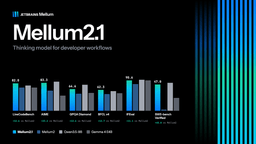
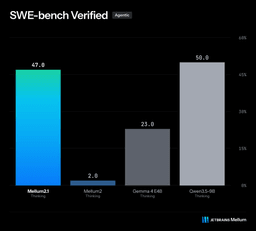
The headline movement is on software-engineering tasks. On SWE-bench Verified, which pairs a model with a repository and a real issue to fix, Mellum2.1 scores 47.0% against 2.0% for Mellum2 — a jump the company attributes almost entirely to the new RL stage rather than to any change in size. On SWE-bench Pro it reports 28.0% (up from 0.0%), and on Terminal-Bench 2.1 it reports 17.4% (up from 0.6%).
| Benchmark | Mellum2.1 | Mellum2 | Gemma 4 (E4B) | Qwen3.5 (9B) |
|---|---|---|---|---|
| LiveCodeBench v6 | 82.0 | 69.4 | 69.4 | 75.4 |
| SWE-bench Verified | 47.0 | 2.0 | 23.0 | 50.0 |
| SWE-bench Pro | 28.0 | 0.0 | 4.0 | 38.0 |
| Terminal-Bench 2.1 | 17.4 | 0.6 | 3.4 | 21.7 |
| AIME 25/26 | 83.3 | 60.1 | 45.0 | 86.7 |
| GPQA Diamond | 64.6 | 51.0 | 53.1 | 77.8 |
| HarmBench (lower is better) | 8.5 | 21.5 | 38.1 | 6.6 |
Two caveats apply to every number. They are self-reported by JetBrains, and the agentic scores depend on scaffolding: the company evaluated all four models through the same open-source harness (Pi v0.73.1, with shell and file tools), a 114K-token context and up to 16K tokens per turn. Read across the rows, Mellum2.1 leads the two similarly-sized comparison models on most coding and reasoning tasks, but Qwen3.5 9B still edges it on SWE-bench Verified, Terminal-Bench and general knowledge.

Speed and Deployment
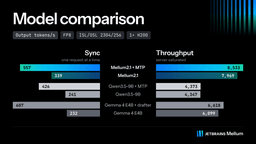
Because post-training left the architecture alone, JetBrains says Mellum2.1 is as fast as Mellum2 — and multi-token prediction (MTP) makes it faster still. The company reports that under heavy load Mellum2.1 is “the fastest model in the group” and serves almost twice as many tokens per second as Qwen3.5 9B on a single H200, while MTP speeds up a single request by about 1.6x.
The intended roles are the ones a small, fast model fills well inside agentic systems: acting as a sub-agent that diagnoses a failing test or drafts and checks a fix, routing and orchestrating work between larger models, and running fully self-hosted so that proprietary code and internal data never leave a user’s infrastructure. The weights are already on Hugging Face in both full and GGUF formats; JetBrains says GGUF builds for llama.cpp, Ollama and LM Studio — plus the MTP head for speculative decoding in vLLM — are “coming soon.”
What This Means
The interesting signal here is not the absolute scores but where the improvement came from. Mellum2.1 is the same size, on the same hardware, as the model it replaces — and it went from near-zero to mid-40s on SWE-bench Verified purely through reinforcement learning in sandboxed environments. That is a concrete demonstration that agentic coding ability is increasingly a post-training property rather than something that requires a bigger base model. For teams weighing self-hosted coding agents, it also reframes the trade-off: a 2.5B-active model that is fast and cheap to serve may be good enough for the sub-tasks that dominate an agent’s token budget, even when it trails the best small models on raw benchmarks.
The limits are worth stating as plainly as the gains. Every benchmark figure is self-reported with no third-party replication, and agentic evaluations are unusually sensitive to the harness, tool definitions and turn budget — the same model can move several points under a different scaffold. Two of the four models compared are older than Mellum2.1, and the strongest comparable open model, Qwen3.5 9B, still leads on several agentic and knowledge tasks. Mellum2.1’s case rests less on being the best small model than on being a fast, openly licensed one that a team can run on its own machines.
Related Coverage
- JetBrains Ships Junie Local: A 27B Coding Agent That Runs Offline — the company’s earlier move to put a coding agent entirely on the developer’s own machine
- Qwen3.8-27B: Frontier Agentic Scores on a Single Consumer GPU — the larger open model most often benchmarked against small agentic coders
- IFM Releases K2 Horizon: Six Open Models With Data, Code, and Logs — a contrasting open-weights strategy that publishes training data alongside the models
This post was drafted with AI assistance and reviewed by RITS staff.
Sources
- Mellum2.1 Gets to Work: A Fast Open Model for Coding Agents — JetBrains AI Blog, Bulat Salimzianov, October 8, 2026
- JetBrains/Mellum2.1-12B-A2.5B-Thinking model card — evaluation table and architecture specifications, self-reported
- Mellum2.1 collection — Hugging Face model weights
- Mellum2 Technical Report — architecture and pre-training methodology for the base model
- Mellum by JetBrains — product overview, pre-training data and licensing


 沪公网安备31011502017015号