Black Forest Labs Releases FLUX 3 Action, an Open-Weight Robot Model


Black Forest Labs released FLUX 3 Action on September 23, 2026 — a 7-billion-parameter, open-weight “world action model” that takes camera frames, a robot’s current state and a text instruction, and returns the next chunk of motor commands together with predicted video of how the scene should unfold. It is the first open-weight release to come out of the FLUX 3 multimodal backbone the German lab announced in July. BFL reports the top score on NVIDIA’s RoboLab-120 simulation benchmark, with less than half the parameters of the previous best open model.
Intermediate

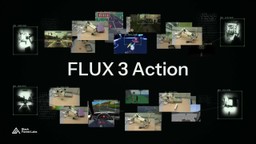
What Was Released
The weights are on Hugging Face in the FLUX 3 Action collection under the FLUX Kommunity License v1.0. The training and inference code in the flux-action GitHub repository is Apache-2.0. The release includes:
- A shared base checkpoint with a video VAE and a Qwen3-VL-4B-Instruct text encoder.
- Ready-made policies for the DROID setup (Franka arm, three cameras) and the low-cost SO-101 arm, which is fine-tuned with LoRA through Hugging Face’s LeRobot framework.
- Three inference recipes, each in BF16 and FP8: the base model (four sampling steps with guidance), a guidance-distilled version, and a step-distilled version that runs in a single step.
The model card rules out using the model to “control a machine in a way that endangers people, without human oversight.”
How It Works
FLUX 3 Action is a flow-matching model. It turns text, recent video and robot state into tokens and denoises the future video and the next actions together, instead of pairing a separate vision-language model with an action head. According to BFL’s documentation, the DROID policy outputs 32 actions at 15 Hz, a plan of roughly two seconds, and the SO-101 policy outputs 42 actions at 30 Hz. BFL gives π0.5’s action horizon as 1.0 second.
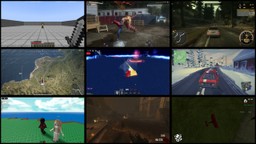
Most of the pretraining was video (BFL says over 95% of tokens). An “action midtraining” stage then mixed joint video/audio data with gaming footage, egocentric human-hand video, handheld-gripper recordings and teleoperation data from 14 robot embodiments. According to BFL, the SO-101 arm learned pick-and-place from about 200 teleoperated demonstrations. The documentation also shows fine-tuned versions controlling video games and a drone, and BFL writes that “an agent that plays games is just one short step from operating other software.”
Benchmarks
On RoboLab-120, NVIDIA’s simulated manipulation benchmark, BFL’s leaderboard table lists FLUX 3 Action at 42.92% overall success. The next results are the closed OASIS WAM at 39.0%, NVIDIA’s 16B Cosmos3-Nano-Policy at 36.8% and π0.5 at 28.0%. BFL’s per-checkpoint results, averaged over several seeds, are slightly lower: 41.60% for the BF16 base model, 42.24% for the guidance-distilled FP8 model and 37.92% for the single-step model. VentureBeat noted that the result was supplied by BFL before publication and that NVIDIA’s public leaderboard had not yet been updated.
BFL reports a latency of 41 ms per inference on a B200 in BF16, and 32 ms for the single-step FP8 variant. It also claims a 1.34–2.28× real-time-factor advantage over π0.5 on workstation and datacenter GPUs, and up to 3.95× over Cosmos 3 Nano.
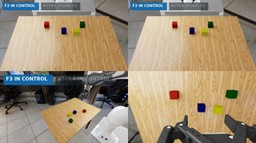
For a real-robot check, BFL commissioned Positronic Robotics to run blind trials on a Franka arm: ten DROID tasks, three attempts each, with a 240-second limit per attempt. FLUX 3 Action completed 28 of 30 attempts. Cosmos 3 Nano completed 27, DreamZero 20 and π0.5 13. In this test FLUX 3 Action and Cosmos 3 Nano are effectively tied; the clearer difference is in model size and speed.

What This Means
The release adds to evidence that video-generation models make strong backbones for robot control. The model predicts what the scene should look like as well as what the arm should do, and that video pretraining appears to carry over to manipulation. The practical point for researchers is size and cost: a 7B open model that runs on a single GPU, has a LeRobot recipe for a low-cost hobbyist arm and publishes its fine-tuning code is much easier to reproduce than most of what sits above it on the leaderboard.
BFL is also candid about the limits. It notes that “there are still tasks that all policies, ours included, fail to solve on their own.” In its experiments a large reasoning model (GPT 6 Astra) could solve every task in the test suite, but at $13.47 and about 16 minutes per success. Letting the reasoner hand routine control to FLUX 3 Action and step in only when needed kept 90% success at $8.77 and about 8 minutes per success. BFL says that is 29% cheaper and 40% faster than the best alternative configuration it tested. A fast policy paired with a slower planner is likely to be how systems like this get used in practice.
Two caveats apply. The benchmark claims are self-reported and not yet on NVIDIA’s leaderboard. The real-robot test covered a small set of simple pick-and-place tasks. The open weights mean both can now be checked independently.
Related Coverage
- Black Forest Labs Unveils FLUX 3, a Multimodal Image, Video, Audio and Action Model — the July 2026 launch of the backbone FLUX 3 Action is built on
- FLUX.1 Kontext [dev] Released: Open-Weights Model for Advanced Image Editing — BFL’s earlier open-weight release strategy
- Black Forest Labs Announces Flux Text-to-Image Model — where the FLUX line began in 2024
This post was drafted with AI assistance and reviewed by RITS staff.


 沪公网安备31011502017015号