Anthropic Launches Claude Managed Agents for Scalable AI Deployment


Anthropic launched Claude Managed Agents on April 8, 2026 — a fully managed platform that lets developers build, deploy, and scale autonomous AI agents in days instead of months. Now in public beta, the service handles infrastructure, orchestration, sandboxing, and error recovery so teams can focus on defining what their agents do rather than how they run.
Intermediate


What Are Managed Agents?
Claude Managed Agents provides a pre-built, configurable agent harness running on Anthropic’s cloud infrastructure. Developers define their agent’s tasks, tools, and guardrails — either through natural language descriptions or YAML configuration files — and Anthropic handles everything else: container provisioning, tool orchestration, context management, and error recovery.
The platform is designed for workloads that need long-running execution (tasks spanning minutes or hours with multiple tool calls), secure sandboxed code execution, persistent file systems and conversation history, and scoped permissions with identity management. Agents can read files, run commands, browse the web, and execute code in isolated containers — all with built-in execution tracing for governance and debugging.

Architecture: Decoupling the Brain from the Hands
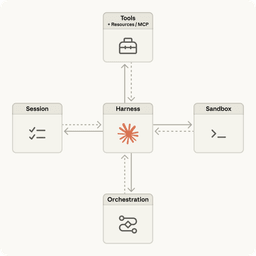
An accompanying engineering blog post reveals the technical design behind Managed Agents. Anthropic decomposed agent functionality into three independent, virtualized components:
- Session — an append-only event log containing the complete history of agent interactions, persisted outside the harness
- Harness — a stateless control loop that invokes Claude and routes tool calls to execution environments
- Sandbox — an isolated execution environment where Claude runs code and manipulates files
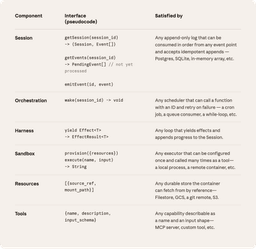
This decoupling means containers become “cattle, not pets” — if one fails, the harness catches it as a tool-call error, and Claude retries automatically. Sessions survive independently of any single harness instance, enabling horizontal scaling and fault recovery through simple primitives like wake(sessionId) and getSession(id).

Security is baked in: credentials never reach the sandbox where Claude executes untrusted code. Repository tokens initialize Git remotes during setup but are not exposed during operations, and OAuth credentials are stored in external secure vaults accessed through a dedicated proxy.
Performance and Pricing
Internal benchmarks show a 10-point improvement in task success for structured file generation versus a standard prompting loop, with the largest gains on the hardest problems. The architecture also delivers dramatic latency improvements: p50 time-to-first-token dropped by approximately 60%, and p95 TTFT improved by over 90% — thanks to lazy container provisioning that starts inference immediately while containers spin up in the background.
Pricing follows a usage-based model: standard Claude API token pricing plus $0.08 per session-hour for active runtime (measured in milliseconds — idle time when the agent waits for input doesn’t count). Web searches cost an additional $10 per 1,000 queries.
Enterprise Adoption
Several high-profile companies are already building with Managed Agents:
- Notion — custom agents for coding, website generation, and presentation creation (private alpha)
- Rakuten — enterprise agents spanning product, sales, marketing, and finance workflows
- Asana — “AI Teammates” collaborative agents embedded within project workflows
- Sentry — paired debugging and patch-writing agents for automated issue resolution
- Vibecode — AI-native application deployment platform
A multi-agent coordination feature is also available in research preview, allowing agents to spawn additional agents for complex parallel tasks.
What This Means
Managed Agents represents Anthropic’s play for the emerging “agents-as-a-service” market, competing with offerings like OpenAI’s Codex and Google’s Vertex AI Agent Builder. By abstracting away the infrastructure complexity that has kept most agent deployments in prototype stage, Anthropic is betting that developers will trade some control for dramatically faster time-to-production. The decoupled architecture — treating harnesses as ephemeral and encoding the principle that “harnesses encode assumptions that go stale as models improve” — also future-proofs the platform as Claude itself evolves.
All Managed Agents endpoints currently require the managed-agents-2026-04-01 beta header. Session tracing is integrated directly into the Claude Console for monitoring and debugging.
Related Coverage
- Anthropic Releases Claude Opus 4.6 with 1M Token Context Window — the model powering Managed Agents
- OpenAI Ships Official Codex Plugin for Anthropic’s Claude Code — competing agent infrastructure approaches
- Agents of Chaos: What Happens When Autonomous AI Agents Get Real Tools — safety research on autonomous agent systems
This post was drafted with AI assistance and reviewed by RITS staff.
Sources
- Claude Managed Agents: get to production 10x faster — Anthropic Blog
- Scaling Managed Agents: Decoupling the brain from the hands — Anthropic Engineering
- Anthropic launches Claude Managed Agents to speed up AI agent development — SiliconANGLE
- With Claude Managed Agents, Anthropic wants to run your AI agents for you — The New Stack


 沪公网安备31011502017015号