AMD Acquires Taalas, the Startup Etching LLMs Into Silicon


On August 6, 2026, AMD announced a definitive agreement to acquire Taalas — the Toronto startup whose chips abandon the idea of loading a model from memory altogether, and instead etch its weights permanently into the transistors themselves. Financial terms were not disclosed. The deal is subject to regulatory approval and is expected to close in the fourth quarter of 2026.
Intermediate


What Taalas Built
Taalas was founded in 2023 by Ljubisa Bajic — a former architect at both AMD and Nvidia, and a co-founder of Tenstorrent — alongside engineers Drago Ignjatovic and Lejla Bajic. The company stayed in stealth until March 2024 and raised $169 million in February 2026, bringing its total to roughly $219 million from backers including Quiet Capital, Fidelity, and semiconductor investor Pierre Lamond. Its team is around 25 engineers drawn from AMD, Apple, Google, Nvidia, and Tenstorrent.
Its pitch is a single sentence: the model is the computer. Rather than compiling a network into instructions that a general-purpose accelerator executes against weights fetched from HBM, Taalas runs what it calls a “foundry” flow that converts a PyTorch model into a mask set — a “Hardcore Model,” in the company’s terminology — where the weights exist as physical structures in the chip’s upper metal layers.


The HC1 Numbers
The first product, the HC1, is fabricated on TSMC’s 6nm node and carries Meta’s Llama 3.1 8B. When Taalas unveiled it in February 2026, the company reported 16,960 tokens per second per user — roughly 48× a contemporary Nvidia GPU and 8.5× a Cerebras accelerator on the same workload — at about one-tenth the power of an H200 or B200.

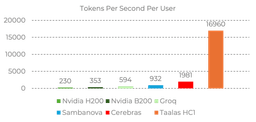
The reason those numbers are so lopsided is that the HC1 does not have the bottleneck the others are optimising around. Weight fetch — the traffic that makes memory bandwidth the binding constraint on token generation — simply does not happen, because the weights never leave the compute. The chip pairs a mask-ROM “recall fabric” holding the frozen weights with an SRAM recall fabric for the things that must stay mutable: KV caches and adapters.
The Obvious Catch
A model etched into a mask is a model you cannot update. Changing the weights means re-spinning the chip. Taalas’s argument is that the re-spin is cheaper than it sounds — only the metal layers carrying the weights need to change, not the full design — and The Register reports the company puts the cost at roughly two orders of magnitude below what training a frontier model costs in the first place. That is a real answer, but it is an economic answer rather than a technical one: it works when a model is stable and served at enormous volume, and not when it is being iterated weekly.
Capacity is the other constraint. The HC1 holds an 8B model; Taalas has said its second-generation HC2 targets roughly 20 billion parameters per chip, with trillion-parameter models reached by pipeline-parallelising across on the order of 50 chips.
What This Means
AMD is not describing this as a GPU replacement. “AMD is building a full-stack AI platform that gives customers the flexibility to deploy the right compute solutions for every AI workload,” said Vamsi Boppana, Senior Vice President of AMD’s Artificial Intelligence Group. “Taalas’ technology and world-class engineering team strengthen our AI portfolio by delivering differentiated inference performance and efficiency.” AMD says it will fold the technology into its accelerator roadmap and build system-level products combining it with Instinct GPUs, alongside Helios rack-scale systems, EPYC CPUs, and ROCm.
The shape that implies is a disaggregated one: prompt processing and anything requiring flexibility stays on programmable silicon, while token generation for a small number of high-volume, frozen models moves to hardwired parts. That is a narrower claim than “hardwired chips beat GPUs,” and a more plausible one — the workloads where a permanent model is acceptable are exactly the workloads where serving costs are large enough to justify a mask set.
It also fits a pattern. Nvidia’s $20 billion Groq licensing arrangement in December 2025, OpenAI’s Jalapeño chip with Broadcom in June, and now this: the largest buyers of AI compute are all acquiring the ability to specialise inference silicon rather than buying it general-purpose. Taalas sits at the far end of that spectrum — as specialised as it is possible to be, with the flexibility traded away entirely.
Ljubisa Bajic, Taalas co-founder and CEO, framed the sale as a scaling problem: “We founded Taalas to rethink AI inference from the ground up by building the hardware around the model… Joining AMD will give us the scale, engineering resources and global reach to accelerate our innovation.”
Related Coverage
- Taalas HC1: Hardwiring Llama 3.1 Into Silicon for 17,000 Tokens/Second — our February coverage of the chip AMD is now buying
- OpenAI and Broadcom Unveil Jalapeño, a Custom LLM Inference Chip — the same specialisation trend from the model-builder side
- ZML: A Zig-Based Inference Engine Bringing LLMs to AMD GPUs — the software side of AMD’s inference stack
This post was drafted with AI assistance and reviewed by RITS staff.
Sources
- AMD Acquires Taalas to Advance Compute Solutions for Rapidly Growing AI Inference Market — AMD Newsroom, August 6, 2026
- AMD acquires AI chip startup Taalas to boost inference performance by etching models into silicon — The Register
- AI Chip Startup Taalas Acquired by AMD — EE Times
- AI chip startup Taalas raises $169m, unveils HC1 processor optimized for Llama 3.1 8B — Data Center Dynamics
- Taalas raises $169M in funding to develop model-specific AI chips — SiliconANGLE
- Taalas — company site


 沪公网安备31011502017015号