IntermediateAI
SperidLabs’ Idol Turns One Photo Into a 3D Gaussian Splat
- SperidLabs
- 3d
- 3d-object-generation
- gaussian splatting
- open weights
SperidLabs released Idol on October 28, 2026, an Apache-2.0 model that turns a single photograph into a 3D object made of Gaussians. The core model is 0.66 billion parameters, peaks at 7.2 GB of GPU memory, and writes a standard .ply splat of up to 1,048,576 Gaussians — including the sides the input image never showed.
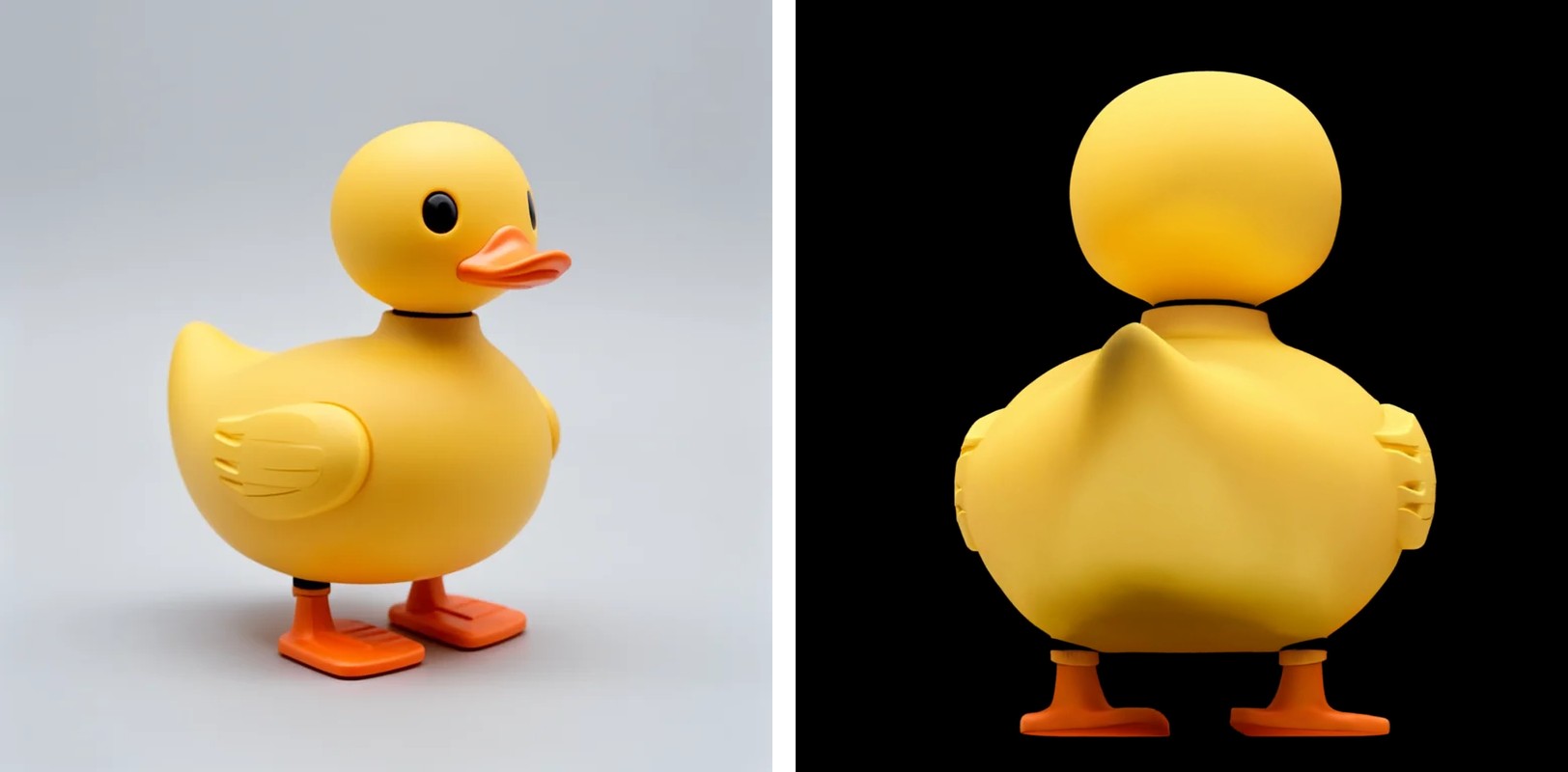
One image, one object
Idol takes a photograph, a render or a generated image, removes the background with BiRefNet, frames the object, and predicts both a camera and a complete Gaussian representation. It writes three files per input: the .ply splat, the cropped image the model actually saw, and a JSON file with the predicted input camera.
Two modes control the crop rather than the model: synthetic, the default, expects a render or generated image of a single object and lets it fill most of the frame; real leaves more room around a photograph. Detail is adjustable from 32,768 Gaussians at 0.4 MB up to 1,048,576 at 12.2 MB, and the sampling controls are the usual diffusion knobs — 50 steps by default, a guidance strength of 3.0, and a time-shift parameter that trades overall shape against fine detail.
What is actually inside
The 0.66B figure covers the three learned parts Idol contributes: a 370.6M-parameter diffusion transformer denoiser, a 50.8M octree decoder and a 237.3M Gaussian decoder. Around them sit three borrowed components — a 220.7M BiRefNet for background removal, an 840.6M DINOv3 ViT-H+/16 image encoder, and the 84.1M VAE from FLUX.2 — bringing a full request to roughly 1.80B parameters.
That distinction matters for anyone planning to deploy it. The model’s own weights are about 3 GB, but a request holds 3.7 to 4.4 GB of weights in memory and peaks at 7.2 GB. SperidLabs says the pipeline was pre-trained from scratch as a 3D diffusion transformer rather than assembled from a multi-view reconstruction stack, which is the architectural choice that lets it produce a single object with occluded sides filled in.

The benchmark, and its asterisk
SperidLabs compares Idol with TripoSplat, TRELLIS and LGM, scoring the input view with PSNR, SSIM, LPIPS and IoU, and seven new views with DINOv2, CLIP and a sharpness distance. At 50 steps and 262,144 Gaussians, Idol scores SSIM 0.726, LPIPS 0.213, IoU 0.862, DINOv2 0.781 and CLIP 0.885, ahead of both TripoSplat and TRELLIS on every one of those measures. Its request time of 6.8 seconds on an H100 also beats TripoSplat’s 9.9 seconds.
The asterisk is instructive. LGM records the highest PSNR of the four at 12.46, yet the lab says its results are visibly blurry — because PSNR averages squared pixel error and rewards a smooth image. Idol’s own PSNR, 12.25, is third. That is a fair piece of self-criticism from the authors, and it is the right reason to read per-view similarity scores alongside the newer-view metrics rather than instead of them.
Speed across consumer hardware
At 50 steps and 262,144 Gaussians, the lab reports a median of 3.4 seconds on a B300 and 3.6 on a B200, 6.7 on an H100, 14.1 on an RTX 5090, 19.1 on an RTX 4090 and 46.2 on an RTX 3080. The slowest tested device, an L4, takes 54.6 seconds. Those are single-image medians over eight images with identical settings, so they are comparable with each other in a way that cross-paper timings usually are not.
What This Means
Gaussian splats have been the awkward middle of 3D generation: fast to render, cheap to store, and hard to evaluate against meshes. Idol’s contribution is not a new representation but a working single-image model at consumer VRAM, released under a licence that permits commercial use. For teaching and rapid prototyping that combination is more useful than a marginally better mesh generator.
Two caveats are worth carrying. First, an Apache-2.0 model that cannot run until a user accepts the terms of a gated DINOv3 checkpoint and a gated FLUX.2 VAE is not fully open in practice, and that dependency sits upstream of SperidLabs. Second, all four benchmarked models are scored on the lab’s own harness; no independent image-to-3D comparison including Idol has been published.
The most interesting pairing is internal to the lab. Iris-3B draws an image from a prompt, and Idol turns that image into a turnable object. Prompt to 3D now runs entirely through two small open models, which is a pipeline a student can run on one GPU rather than a service they have to rent.
This post was drafted with AI assistance and reviewed by RITS staff.
Sources
- SperidLabs — Idol: single image to 3D object (project page, benchmarks, GPU timings)
- Hugging Face — speridlabs/idol model card (Apache 2.0, architecture table, flags)
- GitHub — speridlabs/idol-sdk (inference SDK)




 沪公网安备31011502017015号