AdvancedAI
Mistral Releases Le Chonk Weights: 1T Parameters, Open
- Mistral
- cybersecurity
- mixture of experts
- multimodal
- open weights
Mistral published the weights of Mistral Large 4, nicknamed “Le Chonk,” on October 29, 2026, three weeks after the model entered public preview. It is a 1-trillion-parameter multimodal mixture-of-experts model with 52 billion active parameters, a 1M-token context, and a licence that keeps one commercial use — hosting it as a service — under restriction.

What three weeks of reinforcement learning bought
Mistral says the preview’s feedback fed into continued reinforcement learning, and that the gains are concentrated in coding and defensive cybersecurity. The coding claims are the sharpest: 19.7% on Cognition’s private FrontierCode 2.0 benchmark, which grades whether a repository maintainer would merge the agent’s patch, against the 14.2% to 19.3% range Mistral shows for GLM-5.3, DeepSeek V4.1 Flash, Kimi K3 and Beam 1.0.
On the Artificial Analysis Coding Agent Index, Mistral reports 48%, which it describes as effectively tied with the leading open-weight model while using 47% fewer tokens per task. Mistral also reports Terminal-Bench 4.0 rising 13 points over the preview to 41%, while cutting output tokens by 30%. Hugging Face’s writeup of the same release lists 28.3% instead — a figure that matches Mistral’s own preview number rather than the post-training one — so the 41% is Mistral’s claim and has not yet been independently reproduced.
The release also adds three reasoning modes — low, medium and high, with high as the default — which Mistral frames as a cost control rather than a capability setting.
The architecture
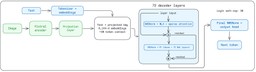
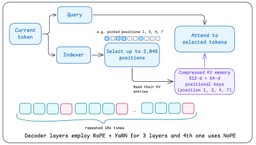
The text decoder has 72 layers, a hidden dimension of 6,144 and 64 attention heads. Its attention blocks combine Multi-head Latent Attention, which keeps a compressed key-value representation, with a DeepSeek-style sparse attention indexer that selects up to 2,048 key positions per query. That is two kinds of sparsity in one stack: one choosing which context positions to read, the other later choosing which feed-forward experts to run.
Layers follow a 3:1 pattern of rotary and non-rotary position encoding, and key-value state is shared across layers. The first decoder layer uses a dense feed-forward network; the other 71 are mixture-of-experts blocks where a softmax router picks four of 128 experts per token, alongside one shared expert that always runs — five active experts in total. Mistral calls its position encoding LeRope, a YaRN-scaled rotary embedding with one learned multiplier per frequency.


Cybersecurity, and a number worth reading twice
Mistral positions the model for defenders, and its headline cyber figure is 51% on the Artificial Analysis Cyber Index. On one test inside that index — reproduce a real vulnerability in open-source software, then patch it — Mistral reports 82%, which it calls the highest score reported on that test.
Those two numbers travelled separately and got merged in some coverage, so it is worth stating plainly: 51% is the index composite, 82% is a single sub-test. Mistral attributes the gap between open and closed models here to refusal behaviour, claiming several closed frontier models score near zero on reproduce-and-patch because they decline the task.
The safety counterweight is a refusal rate of 96.6% on cyber-related prompts drawn from JailbreakBench, StrongREJECT and AgentHarm, which Mistral says is the highest it measures among open models. It also reports 93% on a 40-challenge Cybench suite and 93.3% attack resistance on Lakera’s B3 prompt-injection benchmark.

The licence is the part to read closely
“Open weight” here does not mean OSI-approved. Mistral distributes Le Chonk under the Mistral Ecosystem Open-Weight License, an MIT derivative that adds restrictions aimed at model-as-a-service offerings. Downloading and running the model is open; building a competing hosted endpoint from it is where the terms bite. That is a material difference from Apache 2.0 or MIT, and it is the same pattern Mistral has used across its recent releases.
Practical access is the other constraint. A 1T-parameter model is not a laptop download even at FP8, which is why the GGUF conversions from Unsloth and the llama.cpp team matter more than usual for the research community: they are what makes the weights testable outside a datacenter.
What This Means
Mistral has now shipped a frontier-scale open model whose distinguishing capability is defensive security, in the same week Google put its own cyber-focused frontier model behind a gated rollout. The contrast is the story: Google’s Gemini 4 Carbon is stronger on general benchmarks but only reachable through a partner programme, while Le Chonk is weaker and downloadable by anyone who can hold it.
For a university lab, the honest assessment is that this model is not runnable at home and its licence constrains the most obvious commercial use. What it does offer is inspectability — refusal behaviour, patching behaviour and failure modes can be measured directly rather than taken from a vendor’s summary, which is the one advantage a hosted frontier model cannot provide.
This post was drafted with AI assistance and reviewed by RITS staff.



 沪公网安备31011502017015号