Qwen-Drive-1.0-4B: Alibaba Open-Weights a Driving Foundation Model


Alibaba’s Qwen team released Qwen-Drive-1.0-4B on September 7, 2026 — an open-weight vision-language foundation model for autonomous driving that puts 3D perception, driving question-answering, and motion planning inside a single 5-billion-parameter system. Developed with Huazhong University of Science and Technology and published under Apache 2.0 on Hugging Face, ModelScope, and GitHub, it is the Qwen team’s first entry into driving models — and the accompanying paper is candid that a vision-language model does not acquire spatial competence for free.
Advanced

What Was Released
Qwen-Drive-1.0-4B keeps the architecture of the pretrained Qwen3.5-4B vision-language model and bolts on two external modules rather than replacing the backbone. The repository ships four components: the root VLM at 9.1 GB, a 0.5 GB BEV perception head, and two interchangeable planning experts at 2.1 GB each — planner-sft, trained by imitation, and planner-rl, further optimised with reinforcement learning. Total parameter count is roughly 5B against the 4B base.
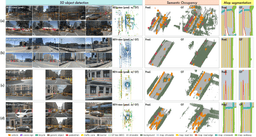
The bird’s-eye-view perception head handles three tasks jointly: 3D object detection, semantic occupancy prediction, and BEV map segmentation. The paper describes it as an “explicit, inspectable interface to 3D scene structure” — the point being that the model’s spatial understanding is legible to an engineer rather than buried in the language model’s activations. The Planning Expert conditions on the shared VLM representation and emits future ego trajectories as (x, y, heading) tuples at 10 Hz over a 5-second horizon.

The Four-Stage Training Recipe
The paper, “Qwen-Drive-1.0: An Initial Step towards a Vision-Language Foundation Model for Autonomous Driving” (arXiv:2609.00111, submitted August 31, 2026), lays out a staged recipe in which each stage freezes most of the network:
- Perception head pretraining — “keep the vision encoder and VLM fixed and optimize only the newly initialized BEV perception head.”
- Perception and VQA joint training — the BEV head, vision encoder, and VLM update together under both perception and language objectives.
- Planning Expert pretraining — “keep the vision encoder and VLM fixed and optimize only the Planning Expert,” trained with flow matching.
- Reinforcement learning — task-level rewards refine trajectory generation while the shared representations are preserved.
Training draws on nuScenes, OpenScene, NAVSIM, the Waymo Open Dataset end-to-end benchmark, PhysicalAI-AV, 24 public driving vision-language datasets, and self-constructed planning-reasoning data. The staging is what lets the model add driving competence without losing general vision-language ability — a claim the general-purpose benchmarks support.
Benchmarks
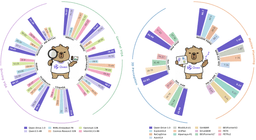
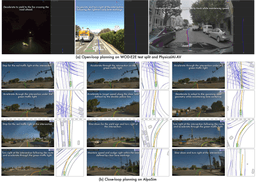
On motion planning, the model card reports 90.7 PDMS on the pseudo-closed-loop NAVSIM benchmark, 8.45/7.91 RFS on the open-loop WOD-E2E validation and test splits, and a 0.37 at-fault score in the AlpaSim closed-loop simulator. On driving question-answering it scores 77.8 on LingoQA, 7.78 Ego3D RMSE (lower is better), and 41.3 on PAI-AV CoC — where the unmodified Qwen3.5-4B base scores 2.58, the single widest gap in the release.
General-purpose ability largely survives: 85.5 MMBench, 75.9 MMStar, 72.7 MMMU, 86.4 OCRBench, 79.0 RealWorldQA. The-Decoder notes that the model “scores well above unmodified Qwen3.5-4B on traffic scene questions” while showing “minimal performance drop on non-driving tasks.”

Where It Falls Down
The more interesting numbers are the negative ones. The paper reports that a perception head trained only on nuScenes “reaches only 16.50 NDS on OpenScene, less than half of its 34.13 nuScenes score” — a blunt illustration of how poorly driving perception transfers across datasets. The model uses no rig-specific camera embeddings, so a single set of weights trains and evaluates across both the six-camera nuScenes rig and the eight-camera OpenScene rig; The-Decoder reports that it nonetheless “performs poorly on unfamiliar camera configurations from different vehicles.”
The second limitation goes to the premise of a talking driving model. The-Decoder’s review found that “the model’s explanations don’t always pinpoint the actual cause of a situation” and that “the planned maneuver also doesn’t always match the reasoning the model gave beforehand” — citing the model treating a distant red light and a child entering the road as comparable situations despite the very different reaction times they demand. The-Decoder also reports that reinforcement-learning training cut the rate at which the vehicle veered off the road in simulation from 24% to 12%, which is a real improvement and still a one-in-eight failure rate.
What This Means
The framing in the title — “An Initial Step” — is doing honest work. What Qwen-Drive-1.0 demonstrates is that a general-purpose 4B VLM can be extended into a competitive driving stack with modest bolt-on modules and staged training, and that the resulting system stays a usable general vision-language model. That is a genuinely useful result for anyone who wants to study end-to-end driving without a proprietary stack, and Apache 2.0 licensing on weights, code, and demo data makes it one of the few such systems that can be reproduced outside a corporate lab.
What it does not demonstrate is that natural-language rationales are a reliable window into what a planner is about to do. The explanation and the trajectory are produced from a shared representation, not derived from one another, and the gap The-Decoder identifies is the predictable consequence — a caution for the interpretability argument often made on behalf of language-based driving models. Reading the rationale is not the same as auditing the plan.
The researchers’ own conclusion, in The-Decoder’s paraphrase — that “a text-image model doesn’t automatically understand three-dimensional space just because it can describe pictures” — is the line most worth carrying forward. Spatial competence had to be trained in deliberately, through a dedicated BEV head and a staged curriculum. It did not emerge from scale.
Related Coverage
- Qwen3.8-Flash-Next: Alibaba Previews the Qwen4 Architecture — the next-generation Qwen backbone, previewed in August 2026
- Qwen3.8-27B: Frontier Agentic Scores on a Single Consumer GPU — the dense vision-language sibling in the Qwen3.8 line
- Alibaba’s RISC-V C950 Runs Qwen3.8-27B at 30 Tokens/s, No GPU — Alibaba’s silicon-side work on the same model family
- LG AI Research Unveils EXAONE 4.5: A Vision-Language Model for the Physical AI Era — a comparable VLM aimed at physical-world deployment
This post was drafted with AI assistance and reviewed by RITS staff.
Sources
- Qwen/Qwen-Drive-1.0-4B model card — Hugging Face
- Qwen-Drive-1.0: An Initial Step towards a Vision-Language Foundation Model for Autonomous Driving — arXiv:2609.00111, August 31, 2026
- QwenLM/Qwen-Drive-1.0 — code, demo data, and inference instructions
- Alibaba’s Qwen releases open-source model for autonomous driving — TechNode, September 7, 2026
- Qwen-Drive 1.0 tells you why it brakes, just don’t expect the explanation to match the maneuver — The Decoder


 沪公网安备31011502017015号